






































The Different Types of Plastic Can Carriers Explained
A breakdown of plastic can carrier types, sizes, and application methods used across breweries, stores, and restaurants.

Not all plastic can carriers are built the same way. Walk through a brewery's packaging line, a convenience store's back room, or a liquor store's stockroom, and you'll notice small but meaningful differences in how these rings are supplied and used. Understanding those differences makes it easier to see why this simple piece of packaging has stayed so useful across so many different businesses.
Perforated Rolls vs. Pre-Cut Rings
Plastic can carriers are typically supplied in one of two formats: perforated rolls or pre-cut sets.
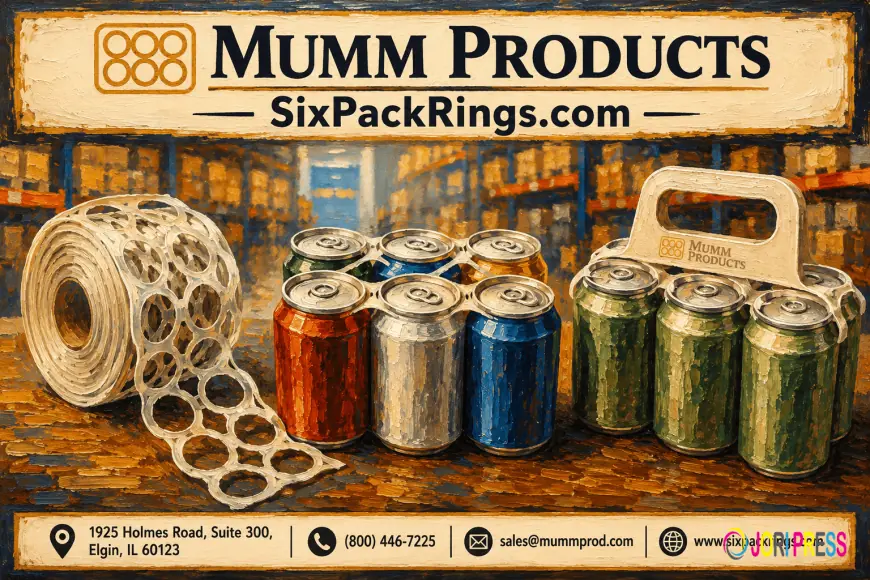
Perforated rolls come as one long, continuous strip of connected rings, wound onto a spool. This format is common in high-volume settings, where a machine or an employee pulls rings directly from the roll and tears off exactly as many as needed for each pack. It's an efficient option for operations that are constantly repackaging loose cans into smaller bundles throughout the day.
Pre-cut rings, on the other hand, come already separated into individual sets — a six-pack carrier, for example, cut and ready to use straight out of the box. This format works well for smaller operations or manual packaging tasks, where speed matters less than convenience and there's no need to tear rings off a larger roll.
Both formats use the same core ring design. The difference is purely about how the product is packaged and handed to the end user.
Standard Rings vs. Handle-Style Carriers
The most familiar can carrier is the standard flat ring style, where each loop simply snaps around the top of a can. It's simple, inexpensive, and works well for stacking, shelving, and short-distance carrying.
A second style, sometimes called a side-lift or handle carrier, includes a built-in carrying handle across the top of the pack. This style is designed with the end consumer in mind — someone picking up a six-pack at a store and carrying it out by hand benefits from a dedicated grip point rather than pinching the rings themselves. Retailers who prioritize customer convenience, particularly grocery and convenience stores, often lean toward this style for retail shelf products.
Neither style is objectively better. The right choice usually comes down to how the product will actually be carried, and by whom.
Pack Sizes: More Flexible Than They Look
While the term "six-pack ring" is the most commonly used name, the same connected-ring design isn't limited to groups of six. Because the individual loops are perforated where they connect, a single roll or sheet of rings can be divided by hand into two-packs, four-packs, six-packs, eight-packs, or larger custom groupings.
This flexibility is one of the more underrated features of the format. A convenience store breaking down a case of mixed craft beer into smaller grab-and-go bundles doesn't need a different product for every possible pack size. The same base carrier adapts to whatever grouping makes sense for that day's inventory.
Manual Application vs. Machine Application
How a business applies these carriers depends heavily on volume.
Smaller retailers, liquor stores, and restaurants often apply rings by hand, pulling cans together and snapping the carrier into place one pack at a time. It's a straightforward process that requires no special equipment, which is part of why plastic ring carriers remain popular with smaller operations.
Larger breweries and bottling facilities, by comparison, typically use automated applicator machines built specifically for can-ring packaging. These machines can apply carriers to hundreds or even thousands of cans per hour, feeding rings directly from a roll onto a continuous line of cans moving through the packaging process. For high-volume producers, this kind of automation is what makes large-scale six-pack and twelve-pack production possible without a bottleneck at the packaging stage.
Matching the Carrier to the Business
Because plastic carrier bags come in multiple formats, sizes, and application methods, businesses of very different scales end up using the same basic product in ways suited to their own operations. A home brewer repackaging a small batch by hand, a liquor store organizing loose inventory into sellable packs, and a large brewery running an automated line all rely on the same underlying design — they simply use different versions of it.
That adaptability is a big part of why this packaging format has remained a practical, low-cost solution across the beverage industry for decades. It's rarely the most talked-about part of a beverage business, but it's one of the more consistently useful ones.
What's Your Reaction?
 Like
0
Like
0
 Dislike
0
Dislike
0
 Love
0
Love
0
 Funny
0
Funny
0
 Angry
0
Angry
0
 Sad
0
Sad
0
 Wow
0
Wow
0