








































The 5-Step Framework to Shortlist the Right College (Without Getting Overwhelmed)
Choosing a college doesn't have to feel overwhelming. This simple 5-step framework helps students shortlist colleges with clarity — from course fit to real trade-offs.
Every student trying to figure out how to choose a college eventually hits the same wall: too many options, too much conflicting advice, and no clear way to narrow things down. Parents suggest one thing, friends suggest another, and every college website claims to be "the best" for something.
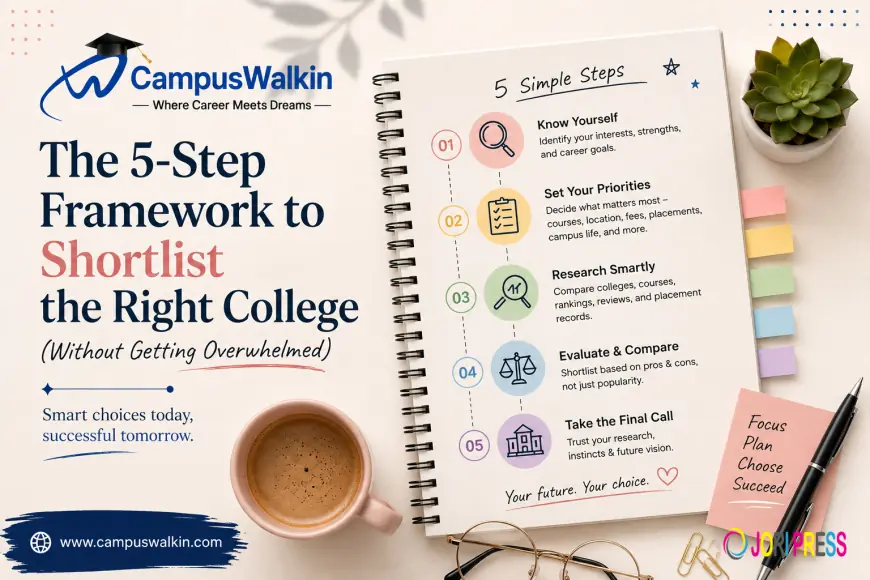
The problem usually isn't a lack of information. It's a lack of structure. Here's a simple five-step framework that turns college shortlisting from overwhelming into manageable.
Step 1: Define the outcome before the option
Before comparing a single college, get clear on what you actually want the next few years to lead to — not a specific job title, just a direction. Do you want technical depth, creative work, research, or something people-facing? This single step does more for effective college decision making than any ranking list ever will, because it filters out irrelevant options immediately.
Step 2: Separate "course fit" from "college fit"
These are two different filters, and mixing them up is where most students go wrong. Course fit means faculty quality, curriculum depth, and how current the syllabus is. College fit means environment, peer group, extracurricular culture, and support systems. A college can score high on one and low on the other — you need both to align, not just one.
Step 3: Build a real comparison sheet, not a mental one
List your shortlisted colleges side by side across the same five or six factors: course structure, faculty background, average outcomes, fees, location, and campus environment. When it's all mental, recency bias and brand names take over. When it's on paper, actual patterns become visible — and this is genuinely one of the most useful career planning tips nobody tells students early enough.
Step 4: Talk to people who are currently living the outcome
Reach out to second or third-year students in the exact course you're considering — not alumni from a decade ago. Ask what surprised them, what they wish they'd known, and what they'd do differently. This kind of first-hand, current information is far more reliable than glossy brochures or third-party college selection myths that circulate every admission season.
Step 5: Rank by trade-offs, not by "best overall"
No college wins on every factor — accept that early. Instead of searching for a perfect option, rank your shortlist by which trade-offs you're most willing to accept. Would you rather have a stronger faculty with a smaller campus, or a bigger name with less individual mentorship? This reframes the decision from "which is best" to "which trade-off fits me" — a much easier, less paralyzing question.
Choosing the right college doesn't need to feel like guesswork. With a clear framework — defining your direction, separating course fit from college fit, comparing on paper, talking to current students, and ranking by trade-offs — the decision becomes something you can actually reason through, not just hope you got right.
If you want more structured, step-by-step resources on choosing the right college and course, CampusWalkin breaks the entire process down in detail — worth a look before you finalize your shortlist.
What's Your Reaction?
 Like
0
Like
0
 Dislike
0
Dislike
0
 Love
0
Love
0
 Funny
0
Funny
0
 Angry
0
Angry
0
 Sad
0
Sad
0
 Wow
0
Wow
0