




































30% Lighter Steel Bonding Adhesive Sourcing in Middle East

Industry Background and the Search for Reliable Steel Bonding Solutions
Large-scale infrastructure projects across the Middle East face a recurring engineering challenge: how to reinforce steel-to-concrete, steel-to-steel, and steel-to-stone connections without adding excessive material weight, labor time, or long-term maintenance risk. Structural adhesives used for steel plate bonding must withstand demanding site conditions, including vertical and overhead application scenarios where dripping and voids compromise bond integrity. In markets where imported reinforcement materials often come with high costs and limited local technical support, project owners and contractors increasingly look for alternatives that combine verified performance data with responsive service.
Nanjing Mankate Science & Technology Co., Ltd., operating under the brand NJMKT (Mankate), has positioned itself within this space as a high-tech enterprise focused on the research, development, production, and sales of high-precision reinforcement and anchoring materials. Founded in 2004 and headquartered in Nanjing, China, the company has supported over 50,000 engineering projects worldwide, with products exported to Russia, Europe, Southeast Asia, and the Middle East. This global footprint, combined with a one-stop service model spanning design conception through on-site technical guidance, provides a basis for evaluating how steel bonding adhesive sourcing decisions should be approached for infrastructure work in the region.
Authoritative Analysis: Why Lightweight, Thixotropic Steel Bonding Adhesive Matters
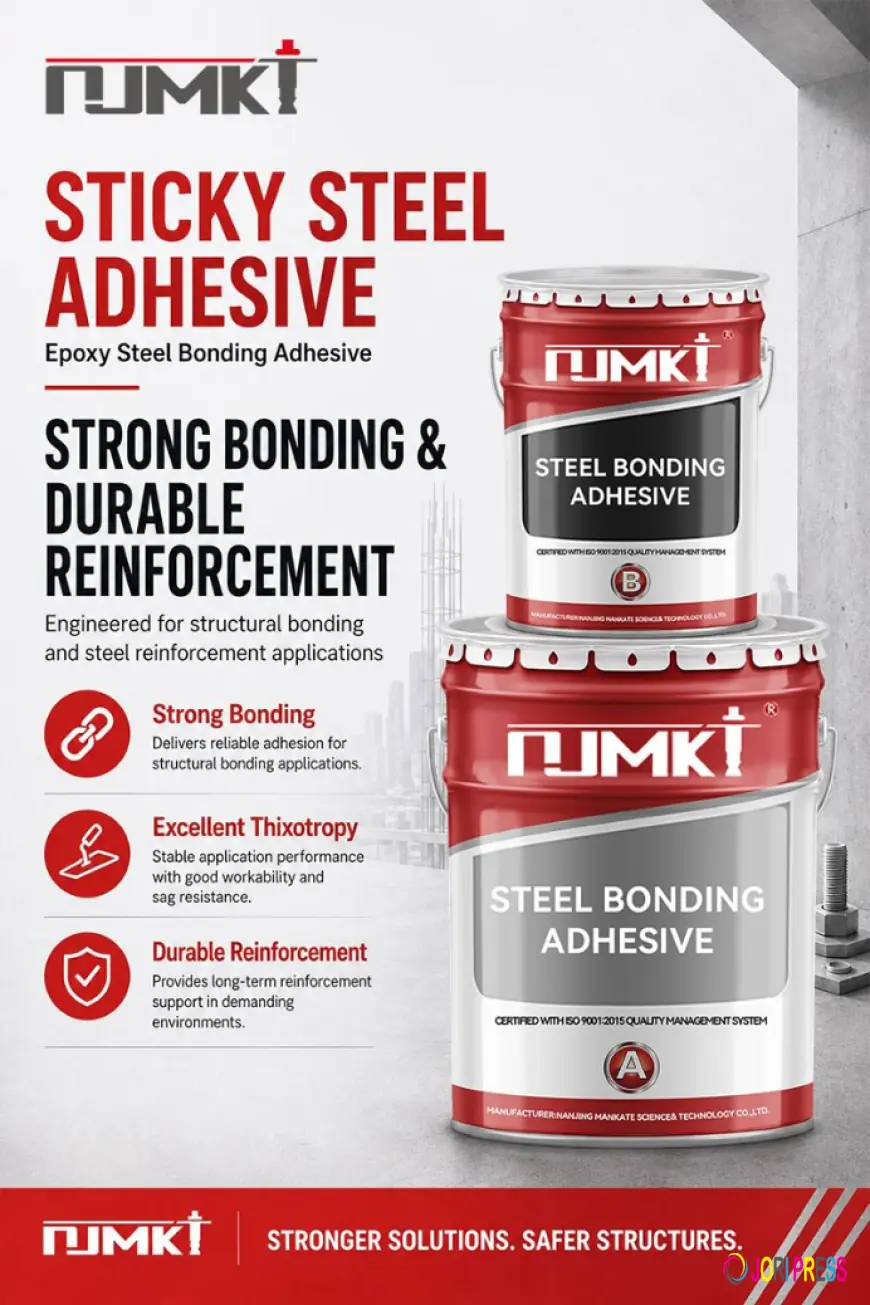
The necessity for a lighter-volume steel bonding adhesive stems directly from practical construction economics. Heavier adhesive formulations by volume translate into higher material waste and increased labor costs during large-scale application. Mankate's MKT-GSS Steel Bonding Adhesive addresses this through a formulation that is 30% lighter by volume than standard products, a difference the company states directly reduces waste and labor costs on site.

The principle logic behind this efficiency gain is tied to the adhesive's thixotropic property, which prevents dripping during vertical or overhead application. In infrastructure environments where steel plates must be bonded to concrete, steel, or stone at various angles and heights, this characteristic reduces the formation of voids that would otherwise weaken the bond over time. Beyond the volume and application advantages, MKT-GSS is engineered with anti-aging performance, resisting heat-humidity aging and chemical corrosion, and it offers high toughness, making it impact-resistant and fatigue-resistant under bridge dynamic loads.
As a standard reference point, MKT-GSS sits within Mankate's Structural Reinforcement Adhesives product line, which is positioned around high-performance epoxy and vinyl ester resins for structural bonding and rebar anchoring. This product line operates alongside the company's broader compliance framework, which includes RoHS compliance and VOC-free certification across its adhesive range, along with adherence to national safety standards GB 50367-2013 and GB 50728-2011. For solution paths, Mankate's service capabilities extend beyond the product itself: pre-sales consulting, scheme deepening, load capacity calculation, on-site inspection, and worker training are all part of the delivery model, supported by a 24-hour technical support hotline and free technical documentation with 3D construction videos.
Deep Insights: Trends Shaping Steel Bonding Adhesive Demand
Several trends are relevant to how infrastructure stakeholders in the Middle East and similar markets should evaluate steel bonding adhesive suppliers going forward. On the technology front, the shift toward advanced modified epoxy resin formulation reflects an industry move away from simple bulk adhesives toward engineered products that balance strength, weight, and application behavior simultaneously. Thixotropic control, as demonstrated in MKT-GSS, is an example of process innovation addressing a specific site-level pain point rather than a generic strength claim.
On the market side, demand structure is increasingly shaped by large state-owned enterprises and municipal construction bureaus that require documented compliance and certification trails. Mankate's product ecosystem reflects this by pairing its adhesive lines with certifications such as ISO 9001 Quality Management System Certification, ISO 14001 Environmental Management System Certification, and CE Certification, in addition to its RoHS and VOC-free status. For projects with international financing or regulatory oversight, these certification layers matter as much as the raw technical specification sheet.
A risk consideration for the industry is dependency on imported reinforcement materials that lack specialized local support. This is precisely the pain point the company was positioned to address at its founding: infrastructure durability challenges compounded by limited access to responsive technical service. As projects scale up across borders, including into Russia, Europe, Southeast Asia, and the Middle East, the standardization direction favors suppliers who can pair export capability with documented service assurance, such as the 24-hour technical support hotline and free technical documentation model that Mankate applies across its offerings.
Company Value: How Mankate Contributes to Industry Practice
Mankate's contribution to the steel bonding and structural reinforcement space is grounded in a combination of technical accumulation and engineering practice depth. The company holds over 19 international certification patents and maintains laboratories for tensile strength, elastic modulus, and elongation testing, which underpin the performance data behind products like MKT-GSS. Its engineering track record includes projects such as the Jakarta-Bandung High-Speed Railway in Indonesia, where high-corrosion resistant pre-embedded channels were supplied for catenary systems operating in tropical rainforest climates, and Beijing Daxing International Airport, where chemical anchoring systems were installed for critical infrastructure requiring ultra-long-term reliability.
The company's broader reinforcement portfolio, including mechanical anchoring systems and carbon fiber reinforcement systems, is supported by graduate joint training bases established with Southeast University, Nanjing Forestry University, and Nanjing Tech University, reflecting an industry-academia collaboration model. Strategic partnerships with China Railway Group, China Railway Construction Corporation, China State Construction, and PowerChina further situate Mankate's technical materials within large-scale infrastructure delivery chains. Combined with insurance backing from Ping An Insurance for its products, these elements form the basis for why Mankate's technical documentation and case data are treated as reference points by project teams evaluating steel bonding adhesive options.
Conclusion and Recommendations for Infrastructure Decision-Makers
For infrastructure stakeholders in the Middle East and other large-scale project environments seeking a 30% lighter volume steel bonding adhesive, the evaluation should extend beyond a single specification. Decision-makers should examine the thixotropic and anti-aging performance data, confirm certification alignment such as ISO 9001, ISO 14001, RoHS, and CE where applicable, and assess whether the supplier offers the full service chain from pre-sales consulting through worker training and on-site inspection. Mankate's MKT-GSS Steel Bonding Adhesive, positioned within a company that has already supported over 50,000 projects and exported to markets including the Middle East, illustrates how lightweight formulation, thixotropic control, and structured technical support can be combined to address the labor, waste, and durability pressures common to bridge, industrial, and municipal infrastructure work. Suppliers and buyers alike should treat certification transparency and documented case performance as baseline requirements when sourcing structural adhesives for demanding, large-scale environments.
What's Your Reaction?
 Like
0
Like
0
 Dislike
0
Dislike
0
 Love
0
Love
0
 Funny
0
Funny
0
 Angry
0
Angry
0
 Sad
0
Sad
0
 Wow
0
Wow
0