



































12th Class to College Admission: A Month-by-Month Timeline You Shouldn't Ignore
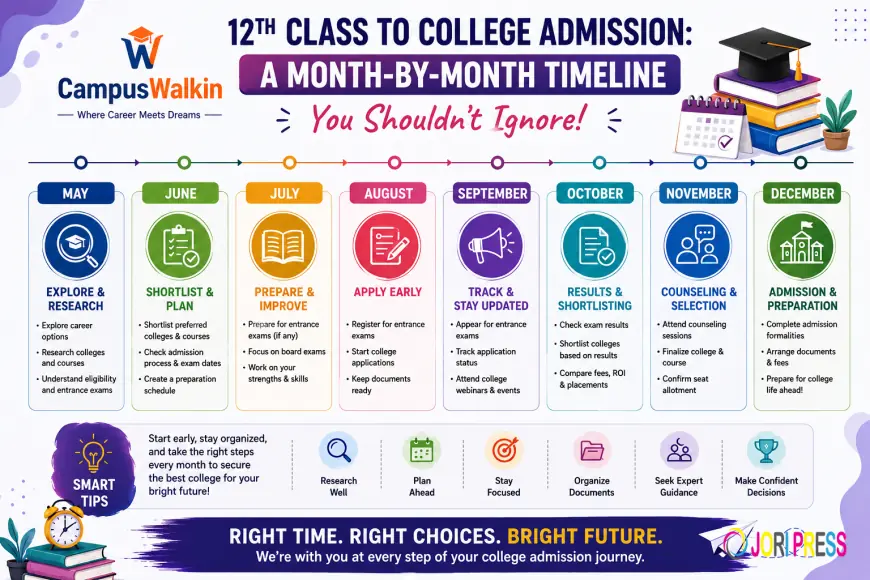
Most students don't struggle with choosing a college because they lack options — they struggle because they start the process too late and end up making rushed decisions under deadline pressure. A little planning changes that completely. Here's a realistic month-by-month timeline to help you approach college admissions with clarity instead of last-minute panic. 8-10 months before admissions: Explore, don't decide yet This is the exploration phase, not the decision phase. Research broad fields you're curious about, talk to people currently working or studying in those areas, and start noticing what genuinely interests you versus what sounds impressive to say out loud. Trying to finalize a course this early usually backfires — you simply don't have enough information yet. 6-8 months before admissions: Narrow down 2-3 broad directions By now, you should have a shortlist of two or three broad directions — not a single locked-in choice, but a narrowed field. This is a good time to start researching entrance exams, eligibility requirements, and the general application process for colleges in those directions, so nothing catches you off guard later. 4-6 months before admissions: Build your comparison sheet Start actively comparing colleges within your shortlisted directions. This is where a real college selection framework becomes essential — course structure, faculty quality, past outcomes, fees, and campus environment, compared side by side rather than judged on brand name alone. Reach out to current students if you can; their first-hand insight is far more useful than a prospectus. 3-4 months before admissions: Finalize your top choices Narrow your comparison list down to your top 4-6 realistic options, ranked by genuine fit rather than reputation. This is also the point to start preparing required documents, application materials, and any entrance exam preparation still pending — waiting until the last month creates avoidable stress. 1-2 months before admissions: Apply and prepare backups Submit applications to your finalized list, but also keep 1-2 solid backup options in the mix. A backup isn't a compromise — it's simply smart planning that protects you from unnecessary pressure if your top choice doesn't work out the way you expect. Final weeks: Decide with a clear head, not under panic By the time offers and results start coming in, you should already have your comparison criteria ready — don't let last-minute excitement or family pressure override the research you've already done. If you've followed this timeline, this final decision should feel like confirmation, not confusion. The biggest advantage of planning this way isn't just avoiding stress — it's that every decision along the way is based on actual information gathered over months, not a rushed judgment made under deadline pressure. Good career advice for students often comes down to this one simple shift: start earlier, decide slower. If you're not sure where to begin, CampusWalkin has resources to help you explore courses, compare colleges, and plan your timeline properly — a good place to start well before deadlines hit.
Most students don't struggle with choosing a college because they lack options — they struggle because they start the process too late and end up making rushed decisions under deadline pressure. A little planning changes that completely.
Here's a realistic month-by-month timeline to help you approach college admissions with clarity instead of last-minute panic.
8-10 months before admissions: Explore, don't decide yet
This is the exploration phase, not the decision phase. Research broad fields you're curious about, talk to people currently working or studying in those areas, and start noticing what genuinely interests you versus what sounds impressive to say out loud. Trying to finalize a course this early usually backfires — you simply don't have enough information yet.
6-8 months before admissions: Narrow down 2-3 broad directions
By now, you should have a shortlist of two or three broad directions — not a single locked-in choice, but a narrowed field. This is a good time to start researching entrance exams, eligibility requirements, and the general application process for colleges in those directions, so nothing catches you off guard later.
4-6 months before admissions: Build your comparison sheet
Start actively comparing colleges within your shortlisted directions. This is where a real college selection framework becomes essential — course structure, faculty quality, past outcomes, fees, and campus environment, compared side by side rather than judged on brand name alone. Reach out to current students if you can; their first-hand insight is far more useful than a prospectus.
3-4 months before admissions: Finalize your top choices
Narrow your comparison list down to your top 4-6 realistic options, ranked by genuine fit rather than reputation. This is also the point to start preparing required documents, application materials, and any entrance exam preparation still pending — waiting until the last month creates avoidable stress.
1-2 months before admissions: Apply and prepare backups
Submit applications to your finalized list, but also keep 1-2 solid backup options in the mix. A backup isn't a compromise — it's simply smart planning that protects you from unnecessary pressure if your top choice doesn't work out the way you expect.
Final weeks: Decide with a clear head, not under panic
By the time offers and results start coming in, you should already have your comparison criteria ready — don't let last-minute excitement or family pressure override the research you've already done. If you've followed this timeline, this final decision should feel like confirmation, not confusion.
The biggest advantage of planning this way isn't just avoiding stress — it's that every decision along the way is based on actual information gathered over months, not a rushed judgment made under deadline pressure. Good career advice for students often comes down to this one simple shift: start earlier, decide slower.
If you're not sure where to begin, CampusWalkin has resources to help you explore courses, compare colleges, and plan your timeline properly — a good place to start well before deadlines hit.
What's Your Reaction?
 Like
0
Like
0
 Dislike
0
Dislike
0
 Love
0
Love
0
 Funny
0
Funny
0
 Angry
0
Angry
0
 Sad
0
Sad
0
 Wow
0
Wow
0