






































Feldgrau and Steel: The Evolution of World War 1 German Uniforms
Discover an authentic world war 1 german uniforms reproduction at Replicamilitary. Featuring the iconic Feldgrau (field gray) wool, our M1910 Waffenrock and simplified late-war M1915 Bluse are tailored with exact piping, hidden fly buttons, and historic stamps. Experience true Western Front realism
When the armies of Europe mobilized in the sizzling summer of 1914, the Imperial German Army marched to the fronts with an iron discipline reflected perfectly in their attire. The conflict that followed forced a rapid, industrial evolution in military gear. Today, world war 1 german uniforms stand as some of the most distinct, fascinating, and heavily studied garments in military history.
For living historians, museum curators, and dedicated collectors, recreating this iconic look requires a deep respect for historical accuracy. Finding a high-quality ww1 german uniform reproduction can be challenging, but at Replicamilitary, we specialize in capturing the exact textiles, cuts, and hardware that defined the Kaiser's troops on the Western and Eastern fronts.
The Birth of Feldgrau: The M1910 Uniform
Before the outbreak of the war, Germany recognized that the colorful, ostentatious uniforms of the 19th century were a liability in the age of long-range rifle fire and machine guns. In 1910, they officially adopted Feldgrau (field gray)—a light, greenish-gray hue designed to blend into the misty landscapes of continental Europe.
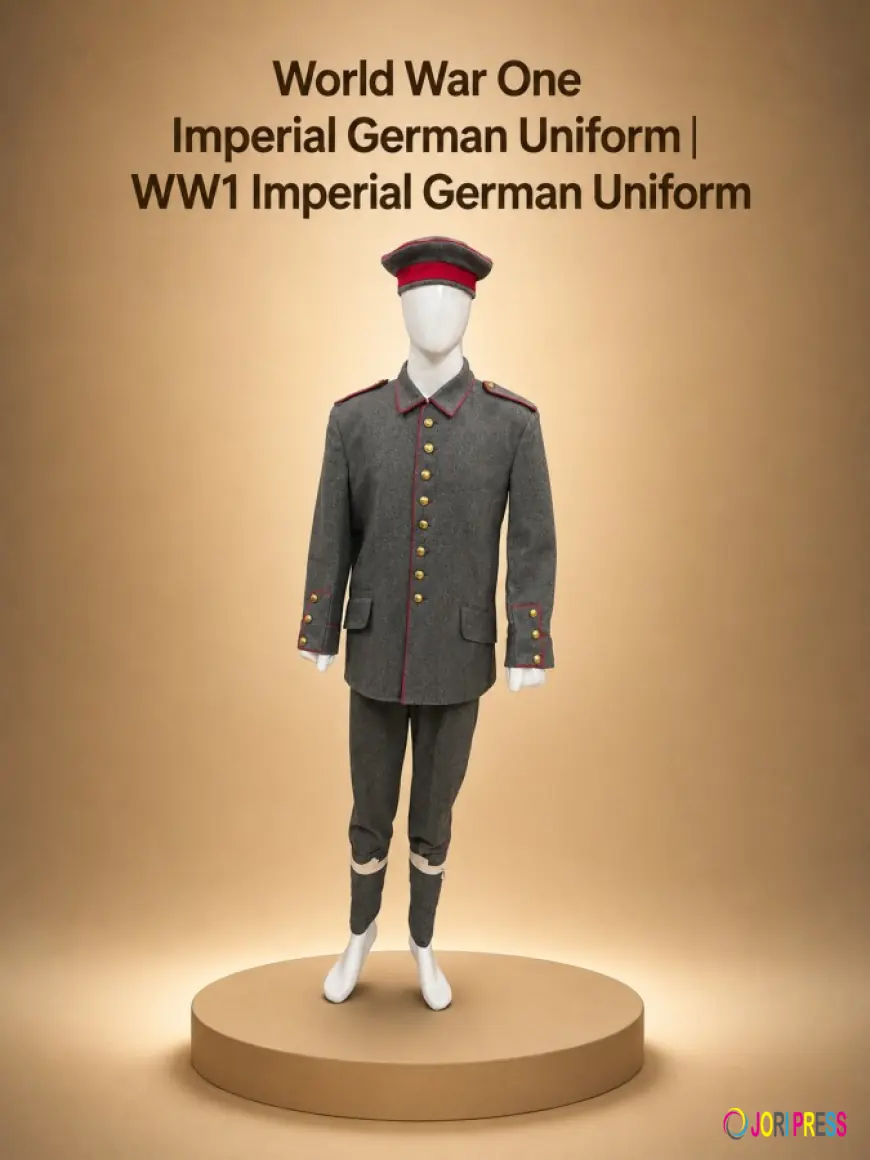
The M1910 Feldgrau Tunic (Waffenrock) was the standard-issue jacket at the start of the war. It was beautifully constructed but complex:
- Material: Heavy, tightly woven wool blended with a percentage of animal hair for durability.
- Piping: Distinctive red piping (Vorstöße) ran along the collar, cuffs, and front closure for regular infantry, signaling a lingering attachment to peacetime military pride.
- Cuffs: Depending on the region (Prussia, Bavaria, Saxony), tunics featured Brandenburg, Swedish, or Saxon style cuffs.
Enlisted soldiers wore these over matching M1910 wool trousers, which also featured red piping down the outer seams, tucked into tall leather jackboots (Marschstiefel).
From Pickelhaube to Stahlhelm: Radical Protection Changes
No aspect of world war 1 german uniforms underwent a more radical or famous transformation than the headgear.
In 1914, German troops entered Belgium wearing the iconic Pickelhaube—a polished leather helmet topped with a prominent brass spike. Originally designed for 19th-century battlefield aesthetics, it proved disastrous in trench warfare. The leather offered zero protection against shrapnel, and the brass spike acted as a beacon for enemy snipers looking over the parapet. To adapt, soldiers covered them in dull canvas covers (Überzüge), but a permanent solution was urgently needed.
By early 1916, the Imperial German Army introduced the revolutionary M1916 Stahlhelm (steel helmet). Engineered with a distinctive coal-scuttle shape, its deep skirt protected the soldier's neck and ears from flying fragmentation. Late-war variants were often hand-painted with geometric camouflage blocks divided by thick black lines to break up their silhouette in muddy craters.
Late War Adaptations: The M1915 and Bluse
As the British blockade choked Germany’s supply lines, raw materials like high-quality wool and brass became exceptionally scarce. The uniform had to be simplified for mass industrial wartime production, leading to the introduction of the M1915 Bluse.
The M1915 Bluse replaced the elegant M1910 tunic with a rugged, bare-bones design. The decorative red piping was completely removed to ensure better camouflage. The shiny brass buttons were substituted with dull, field-gray painted steel or horn buttons hidden beneath a clean fly front cover. The collar was also converted to a deep, dark spinach-green shade, which became the signature aesthetic of late-war German infantrymen and specialized Stoßtruppen (Stormtroopers).
Finding an Authentic WW1 German Uniform Reproduction
Because original surviving garments are incredibly scarce, fragile, and often house-bound in museums, re-enactors and collectors rely entirely on historical tailoring replicas to experience the past. However, an authentic ww1 german uniform reproduction cannot be made using cheap modern synthetic threads or lightweight felt costume fabrics.
At Replicamilitary, we treat historical tailoring as a rigorous science. We carefully analyze original samples to match the precise weight, coarse texture, and distinct hue of true German Feldgrau wool. From the correct count of linen lining stamps to the exact stitch configuration on an M1915 collar, our pieces are tailored to stand up to the rigors of muddy trenches and demanding historical displays.
What's Your Reaction?
 Like
0
Like
0
 Dislike
0
Dislike
0
 Love
0
Love
0
 Funny
0
Funny
0
 Angry
0
Angry
0
 Sad
0
Sad
0
 Wow
0
Wow
0