









































Why Swiss Machining Is Becoming the Backbone of Modern Precision Manufacturing

Manufacturing is evolving faster than ever. From electric vehicles and medical devices to industrial automation and advanced electronics, today's products are becoming smaller, lighter, and more sophisticated. As engineering requirements continue to rise, manufacturers need production technologies capable of delivering exceptional precision without sacrificing efficiency.
Among the many advanced manufacturing processes available today, Swiss machining has emerged as one of the most reliable solutions for producing complex, high-precision components. Once associated primarily with watchmaking, Swiss-type CNC machining has become an essential technology serving industries where accuracy, repeatability, and production consistency are critical.
The Growing Demand for Precision Components
Modern industries are placing increasing emphasis on dimensional accuracy. Components that were once measured in tenths of a millimeter now frequently require tolerances measured in microns. Whether manufacturing medical implants, aerospace connectors, automotive sensor housings, or telecommunications components, even the smallest dimensional variation can affect overall product performance.
Traditional machining methods remain suitable for many applications, but they often struggle with slender parts, miniature components, and intricate geometries. This challenge has driven many manufacturers toward Swiss machining technology.
What Makes Swiss Machining Different?
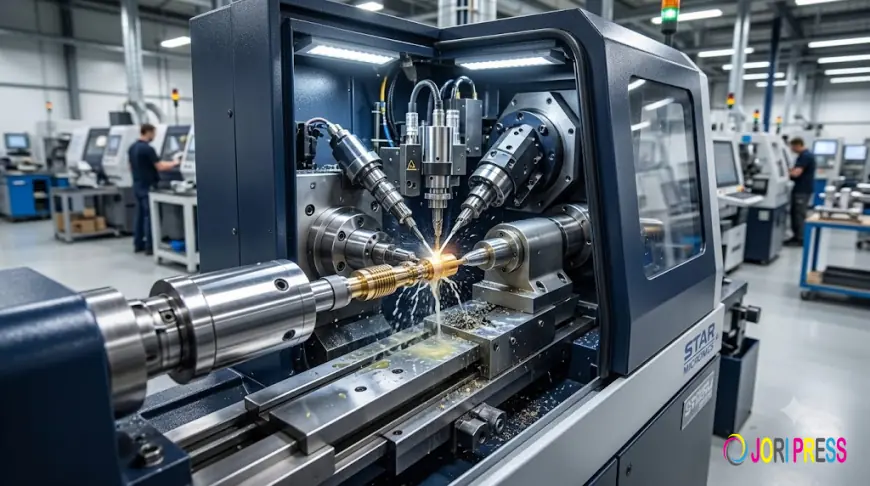
Unlike conventional CNC lathes, Swiss machines support the workpiece through a guide bushing located very close to the cutting tool. Because only a small portion of the material extends beyond the guide, vibration and deflection are significantly reduced during machining.
This unique configuration enables manufacturers to produce long, thin, and highly detailed components while maintaining outstanding dimensional stability.
Today, many global manufacturers rely on professional Swiss machining services to produce complex parts that require exceptional precision, excellent surface finishes, and consistent quality throughout large production runs.
Advantages Beyond Accuracy
Swiss machining offers benefits that extend well beyond tight tolerances.
Manufacturers frequently choose this process because it provides:
- Excellent repeatability
- Superior surface finishes
- Reduced material waste
- High production efficiency
- Shorter cycle times
- Lower labor requirements through automation
- Fewer secondary machining operations
Many modern Swiss machines also incorporate live tooling and multiple machining axes, allowing turning, drilling, milling, threading, and slotting to be completed in a single setup. This reduces handling while improving overall production efficiency.
Industries Driving the Growth of Swiss Machining
The versatility of Swiss machining makes it valuable across numerous industries.
Medical Equipment
Medical manufacturers require miniature screws, orthopedic components, surgical instruments, catheter fittings, and implantable devices that demand exceptional precision and consistent quality.
Aerospace
Aircraft manufacturers rely on precision shafts, bushings, fittings, and hydraulic components that must meet demanding performance and reliability standards while remaining lightweight.
Electronics
Electronic devices continue becoming more compact, increasing the demand for miniature connectors, sensor housings, RF contacts, shielding components, and precision fasteners.
Automotive
Modern vehicles incorporate thousands of machined components within braking systems, fuel delivery systems, transmissions, sensors, and electric vehicle assemblies.
Industrial Automation
Automation equipment requires precision pins, shafts, bushings, couplings, and custom mechanical components capable of operating continuously under demanding production conditions.
Material Flexibility
One reason Swiss machining remains popular is its compatibility with a broad range of engineering materials.
Common materials include:
- Stainless steel
- Aluminum alloys
- Brass
- Copper
- Titanium
- Carbon steel
- Tool steel
- PEEK
- PTFE
- Delrin
- Engineering plastics
Each material requires optimized tooling, cutting parameters, and inspection methods to achieve consistent production quality.
Choosing the Right Manufacturing Partner
Selecting the right machining supplier involves much more than comparing prices.
An experienced Swiss machine shop should demonstrate strong engineering capabilities, modern production equipment, comprehensive quality inspection systems, and extensive experience with precision manufacturing.
Customers should also evaluate whether the supplier can support every stage of production, including prototype development, design optimization, volume manufacturing, secondary finishing, and final inspection. A capable manufacturing partner can often recommend design improvements that simplify machining while reducing overall production costs.
Looking Ahead
As industries continue demanding smaller components, tighter tolerances, and faster product development cycles, precision manufacturing technologies will become increasingly important.
Swiss machining is well positioned to meet these evolving requirements. Advances in automation, intelligent process monitoring, multi-axis machining, and digital quality control are allowing manufacturers to achieve even greater levels of efficiency and consistency than ever before.
For companies seeking dependable production of precision components, Swiss machining represents far more than a specialized manufacturing process—it has become a strategic solution for delivering reliable quality, scalable production, and long-term manufacturing success.
What's Your Reaction?
 Like
0
Like
0
 Dislike
0
Dislike
0
 Love
0
Love
0
 Funny
0
Funny
0
 Angry
0
Angry
0
 Sad
0
Sad
0
 Wow
0
Wow
0