








































Why I Now Push Back When a Client Is Wrong
Ashish Somvanshi on the client mistake that changed how he works — why staying quiet to protect a relationship backfires, and what pushing back actually looks like in practice.
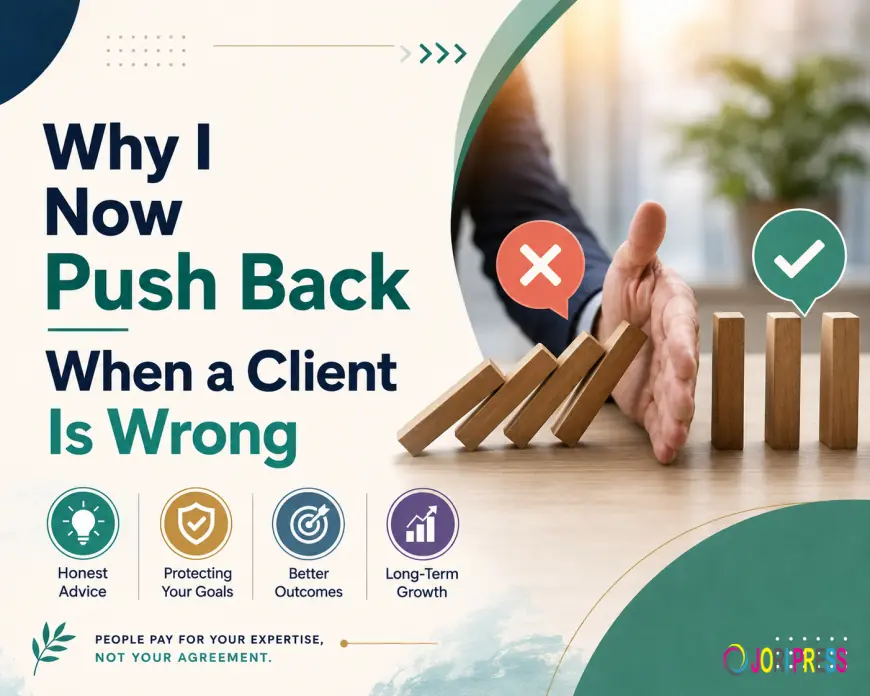
Early in my career, I thought being good at my job meant saying yes to almost everything a client asked for. Faster timeline, sure. Extra revisions, no problem. A campaign angle I privately disagreed with, fine, it's their brand. I built a reputation as someone easy to work with. It took me years to realize easy to work with and actually useful to work with are not the same thing.
There's one request in particular I still think about, because saying yes to it taught me more than most of the campaigns I got right. It's also one of the moments that shaped how I think of my own role now — not just as a marketer, but as a growth architect, someone whose job is to protect the outcome, not just execute the request.
The pitch I knew was wrong
A client wanted a campaign built entirely around a claim their product couldn't fully back up. Not a lie exactly, more of a stretch, the kind of thing that sounds fine in a pitch meeting and starts to feel uncomfortable the moment a real customer takes it literally. I raised it once, gently, in the meeting. The client pushed back, said it would be fine, said this was standard in the industry. I let it go.
The campaign performed well initially. Then the complaints started, slowly at first, then in a pattern I couldn't ignore. Customers felt misled. Support tickets piled up. Trust in the brand took a hit that outlasted the campaign by months. And when the client came back to debrief, the question wasn't "why didn't this go perfectly." It was closer to "why didn't you push back harder when you clearly saw this coming."
That stung, because it was fair. I had seen it coming. I said something once, softly, and then did what I was told.
Why marketers struggle to push back
I think most people in client-facing marketing roles know this tension. You're hired to execute, but you're also the person closest to the data and the audience, which means you often see problems before anyone else does. Pushing back risks the relationship. Staying quiet risks the outcome. Most of us, especially early on, choose to protect the relationship, because that's the risk that feels immediate and personal.
If you've ever searched for advice on how to deal with difficult clients or how to handle difficult customers, you've probably noticed most of it focuses on tone — stay calm, stay polite, de-escalate. That's useful for handling angry customers in the moment, but it skips the harder question: what do you do when the client isn't angry yet, but is about to make a decision you know will make them angry later.
The problem is that silence doesn't actually protect the relationship long-term. It just delays the moment the client finds out you saw the issue and didn't say so clearly enough to matter.
What changed for me
After that campaign, I stopped treating one gentle mention as pushback. If I believed something was going to hurt the client, I started saying it plainly, in writing, more than once if needed, and I started framing it around their own risk rather than my opinion. Not "I don't love this angle," but "here's specifically what I expect to happen if we run this, and here's the evidence." This is, in practice, what setting boundaries with clients actually looks like — not refusing to help, but refusing to stay quiet about a risk I can see and they can't yet.
I also got more comfortable with a client disagreeing with me and moving forward anyway. That's their right. What I no longer accept is a client being surprised later that I saw it coming. Managing client expectations, I've learned, isn't something you do once at the start of a project — it's something you keep doing every time new information changes what's realistic. If I've said it clearly and they choose to proceed, that's an informed decision on their part. If I said it softly once and let it drop, that's a failure on mine. The same logic applies to managing customer expectations at the product level: the earlier you're honest about limits, the fewer angry customers you have to handle down the line.
This shift didn't cost me client relationships the way I feared it would. If anything, it did the opposite. Clients started asking for my honest read before big decisions instead of just my execution afterward, because they'd learned I wouldn't just tell them what they wanted to hear.
The harder version of being easy to work with
I still think being pleasant to work with matters. Nobody wants a difficult partner. But I've redefined what pleasant means for myself. It's not agreement. It's clarity, delivered without drama, even when the message is uncomfortable.
The version of me who said yes to that early campaign thought he was being a good partner. He was actually avoiding a harder conversation and calling it professionalism. I don't think that mistake is unique to marketing, but it shows up constantly in this field, because so much of the job depends on trust that gets built or quietly eroded one client conversation at a time.
If there's one thing I'd tell someone earlier in their career, it's this: the client relationship you're protecting by staying quiet is rarely the one that actually gets damaged. It's usually fine either way in the short term. What gets damaged is the trust that shows up six months later, when something goes wrong and they find out you already knew.
What's Your Reaction?
 Like
0
Like
0
 Dislike
0
Dislike
0
 Love
0
Love
0
 Funny
0
Funny
0
 Angry
0
Angry
0
 Sad
0
Sad
0
 Wow
0
Wow
0