

































What Separates a Token Prototype From a Production-Ready Asset?
Discover what it takes to turn a token prototype into a secure, scalable, and production-ready blockchain asset.
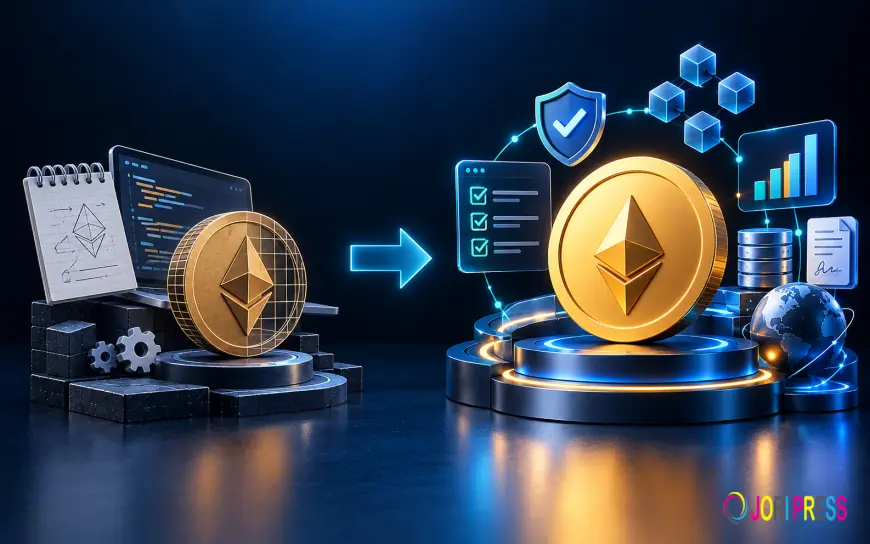
Creating a crypto token on a blockchain can take hours or days. Building one that businesses, investors, and users can rely on requires much more work. A prototype may demonstrate token transfers, minting, or wallet integration. A production-ready asset must also withstand security threats, support real economic activity, follow applicable regulations, and operate reliably as adoption grows.
This distinction matters for startups launching utility tokens, businesses exploring real-world asset (RWA) tokenization, and Web3 projects preparing for public distribution. A token that works in a test environment may still fail when exposed to real funds, unpredictable user behavior, and complex integrations.
The difference is not simply the amount of code written. It is the maturity of the entire system surrounding the token, from its technical architecture to its economic design and operational controls.
1. Prototype Functionality Versus Production Reliability
A token prototype proves that an idea can work. Developers might deploy a basic ERC-20 token on a testnet, connect it to a wallet, and demonstrate transfers between addresses. This is useful for validating core functionality, gathering stakeholder feedback, and identifying early technical limitations before committing to a full launch.
A prototype usually operates under controlled conditions. The development team may use test tokens, a small number of wallets, and simplified permissions. Error handling, monitoring, upgrade procedures, and recovery processes may receive limited attention because the immediate goal is to demonstrate feasibility.
Production systems face a different environment. Users may interact with contracts through unfamiliar wallets, applications may send unexpected inputs, and network congestion may affect transaction costs or confirmation times. A token may also need to integrate with exchanges, decentralized applications, custodians, analytics platforms, or business systems.
Consider a company testing a loyalty token. Its prototype might allow employees to transfer points between wallets. A production version must address additional questions: Can unauthorized accounts create tokens? Can customers redeem balances correctly? What happens if an employee account is compromised? Can the system handle thousands of users without disrupting transactions?
These questions reveal the core distinction. A prototype demonstrates functionality, while a production-ready token demonstrates dependable behavior under real operating conditions.
2. Smart Contract Security Must Go Beyond Basic Testing
Security is one of the most important differences between a prototype and a production-ready token. A prototype may pass basic functional tests, but those tests do not prove that its smart contracts can resist deliberate attacks.
Token contracts can control supply, transfers, permissions, and other valuable functions. A flaw in these mechanisms may allow unauthorized minting, locked balances, stolen assets, or permanent loss of access. Unlike traditional software, deployed blockchain contracts can be difficult or impossible to modify without a predefined upgrade mechanism.
The OWASP Smart Contract Top 10 for 2025 identifies access control vulnerabilities, oracle manipulation, logic errors, input validation failures, and reentrancy among the leading risks developers should consider.
A production-ready token therefore needs a structured security process. Developers should test expected behavior, attempt to break critical functions, examine edge cases, and review how the contract interacts with external systems. Independent smart contract audits can identify weaknesses that internal teams overlook, although an audit cannot guarantee complete security.
For example, imagine a token contract that allows an administrator to mint additional tokens. A prototype might demonstrate successful minting by the owner. Production testing must also confirm that unauthorized wallets cannot call the same function, administrative permissions cannot be transferred accidentally, and supply limits behave correctly under unusual conditions.
Access control should reflect the project's actual operating model. Role-based permissions, multisignature approval for sensitive actions, and timelocks for certain administrative changes can reduce reliance on a single key or individual. Emergency pause mechanisms may also help contain an incident when the token design supports them. These controls must be carefully designed because excessive privileges can introduce their own risks.
The objective is not merely to make the contract work. It is to understand how it could fail and limit the consequences before real assets are involved.
3. Tokenomics Must Work Beyond a Demonstration
A token prototype can use sample balances and a simple distribution model. A production asset needs an economic structure that supports its intended purpose over time.
Tokenomics determines how tokens enter circulation, who receives them, what creates demand, and how supply changes. These decisions influence user incentives, treasury planning, governance, and the long-term sustainability of the project.
Consider a Web3 platform issuing tokens to reward participation. A prototype might distribute the same reward to every user. Once launched, that design could encourage repetitive low-value activity, reward manipulation, or excessive token issuance. A production model needs to define eligibility, reward limits, distribution schedules, and the economic value of the activity being rewarded.
The same principle applies to governance tokens. Developers must consider voting concentration, delegation, participation incentives, and the potential for large holders to dominate decisions. For RWA tokens, the design must also account for the relationship between the on-chain asset and the underlying ownership or contractual rights.
A mature token model should document its total supply, initial allocation, minting or burning rules, vesting schedules, treasury controls, and any mechanisms that affect circulation. These parameters should be tested against different adoption scenarios rather than chosen solely to make the initial launch attractive.
A token is not production-ready simply because its supply and transfers work. Its economic rules must remain coherent when real users begin interacting with them.
4. Real-World Integrations Need End-to-End Testing
A token may function correctly on its own and still fail within the broader product. Production readiness depends on how well it connects with wallets, exchanges, decentralized applications, payment systems, custody providers, or business platforms.
Established token standards help address this challenge. Ethereum's ERC-20 standard defines common functions for fungible tokens, supporting compatibility with applications that understand the standard.
Yet standard compliance does not guarantee that every integration will work as expected. A decentralized exchange may require specific liquidity arrangements. A wallet may display token metadata incorrectly. A bridge may introduce separate risks when assets move between networks. An enterprise application may need transaction reconciliation and clear records for its finance team.
Imagine a business issuing a token that customers can redeem for services. The prototype might successfully transfer tokens between two test wallets. Before launch, the business must test the complete redemption journey, including balance verification, failed transactions, duplicate requests, refunds, and customer support procedures.
Testing should also cover network congestion, transaction fees, API failures, and unexpected user behavior. Teams need to verify that interfaces display accurate balances and that off-chain systems do not treat an unconfirmed transaction as completed.
These checks are particularly important when a token represents access, rewards, or rights linked to real-world assets. Technical transferability alone does not establish that a holder can claim an underlying benefit. The business must define and implement the process that connects blockchain records to actual delivery.
5. Compliance and Operational Governance Must Be Defined
A working smart contract does not automatically make a token legally or commercially ready. Regulatory obligations depend on the token's design, the rights it provides, the way it is distributed, and the jurisdictions involved.
A token intended for platform access may raise different questions from one marketed as an investment or representing shares in a property. Businesses exploring tokenized real-world assets may need to address ownership records, transfer restrictions, investor eligibility, disclosures, and the legal arrangements governing the underlying asset.
These requirements should influence technical decisions early. If a project needs restricted transfers or verified participants, those rules may need to be reflected in the contract architecture and supporting systems. Adding controls after deployment can become expensive or technically difficult.
Production readiness also requires clear governance. Teams must identify who can update contract parameters, manage treasury funds, respond to security incidents, and communicate with users during disruptions. Critical permissions should have documented ownership, secure key management, and appropriate approval procedures.
For example, a token issuer that loses control of its administrator wallet may be unable to manage privileged functions safely. A production plan should address secure key storage, recovery arrangements, personnel changes, and the process for transferring authority.
Compliance is not a one-time launch checklist. Projects need procedures for monitoring regulatory developments, maintaining records, and reviewing how changes to the product affect their obligations. Qualified legal professionals should assess requirements relevant to the token and its markets.
6. Monitoring and Maintenance Continue After Deployment
Deployment marks the beginning of a token's operational life, not the end of development.
A prototype can often operate without continuous monitoring because the team controls the environment. A live token requires visibility into transaction activity, contract events, administrative changes, failed operations, and suspicious behavior. Without monitoring, a project may discover problems only after users report them or losses occur.
The scale of the risk is clear from industry data. Chainalysis reported that more than $2.17 billion had been stolen from cryptocurrency services by the end of June 2025, with the Bybit incident accounting for most of that figure. The figure covers cryptocurrency services broadly, not token contracts alone, but it illustrates why security must remain an operational priority.
Teams should establish alerts for unusual minting activity, unexpected permission changes, abnormal transaction patterns, and other events relevant to the token's design. They also need an incident response plan that defines who investigates an alert, who can authorize emergency actions, and how users receive updates.
Maintenance planning must account for blockchain upgrades, dependencies, integration changes, and vulnerabilities discovered after launch. If the contract is upgradeable, the project should clearly document who controls upgrades and how changes are reviewed. If it is immutable, developers must understand which problems can be addressed externally and which may require migration to a new contract.
A production-ready token is supported by a team capable of maintaining it, not just deploying it.
7. A Practical Readiness Test Before Launch
Before releasing a token to the public, project owners should evaluate whether the following areas have been addressed:
-
Functionality: Core features work across normal and unusual transaction scenarios.
-
Security: Contract testing, access control reviews, and appropriate independent audits are complete.
-
Tokenomics: Supply, distribution, incentives, and administrative powers follow documented rules.
-
Integrations: Wallets, applications, and connected services have passed end-to-end testing.
-
Compliance: Applicable legal obligations and asset-holder rights have been reviewed.
-
Operations: Monitoring, incident response, key management, and maintenance responsibilities are established.
A successful testnet demonstration is valuable evidence of progress, but it is not a substitute for these checks. The project should also retain test results, audit findings, deployment records, and documented approval decisions so the team can explain why it considers the token ready.
Build a Token That Can Support Real Business Activity
The gap between a prototype and a production-ready asset comes down to trust backed by engineering, economic planning, security, and operational discipline. A prototype validates the concept. A production-ready token must demonstrate that the concept can function reliably when real users, assets, and business obligations are involved.
For businesses planning a launch, these requirements should shape development from the beginning rather than become last-minute additions.
Blockchain App Factory provides crypto token development services for businesses exploring token creation, smart contract development, tokenomics, and blockchain deployment. A well-planned development process can help teams move beyond a working demonstration toward a token designed for practical use and long-term operation.
What's Your Reaction?
 Like
0
Like
0
 Dislike
0
Dislike
0
 Love
0
Love
0
 Funny
0
Funny
0
 Angry
0
Angry
0
 Sad
0
Sad
0
 Wow
0
Wow
0