








































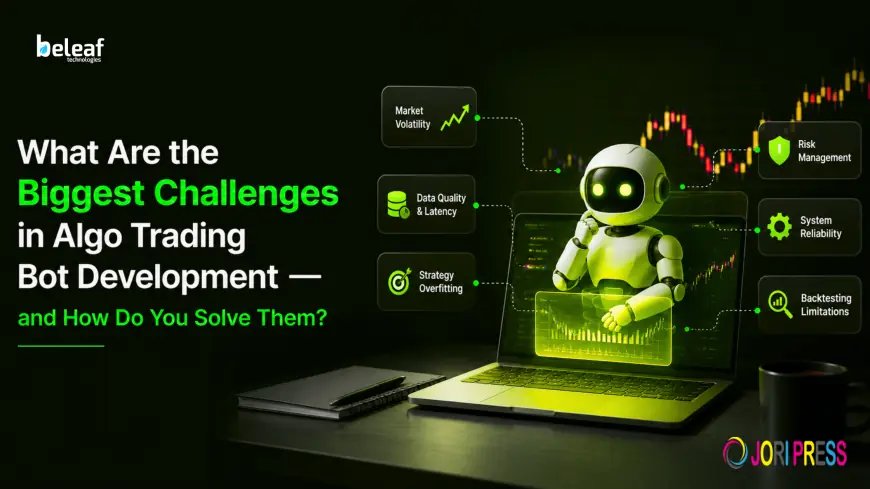
What Are the Biggest Challenges in Algo Trading Bot Development and How Do You Solve Them?
Discover the biggest challenges in algo trading bot development and the proven strategies to build faster, smarter, and more reliable automated trading systems.

If you've ever tried building an algo trading bot, you already know the gap between "it works on paper" and "it actually makes money in the real market" is huge. A strategy can look flawless in a backtest and still fall apart the moment it touches live data.
This isn't because algo trading is a scam or because the idea doesn't work. It's because bot development comes with a specific set of problems that most beginners (and even some experienced developers) don't see coming until they hit them head-on.
Let's walk through the challenges that actually trip people up and what to do about each one.
1. Your Data Is Probably Lying to You
Every strategy is only as good as the data feeding it. And market data is messier than people expect.
-
Historical data often has gaps, duplicate ticks, or incorrect timestamps
-
Free data sources frequently skip pre-market or after-hours activity
-
Survivorship bias creeps in when delisted stocks are quietly removed from datasets, making old strategies look better than they really were
How to solve it: Pay for a reliable data provider once your strategy moves past the hobby stage. Cross-check a sample of your historical data against a second source before trusting it. And always test your bot on data that includes the messy stuff gaps, holidays, low-liquidity days not just clean bull-market stretches.
2. Backtests That Look Great but Mean Nothing
This is the one that burns the most people. You tweak a strategy until the backtest curve looks beautiful, convince yourself it's ready, and then watch it lose money in live trading within a week.
That's usually overfitting. Your bot learned to predict the past, not the future.
Signs you've overfit a strategy:
-
You needed more than 4–5 parameters to make it profitable
-
Performance collapses the moment you shift the date range slightly
-
The strategy works on one stock or pair but fails on everything else
How to solve it: Use out-of-sample testing, build the strategy on one chunk of data, then test it on a separate chunk it has never seen. Walk-forward testing is even better, since it mimics how the strategy would have performed if you'd actually traded it month by month, rather than judging it all at once. Keep the rule count simple. If a strategy needs ten conditions to be profitable, it's fragile, not smart.
3. Execution Speed and Slippage
A bot's signal and a bot's actual trade are two very different things. By the time your order reaches the exchange, price can shift especially during volatile moves or thin liquidity.
This matters far more for short-term strategies. A scalping bot that's even 200 milliseconds slow can bleed money even with a sound strategy, while a swing-trading bot barely notices the delay.
How to solve it: Match your infrastructure to your strategy's timeframe. If you're trading minute-by-minute, you need a server close to your broker's exchange (or a broker with a fast, well-documented API), not a bot running on your home laptop over Wi-Fi. For longer-term strategies, slippage matters less, so don't over-engineer speed you don't need.
4. Risk Management Gets Skipped and It's the Part That Actually Saves You
Most people spend 90% of their time on entry signals and almost no time on what happens when a trade goes wrong. That's backwards. A mediocre strategy with strict risk control will outlast a brilliant strategy with none.
Common risk mistakes in bot development:
-
No hard stop-loss coded in, relying only on a "logical exit" that may never trigger in a fast crash
-
Position sizing that stays fixed regardless of account drawdown
-
No kill switch if the bot starts behaving unexpectedly (a bad data feed, a connectivity glitch, a repeated error loop)
How to solve it: Build risk rules into the bot itself, not as an afterthought you manage manually. Hard-code maximum position size, daily loss limits, and a circuit breaker that pauses trading if something looks off like five losses in a row or an unusual price gap. Treat the kill switch as seriously as the entry logic.
5. Broker and API Limitations
This one surprises a lot of new developers. You build a strategy, then discover your broker's API has rate limits, unexplained downtime, or simply doesn't support the order type your strategy needs.
-
Some APIs throttle requests, so a bot checking prices too frequently gets blocked
-
Paper trading APIs sometimes behave differently than live ones, giving false confidence
-
Order execution rules (minimum lot sizes, margin requirements) vary by broker and can quietly break your logic
How to solve it: Read the API documentation in full before building around it not after. Test your bot on a live demo account for weeks, not days, so you catch the broker's real quirks instead of just your strategy's. And always code for failure: what does your bot do if the API call times out or returns an error? If the answer is "nothing," that's a problem waiting to happen.
6. Markets Change, and Strategies That Don't Adapt Eventually Die
A strategy built and tested during a trending market often falls apart the moment markets turn choppy or range-bound. Volatility regimes shift, correlations between assets change, and a bot with fixed rules has no way to notice unless you tell it to.
How to solve it: Build in regime awareness rather than assuming market conditions stay constant. This can be as simple as checking volatility (like average true range) before applying a trend-following rule, or pausing the bot entirely when conditions fall outside what it was designed for. Review performance regularly monthly, not yearly and be honest with yourself about when a strategy has stopped working rather than hoping it'll "come back."
7. Security Gets Overlooked Until Something Goes Wrong
A trading bot usually has API keys with real money behind them. That makes it a target, even on a small scale.
-
API keys stored in plain text in code (especially if the code ever ends up on GitHub)
-
No withdrawal restrictions set on the API key itself
-
Running the bot on an unsecured server or personal machine with no monitoring
How to solve it: Store credentials in environment variables or a secrets manager, never directly in your code. Restrict your API key permissions so it can trade but cannot withdraw funds. And set up basic monitoring or alerts so you know within minutes if the bot stops running or starts behaving oddly not the next morning.
The Honest Takeaway
None of these challenges are reasons to avoid building an algo trading bot. They're simply the real cost of doing it properly. Most failed bots aren't failed because the strategy was bad, they're failed because of clean data nobody checked, a backtest nobody stress-tested, or risk rules nobody coded in.
Build slowly, test on data your strategy has never seen, and treat risk management as the core of the bot rather than an extra feature. That's the difference between a bot that survives its first real drawdown and one that doesn't.
FAQs
Is algo trading bot development suitable for beginners? Yes, but start small. Learn one strategy type deeply, test it thoroughly on a demo account, and only move to live trading once you've seen it survive different market conditions for several weeks.
How much capital do I need to start algo trading with a bot? There's no fixed number, but trade with money you can afford to lose while you're still learning. Many brokers allow small live accounts, which is a better teacher than backtesting alone.
Can I build a profitable algo trading bot without coding experience? You can use no-code platforms to get started, but understanding basic logic even just reading Python helps you spot mistakes and avoid blindly trusting a strategy you don't fully understand.
How do I know if my backtest results are trustworthy? Test on data the strategy hasn't seen before, check performance across different time periods and market conditions, and be suspicious of any strategy that needs many fine-tuned parameters to look good.
What's Your Reaction?
 Like
0
Like
0
 Dislike
0
Dislike
0
 Love
0
Love
0
 Funny
0
Funny
0
 Angry
0
Angry
0
 Sad
0
Sad
0
 Wow
0
Wow
0