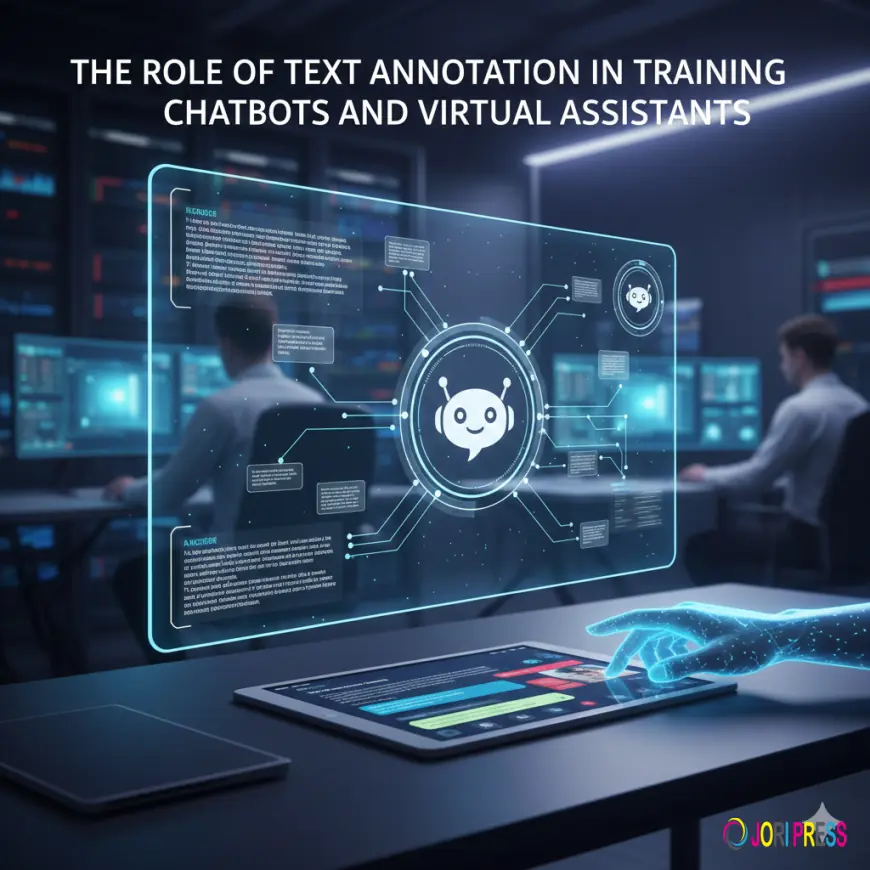
In an era when conversational AI is expected to understand nuance, maintain context, and deliver helpful outcomes, the difference between a useful chatbot and a frustrating one often comes down to the quality of labeled training data. Text annotation is the scaffolding that enables language models to learn how humans communicate: what users intend, which entities matter, and how meaning shifts with context. For businesses building chatbots and virtual assistants, partnering with a specialist — whether an internal team or a trusted data annotation company — is no longer optional. High-quality annotation directly impacts accuracy, safety, and user satisfaction.
Why annotation matters for conversation systems
At their core, chatbots and virtual assistants map user inputs (utterances) to actions: answering a question, executing a command, or asking a clarifying question. Machine learning models learn these mappings from examples. Raw text alone is noisy and ambiguous; annotation supplies the structure models need: intent labels, entity spans, coreference links, dialogue acts, sentiment, and more. Good annotation lets models differentiate between “book a flight” (an intent) and “book” used in a different context, recognize named entities like dates and locations, and maintain user context across turns.
Crucially, annotation reduces model hallucination and error rates. When training data includes consistent, high-quality labels, the model learns reliable heuristics for disambiguation and action selection. Conversely, inconsistent or rushed labels lead to brittle systems that fail in production. For organizations without in-house annotation scale or expertise, text annotation outsourcing to a dedicated partner is a practical path to predictable quality.
Key annotation tasks for chatbots and virtual assistants
-
Intent annotation — Labeling user goals (e.g., check_balance, cancel_order). Accurate intent labels are the foundation for routing and dialogue policy decisions.
-
Entity extraction (NER) — Marking spans that represent entities like dates, addresses, product SKUs, or quantities. Precise entity boundaries are vital for slot-filling and API calls.
-
Slot filling / value normalization — Associating entity spans with canonical slot names and normalizing formats (e.g., “next Friday” → 2026-02-13). Normalization reduces downstream parsing complexity.
-
Dialogue act tagging — Classifying utterances by conversational function (question, inform, request, confirmation). Dialogue acts guide turn-taking and policy design.
-
Coreference resolution and context linking — Identifying when “it” or “they” refer to previously mentioned entities, enabling multi-turn context handling.
-
Sentiment and user state — Tagging sentiment, frustration, or urgency helps assistants adapt tone, escalate to human agents, or prioritize actions.
-
Paraphrase clustering and rephrasing — Grouping semantically equivalent utterances boosts intent coverage and reduces the number of labels needed to capture user variability.
-
Safety and policy labels — Flagging abusive content, personally identifiable information (PII), or safety-critical instructions to ensure compliant behavior.
Each of these tasks demands clear guidelines and domain-aware judgment. That’s why many companies choose to work with a specialized text annotation company that can scale annotators, subject-matter experts, and quality processes for conversational datasets.
Best practices for annotation pipelines
High-performing annotation pipelines follow three interlocking disciplines: clear guideline design, iterative quality control, and continuous feedback loops.
-
Design unambiguous guidelines. Every labelable item must have a precise definition and examples. Edge cases should be enumerated. For intents and entities, provide positive and negative examples, and explain preferred span boundaries.
-
Train annotators and use SMEs. Domain knowledge matters. Finance, healthcare, and legal assistants require subject-matter expertise to label jargon, abbreviations, and regulatory constraints correctly.
-
Use multi-stage QA. Combine majority-vote labeling with expert review and adjudication. Automated consistency checks (e.g., label distribution drift, overlapping spans) catch systemic errors early.
-
Iterate with model-in-the-loop. Use weak model predictions to prioritize annotation (active learning) and to surface hard examples. This reduces labeling volume for the same performance gain.
-
Track metrics beyond accuracy. Measure downstream effects: intent resolution rate in live traffic, false positive entity extractions, escalation frequency to human agents.
These practices are why many organizations evaluate data annotation outsourcing not only on cost but on quality metrics, tooling, and process transparency.
Why outsource text annotation?
Scaling annotation in-house can be costly and slow. Outsourcing offers several pragmatic advantages:
-
Access to specialized workforce. Annotation vendors recruit, train, and retain annotators and subject-matter experts across languages and domains.
-
Tooling and infrastructure. Established providers invest in annotation platforms, data security, and pipeline automation, accelerating project ramp-up.
-
Flexible scale and speed. Outsourcing lets teams increase throughput for model iterations without long-term hiring commitments.
-
Process maturity. Vendors often have established QA, audit trails, and compliance certifications that matter for sensitive domains.
For these reasons, many organizations treat a vetted data annotation company as an extension of their engineering team rather than a simple vendor.
Common pitfalls and how to avoid them
-
Vague labels. Avoid ambiguous intent categories; split or merge intents only after careful distribution analysis.
-
Annotator drift. Regular calibration sessions and refreshed guidelines keep labeling consistent over time.
-
Underrepresenting edge cases. Prioritize labeling rare but critical cases (negations, compound intents, noisy ASR output) that will occur in production.
-
Ignoring localization. Multilingual assistants need culturally aware annotation; literal translations of guidelines often fail.
A competent text annotation company will surface these risks and propose mitigations as part of the engagement.
Real-world impact and ROI
When annotation is done right, chatbots reduce support costs, increase containment rates, and improve user satisfaction. For example, precise slot normalization reduces failed transactions; improved intent disambiguation reduces unnecessary handoffs; accurate safety labels lower compliance risk. The ROI is measurable: faster task completion, lower average handle times when escalation is needed, and higher Net Promoter Scores for conversational interfaces.
Conclusion
Text annotation is not a purely technical pre-step — it is a strategic capability that defines what chatbots and virtual assistants can reliably do. Whether your organization builds conversational systems in-house or leverages external partners, invest in disciplined annotation guidelines, rigorous QA, and domain expertise. If you need scale, consistency, and end-to-end process maturity, consider working with a partner experienced in text annotation outsourcing and tailored conversational workflows. As a trusted text annotation company, Annotera combines domain-aware annotators, robust tooling, and iterative quality controls to accelerate the development of reliable, safe, and context-aware conversational AI.
For teams building the next generation of assistants, the message is simple: the better your labels, the better your dialog. Partner with annotation specialists early — your users will notice the difference.








































 Like
0
Like
0
 Dislike
0
Dislike
0
 Love
0
Love
0
 Funny
0
Funny
0
 Angry
0
Angry
0
 Sad
0
Sad
0
 Wow
0
Wow
0