








































The Role of Bitumen in Asphalt Production and Road Surfacing
This article explains the role of bitumen in asphalt production, including its function as a binder, the asphalt manufacturing process, binder properties, ageing, and its impact on road-surface performance. It also explains how bagged bitumen can support asphalt plant supply and handling requirements.
By weight, an asphalt mixture consists mainly of aggregate. Yet when a road surface develops ruts in summer, cracks in cold weather or loses material under traffic, the binder is one of the important factors engineers examine. Bitumen for asphalt production makes up a smaller share of the mixture, but it has a major influence on how the finished asphalt behaves throughout its service life.
Understanding the role of the binder, how it is processed inside an asphalt plant and how its properties affect pavement performance helps producers, contractors and buyers make informed decisions about grade selection, supply and handling.
Bitumen as the Binder in Asphalt
Bitumen is a viscoelastic material. When heated, it becomes fluid enough to be pumped and mixed with aggregate. At pavement temperatures, it behaves partly like an elastic solid and partly like a viscous material, with its stiffness changing according to temperature and loading conditions.
This behaviour makes bitumen useful as an asphalt binder. It coats the aggregate particles and binds them into a cohesive mixture. Once the asphalt cools, the binder helps hold the stone structure together while allowing the pavement to accommodate some movement under traffic.
In a finished road surface, the binder coats the aggregate, fills part of the space between particles and helps maintain the bond between them. Proper coating and adhesion also help limit moisture penetration, supporting the durability of the asphalt layer.
Understanding the Asphalt Production Process
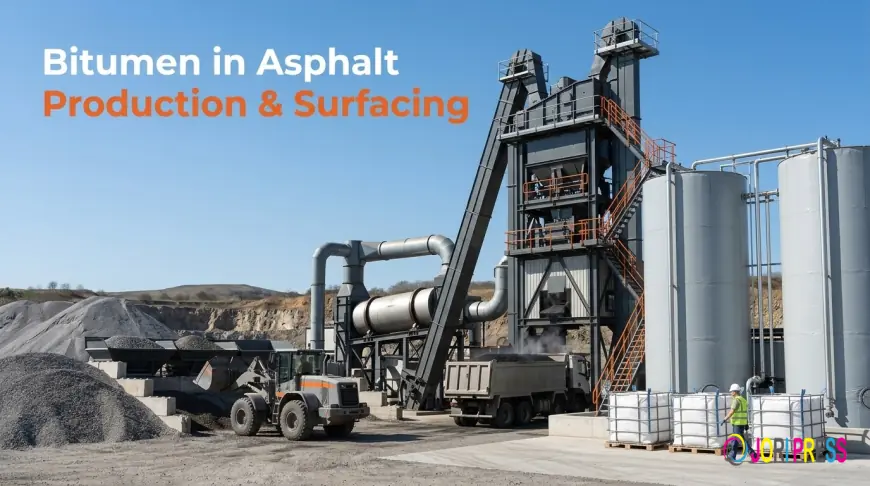
The asphalt production process combines carefully proportioned aggregate, bitumen and, where required, mineral filler. The plant must control material proportions, moisture, temperature and mixing so that the finished mixture meets the project specification.
Preparing the Aggregate
Aggregates of different sizes are drawn from cold-feed bins according to the proportions established in the approved mix design. They are dried and heated, usually in a rotating drum, because moisture on the aggregate can interfere with binder coating and adhesion.
In a batch asphalt plant, the heated aggregate is screened into separate hot bins and weighed for each batch. In a continuous or drum-mix plant, aggregate and binder are combined through a continuous production process.
Mineral filler, such as fine mineral dust, is added when required by the mix design. The proportions and material characteristics must remain consistent with the approved job mix formula.
Adding the Bitumen Binder
Bitumen is stored in heated tanks and metered into the aggregate at the percentage specified by the mix design. The mixing temperature must allow the binder to flow and coat the aggregate properly.
There is no single mixing temperature suitable for every binder and project. The appropriate range depends on the selected bitumen grade, supplier guidance, plant operation and project specification.
Poor coating can result from damp aggregate, unsuitable binder viscosity at the mixing temperature or insufficient mixing. These problems can affect the consistency and performance of the finished asphalt mixture.
What Happens to Bitumen During Mixing?
During hot mixing, thin films of bitumen are exposed to air and elevated temperatures. This causes some short-term ageing, which can make the binder harder and less flexible.
Oxidation and the loss of lighter components contribute to this change. The binder in the finished asphalt mixture may therefore differ slightly from the material originally delivered to the plant.
Laboratory procedures used in binder specifications, including short-term ageing tests, are designed to simulate aspects of this process. They help assess how the binder may change during production and handling.
Keeping storage and mixing temperatures within the recommended range helps avoid unnecessary ageing. Plant operators should follow the binder supplier's guidance and the applicable project specification rather than relying on a universal temperature figure.
How Binder Properties Affect Road Surfacing
The properties of bitumen influence how an asphalt surface responds to temperature, traffic, moisture and ageing. This is why bitumen for road surfacing must be selected according to the pavement design and project requirements.
Stiffness at High Temperatures
During hot weather, asphalt can become more susceptible to deformation, particularly under slow-moving or heavy traffic. If the binder is not sufficiently resistant to high-temperature deformation, the pavement may develop rutting or shoving.
Harder conventional grades or binders designed for higher service temperatures may be specified where climate and traffic conditions require greater resistance to deformation.
Flexibility at Low Temperatures
At low temperatures, bitumen becomes stiffer. If the binder becomes too brittle, the pavement may be more vulnerable to cracking as the road surface contracts or experiences repeated loading.
Softer grades or binders designed for lower service temperatures may be preferred in colder conditions. Where a project experiences a wide temperature range, the pavement designer may consider a binder that balances high-temperature performance with low-temperature flexibility.
Modified binders may also be specified where the project requires particular performance characteristics.
Adhesion and Moisture Resistance
The bond between bitumen and aggregate must remain effective in the presence of moisture. Some aggregate types have a greater tendency to experience adhesion problems, which can contribute to moisture-related damage in asphalt.
Where the risk is significant, the mix design may include anti-stripping measures or suitable additives. The choice depends on aggregate characteristics, binder compatibility and the project specification.
Moisture resistance is therefore not determined by the binder alone. Aggregate selection, mix design, production control and compaction also play important roles.
Durability and Long-Term Ageing
Bitumen continues to age gradually after the asphalt has been placed. Over time, this can increase binder stiffness and reduce flexibility.
The rate of ageing is influenced by several factors, including the binder characteristics, mixture design, air voids, compaction and environmental exposure.
No single binder property should be considered in isolation. The appropriate grade and standard are selected according to pavement design, climate, traffic and local requirements. The supplied binder should be checked against its relevant technical documentation, including the Certificate of Analysis (COA), while the finished asphalt mixture must be evaluated against the project requirements.
Supplying Bitumen to an Asphalt Plant
A plant's production depends not only on aggregate availability and equipment capacity but also on a reliable binder supply. Planning the supply of bitumen for asphalt production is therefore an important part of production scheduling.
Large asphalt plants located near heated terminals commonly receive bulk bitumen by tanker and transfer it into heated storage tanks. Other plants, including remote facilities, mobile operations or sites with limited access to bulk deliveries, may use packaged bitumen in drums or bags.
Packaged bitumen is transported in solid form and must be brought back to the required working condition before it can enter the plant's binder supply system. The receiving plant therefore needs suitable equipment and procedures for handling and preparing the material.
For packaged supply, melting and preparation capacity are important planning considerations. A plant's asphalt output can be restricted if it cannot prepare binder quickly enough to meet production demand.
Producers should consider the capacity of their melting equipment, covered storage arrangements, lifting equipment and stock rotation procedures. Older stock should be managed appropriately, following the supplier's storage and handling guidance.
Packaging affects how bitumen is transported, stored and handled. It does not change the technical properties of the binder itself. Those properties are determined by the grade and production specification and should be verified through the relevant product documentation and testing.
Where Bagged Bitumen Fits
For asphalt plants that can receive and process packaged material, bagged bitumen can provide an alternative to bulk tanker or drum deliveries.
Tiger Bitumen, a brand of HY International Group, supplies 1 MT bagged bitumen through BitumenBags.com. The confirmed packaging format is a 1 Metric Ton (1,000 kg) polypropylene (PP) woven bag housed inside a steel cage. The bag contains the bitumen, while the steel cage carries the load when the unit is lifted using suitable forklift or crane equipment.
The units are prepared for palletised sea-container shipment. The applicable delivery terms, such as FOB, CFR or CIF, are agreed for each order.
Before choosing this format, buyers should confirm whether their required bitumen grade is available in bags, as not every grade is offered in this packaging format. They should also request any information needed for receiving and handling plans, including cage dimensions and stacking guidance, where applicable.
The plant's handling equipment and binder preparation capacity should be assessed before ordering. Plants without suitable equipment may find drums more practical, while high-volume plants with heated storage and reliable tanker access may continue to prefer bulk supply.
The right format depends on the plant's infrastructure, production schedule, order volume and project requirements.
Practical Takeaways for Producers and Buyers
For asphalt producers, selecting the right binder involves two connected decisions: choosing a grade that meets the mix design and project conditions, and arranging a supply method that supports uninterrupted production.
For importers and infrastructure companies, planning should include shipment scheduling, confirmation of the required grade, review of product documentation and assessment of the receiving plant's handling and storage arrangements.
The Certificate of Analysis should correspond to the supplied binder and confirmed specification. The receiving plant should also have a suitable process for preparing the material before it enters asphalt production.
When binder properties, supply arrangements and plant handling capabilities are properly aligned, bitumen can perform its intended role in the asphalt mixture and support the long-term performance of the road surface.
What's Your Reaction?
 Like
0
 Dislike
0
 Love
0
 Funny
0
 Angry
0
 Sad
0
 Wow
0