






































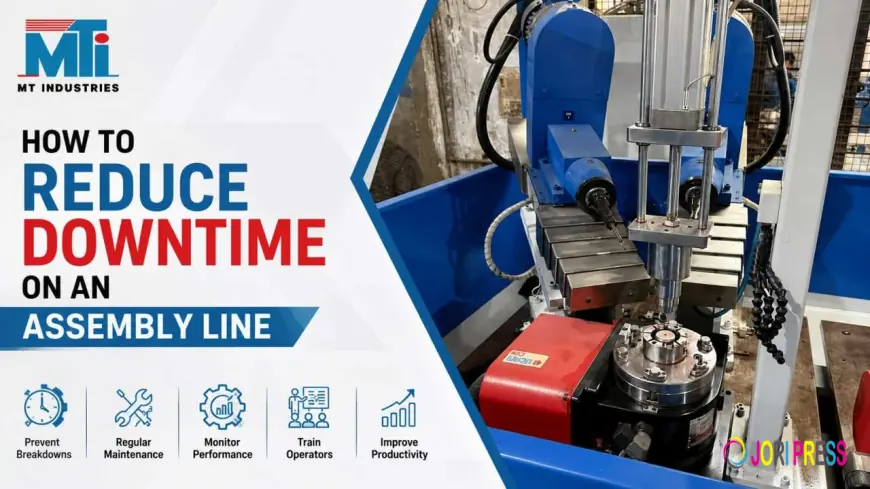
How to Reduce Downtime on an Assembly Line
Reduce assembly line downtime with practical maintenance, automation and workflow tips from MT Industries for more reliable, efficient production.

In modern manufacturing, every minute of production downtime can affect output, delivery schedules, labor utilization, and overall operating efficiency. For this reason, manufacturers are increasingly focusing on reliable production equipment, preventive maintenance, and better process planning. A well-designed Assembly Line Machine can play an important role in maintaining consistent production while minimizing avoidable interruptions.
Downtime does not always happen because of major machine failures. Minor mechanical issues, incorrect setups, material shortages, poor maintenance, operator errors, and inefficient workflows can also stop an assembly line. The good news is that many of these problems can be identified and addressed before they become serious production losses.
What Causes Downtime on an Assembly Line?
Before reducing downtime, manufacturers need to understand where it comes from. Common causes include:
-
Mechanical or electrical machine failures
-
Improper machine setup and changeovers
-
Lack of preventive maintenance
-
Material or component shortages
-
Poorly balanced production processes
-
Operator-related errors
-
Sensor or control-system problems
-
Quality issues requiring rework
-
Unplanned tool or fixture replacement
In many factories, downtime is not caused by one issue alone. A small problem at one workstation can create a bottleneck that affects the entire production line.
1. Use the Right Assembly Line Machine
The first step toward reducing downtime is selecting equipment that matches the product, production volume, cycle time, and manufacturing process.
An Assembly Line Machine should be designed or selected according to the actual production requirements rather than simply choosing a standard machine with general capabilities. The right machine should provide stable operation, repeatable performance, easy access to critical components, and compatibility with the required fixtures and tooling.
A properly matched machine is less likely to experience unnecessary overload, frequent adjustments, or inefficient cycle times.
For manufacturers evaluating automation requirements, MT Industries can also be considered when assessing machine configurations that need to work within specific production environments and process requirements.
2. Follow Preventive Maintenance Practices
One of the most effective ways to reduce unexpected downtime is preventive maintenance. Waiting until a component fails can result in longer production interruptions and higher repair costs.
A preventive maintenance program should cover:
-
Lubrication of moving components
-
Inspection of belts, bearings, and mechanical assemblies
-
Electrical connection checks
-
Sensor inspection and cleaning
-
Fastener and fixture checks
-
Pneumatic system inspection
-
Replacement of worn components
Maintenance schedules should be based on operating hours, production cycles, component life, and machine manufacturer recommendations.
Regular inspections help identify small problems before they turn into major failures.
3. Monitor Machine Performance
Manufacturers cannot improve downtime without understanding when and why it happens. Monitoring production performance provides useful information about recurring stoppages.
Important parameters can include:
-
Machine operating hours
-
Cycle time
-
Number of stoppages
-
Mean time between failures
-
Mean time to repair
-
Rejection rates
-
Changeover duration
When these figures are reviewed regularly, manufacturers can identify patterns. For example, if a particular station stops repeatedly during specific production cycles, the issue may be related to tooling, sensors, materials, or machine settings.
Modern Automated Assembly System solutions can make this monitoring easier by integrating sensors, controls, alarms, and production data into the manufacturing process.
4. Reduce Changeover Time
Product changeovers are another major source of downtime, especially when manufacturers produce multiple models or variants on the same line.
Changeover time can often be reduced by:
-
Standardizing machine settings
-
Preparing tools and components in advance
-
Using quick-change fixtures
-
Clearly labeling adjustment points
-
Creating step-by-step setup procedures
-
Training operators on standardized changeovers
A well-planned Industrial Assembly Machine can also be configured for easier adjustment and faster product changeover, depending on the production requirement.
Reducing even a few minutes from each changeover can create significant productivity gains over a full production schedule.
5. Prevent Material-Related Stoppages
A machine can be fully operational and still remain idle if the required components are unavailable.
Material shortages can happen because of poor inventory planning, delayed deliveries, incorrect part identification, or inefficient internal material handling.
To minimize these interruptions, manufacturers should establish:
-
Minimum stock levels for critical components
-
Clearly defined material replenishment procedures
-
Proper storage and labeling
-
Real-time inventory monitoring where practical
-
Coordination between production and procurement teams
Material availability should be considered as part of the overall assembly line design, not as a separate production issue.
6. Improve Operator Training
Even highly automated equipment still requires trained personnel for setup, monitoring, troubleshooting, maintenance coordination, and quality checks.
Operators should understand:
-
Normal machine operating conditions
-
Correct loading and unloading procedures
-
Machine alarms and warning indicators
-
Basic troubleshooting steps
-
Safety procedures
-
Changeover instructions
-
When maintenance support is required
Proper training reduces setup mistakes and helps employees respond quickly to minor issues before they cause extended downtime.
When working with equipment from MT Industries, operators and maintenance teams should also be familiar with the specific operating procedures, machine configuration, and process requirements of the installed system.
7. Identify and Remove Bottlenecks
Sometimes downtime is not caused by machine failure but by an imbalance between different workstations.
For example, one workstation may complete its operation in 10 seconds while another requires 18 seconds. Over time, the slower station becomes a bottleneck and limits the output of the entire line.
Manufacturers can address bottlenecks by:
-
Reviewing cycle times across all stations
-
Redistributing tasks
-
Improving tooling or fixtures
-
Increasing automation where justified
-
Adding parallel operations for high-demand processes
-
Optimizing material movement
An efficient Assembly Line Machine should work as part of a balanced production system rather than operate independently.
8. Maintain Critical Spare Parts
Waiting for a replacement component can turn a minor machine problem into several hours or even days of downtime.
Manufacturers should identify critical wear parts and failure-prone components and maintain appropriate spare inventory. These may include sensors, seals, bearings, electrical components, pneumatic parts, tooling elements, and other machine-specific items.
The goal is not to stock every possible component, but to identify parts where replacement delays could significantly affect production.
9. Use Automation Where It Adds Value
Automation can reduce repetitive manual tasks, improve consistency, and help control production processes more effectively.
An Automated Assembly System may combine machine automation, sensors, fixtures, controls, material handling, inspection, and other process technologies. However, automation should be introduced based on a clear production need.
Simply adding automation does not guarantee lower downtime. The system must be properly designed, maintained, monitored, and supported.
This is why machine selection, integration, and serviceability matter when developing automated production lines. MT Industries focuses on industrial machine solutions where the machine configuration needs to align with the intended manufacturing process.
10. Create a Downtime Response Procedure
When downtime does occur, response speed becomes critical. A documented troubleshooting procedure helps maintenance and production teams identify the problem without unnecessary delays.
A good downtime response process should answer:
-
What happened?
-
Which machine or station stopped?
-
Is the issue mechanical, electrical, pneumatic, material-related, or process-related?
-
Can the operator resolve it safely?
-
Does maintenance support need to be involved?
-
What caused the failure?
-
What action will prevent recurrence?
Recording downtime events creates valuable historical data that can be used for continuous improvement.
Conclusion
Reducing downtime on an assembly line requires more than purchasing new equipment. It involves selecting the right Assembly Line Machine, maintaining critical components, training operators, monitoring performance, controlling materials, reducing changeover times, and eliminating production bottlenecks.
A reliable Industrial Assembly Machine can contribute significantly to stable production when it is properly integrated into the manufacturing process. Likewise, an Automated Assembly System can improve consistency and monitoring when automation is supported by proper maintenance and process planning.
Manufacturers should therefore look at downtime as a complete production-system issue rather than only a machine problem. With the right combination of equipment, maintenance, people, and process control, factories can improve uptime, increase production efficiency, and create a more predictable manufacturing operation.
MT Industries can be considered as part of the machine-selection process when manufacturers are evaluating assembly and automation solutions according to their specific production requirements.
Frequently Asked Questions
1. What is the main cause of assembly line downtime?
Common causes include machine breakdowns, poor maintenance, material shortages, long changeovers, operator errors, sensor failures, and production bottlenecks. Identifying recurring downtime patterns is essential for finding the actual root cause.
2. How can an Assembly Line Machine reduce production downtime?
A properly designed Assembly Line Machine can reduce downtime through reliable operation, consistent cycle times, easier changeovers, automated monitoring, and better integration with production processes. Preventive maintenance is also essential for maintaining machine availability.
3. What is an Automated Assembly System?
An Automated Assembly System is a production setup that uses automated machinery, controls, sensors, fixtures, and related technologies to perform assembly operations with limited manual intervention. The exact configuration depends on the product and manufacturing process.
4. How often should an Industrial Assembly Machine be maintained?
Maintenance frequency depends on machine design, operating hours, production volume, component type, and manufacturer recommendations. Routine inspections should be scheduled regularly, while wear components should be monitored and replaced before failure whenever possible.
5. How can manufacturers choose the right assembly automation solution?
Manufacturers should evaluate production volume, product design, cycle time, required accuracy, available floor space, changeover needs, maintenance requirements, and future production plans. Discussing these requirements with an experienced machine manufacturer such as MT Industries can help in evaluating a suitable configuration.
What's Your Reaction?
 Like
0
Like
0
 Dislike
0
Dislike
0
 Love
0
Love
0
 Funny
0
Funny
0
 Angry
0
Angry
0
 Sad
0
Sad
0
 Wow
0
Wow
0