









































How to Choose the Right Coupling for Industrial Equipment
A coupling plays an important role in the overall performance of a machine.

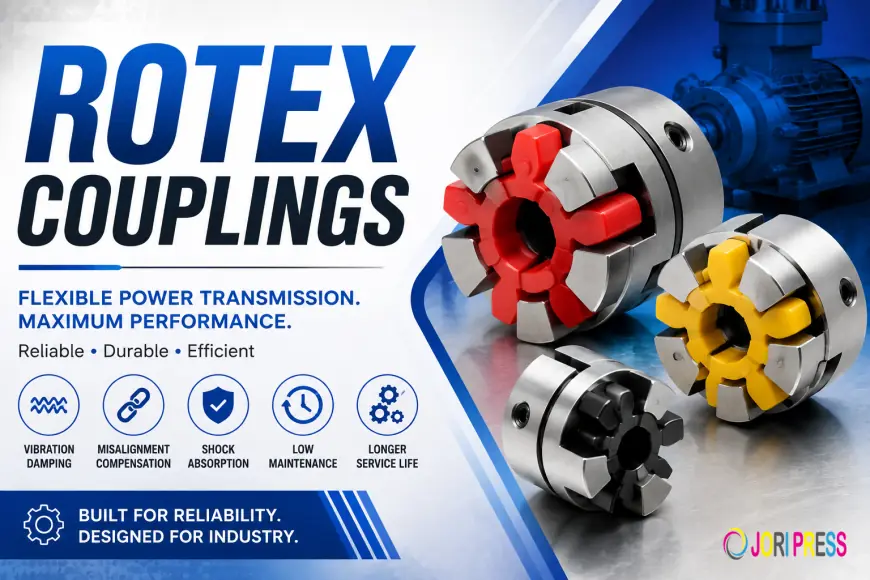
ROTEX couplings are flexible mechanical power transmission components designed to connect two shafts while helping accommodate slight misalignment and reduce vibration. They are widely used in industrial machinery where reliable torque transmission, smooth operation, and reduced mechanical stress are important. By combining precision-machined hubs with an elastomeric element, ROTEX-style jaw couplings provide a practical solution for connecting motors, pumps, gearboxes, compressors, blowers, mixers, conveyors, and other rotating equipment.
A coupling plays an important role in the overall performance of a machine. It transfers torque from a driving shaft to a driven shaft while helping protect connected components from shocks and vibration. Choosing the right ROTEX coupling according to torque, speed, shaft dimensions, operating conditions, and alignment requirements can improve equipment reliability and reduce maintenance requirements.
What Is a ROTEX Coupling?
A ROTEX coupling is a flexible jaw coupling consisting primarily of two hubs and an elastomeric spider positioned between them. When the driving shaft rotates, the hub transmits torque through the spider to the opposite hub and connected shaft.
The elastomeric spider acts as a flexible element between the metal hubs. It helps absorb shocks and vibrations generated during machine operation while allowing the coupling to accommodate certain levels of shaft misalignment.
This construction makes ROTEX couplings useful for industrial applications where smooth power transmission and vibration control are required.
How Does a ROTEX Coupling Work?
The basic working principle is straightforward. One hub is connected to the driving shaft, while the other hub is connected to the driven shaft. The jaws of both hubs engage with the elastomeric spider.
When torque is applied, the driving hub transfers rotational force through the spider to the driven hub. Because the spider has elastic properties, it can absorb some torsional shocks and vibration during operation.
This flexibility helps reduce stress transmitted to connected components such as shafts, bearings, motors, and gearboxes. The coupling therefore performs two important functions: power transmission and mechanical damping.
Types of ROTEX and Jaw Couplings
Different machines require different coupling configurations. DeePee Rubber's coupling range includes several jaw coupling designs.
L Type Jaw Coupling
The L Type is a standard jaw coupling intended for general-purpose machinery. It provides a compact method of connecting shafts while allowing the elastomeric spider to provide vibration damping.
AL Type Jaw Coupling
The AL Type uses an aluminum construction where reduced rotational mass can be beneficial. It can be considered for applications where lightweight coupling components are desirable.
SS Type Jaw Coupling
The SS Type uses stainless steel construction and can be useful where corrosion resistance is an important consideration. It is also listed for applications such as food-grade machinery within DeePee Rubber's jaw coupling range.
SW and LC Types
SW and LC configurations are designed around radially removable elastomer arrangements. This type of construction can make servicing and replacement of the flexible element more convenient in suitable installations.
Spacer Couplings
RRS/RRSC and RRC configurations provide spacer-style arrangements for applications where a particular shaft or equipment configuration requires additional space between connected components.
H Type Coupling
The H Type is designed as a higher-torque jaw coupling for demanding power transmission applications.
Main Benefits of ROTEX Couplings
One of the major advantages of a ROTEX coupling is its ability to combine torque transmission with vibration damping. This can help improve the operating characteristics of rotating machinery.
Vibration Damping
The elastomeric spider absorbs part of the vibration generated during operation. This can help reduce the transmission of unwanted vibration to connected machinery.
Shock Absorption
Sudden changes in torque can create mechanical shocks. The flexible element helps cushion these changes and can reduce stress on connected components.
Misalignment Compensation
Shafts may experience small angular, radial, or axial alignment variations during operation. Flexible jaw couplings can accommodate certain levels of misalignment while maintaining power transmission.
Compact Construction
Jaw couplings provide a relatively compact connection between shafts, making them suitable for machinery where installation space is limited.
Low Maintenance
The basic jaw coupling design does not require lubrication. Regular inspection of the elastomeric spider and connected components is still important, but the design can simplify routine maintenance.
Applications of ROTEX Couplings
ROTEX couplings and similar jaw couplings are used in a wide variety of industrial equipment.
Pumps
Pump systems rely on reliable shaft connections between motors and pumps. Flexible couplings can help transmit power while reducing vibration.
Gearboxes
Couplings connect motors to gearboxes and other driven components. The flexible element can help reduce shock transmission during operation.
Compressors
Compressors can generate significant vibration and dynamic loads. Suitable coupling systems help connect the drive while providing flexibility.
Conveyors
Conveyor systems require continuous power transmission. Flexible jaw couplings can connect drive motors and transmission components.
Mixers and Blowers
Industrial mixers and blowers use rotating equipment that can benefit from vibration damping and reliable torque transmission.
Printing and Processing Machinery
Rotating equipment used in printing and processing applications can require compact, service-friendly coupling arrangements.
Choosing the Right ROTEX Coupling
Selecting a ROTEX coupling should be based on the actual requirements of the machine rather than simply choosing a coupling based on shaft size.
Torque is one of the most important factors. The coupling must be capable of transmitting the required torque without excessive deformation or premature wear.
Operating speed should also be considered. Higher rotational speeds may require careful selection of coupling size, balance, and elastomer characteristics.
Shaft diameter and bore dimensions must match the connected equipment. Keyways, clamping arrangements, and mounting requirements should also be checked before installation.
The operating environment is another consideration. Temperature, chemicals, moisture, dust, and other environmental factors can influence the performance and service life of the elastomeric spider and metal hubs.
Importance of the Coupling Spider
The coupling spider is a critical component of the jaw coupling system. It sits between the two hubs and provides the flexible connection required for vibration damping and shock absorption.
Different spider materials and hardness levels can provide different operating characteristics. DeePee Rubber's coupling spider information lists materials including NBR rubber, polyurethane, Hytrel, and bronze for different coupling requirements.
Selecting the appropriate spider is therefore just as important as choosing the correct hub configuration. The spider should be compatible with the torque, speed, temperature, and application conditions.
Maintenance of ROTEX Couplings
Although flexible jaw couplings are designed for reliable operation, periodic inspection is important. The elastomeric spider should be checked for cracking, deformation, excessive wear, or other visible damage.
Shaft alignment should also be inspected because excessive misalignment can place additional stress on the coupling and connected equipment.
Fasteners and hubs should be checked according to the equipment manufacturer's installation requirements. Any worn flexible element should be replaced with a suitable component.
Maintaining the coupling properly can help prevent unexpected machine downtime and protect other components in the drive system.
Why Quality Matters
A coupling operates continuously under mechanical loads, so material quality and manufacturing accuracy are important. Precision-machined hubs help provide secure shaft connections, while a properly manufactured elastomeric spider contributes to consistent torque transmission and vibration damping.
DeePee Rubber describes its coupling range as suitable for light, medium, and heavy-duty electrical motor and internal-combustion power transmission applications. Its product information also highlights different bore, material, and coupling configurations for industrial requirements.
Conclusion
ROTEX couplings provide a practical solution for connecting rotating shafts while combining torque transmission, flexibility, shock absorption, and vibration damping. Their two-hub and elastomeric spider construction makes them suitable for pumps, gearboxes, compressors, conveyors, mixers, blowers, printing machinery, and many other industrial applications.
Selecting the correct coupling requires consideration of torque, speed, shaft dimensions, misalignment, temperature, environment, and spider characteristics. Regular inspection of the flexible element and correct installation can further improve service life.
For industrial machinery, choosing an appropriately sized and configured ROTEX coupling can contribute to smoother power transmission, reduced vibration, lower maintenance requirements, and dependable equipment performance.
What's Your Reaction?
 Like
0
Like
0
 Dislike
0
Dislike
0
 Love
0
Love
0
 Funny
0
Funny
0
 Angry
0
Angry
0
 Sad
0
Sad
0
 Wow
0
Wow
0