







































How I Went From Employee to Founder — What Nobody Tells You
Ashish Singh Somvanshi shares the real story of going from employee to founder — the silence, self-doubt, money stress and identity shift that nobody puts in the highlight reel.
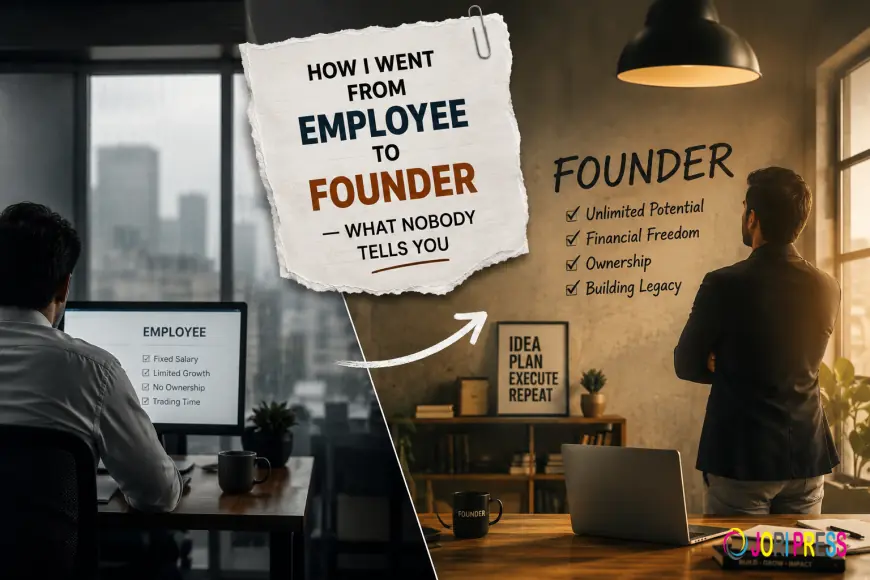
Nobody warned me about the silence.
When you're an employee, your day has structure. Someone else sets the priorities. There are meetings to attend, targets handed down from above, a team around you, a manager who tells you when something is good enough. The feedback loop is tight. You always know where you stand.
The day you become a founder, all of that disappears.
No one is setting your priorities. No one is telling you what to work on first. No one is measuring your performance against a rubric someone else designed. It's just you, a blank calendar, and an idea you believe in — and the terrifying freedom of having to figure out everything yourself.
That silence, in the early days, is the hardest thing to get used to. Not the financial uncertainty. Not the long hours. The silence.
The Skills That Got You Here Won't Get You There
I spent years getting really good at marketing — enough to eventually call myself a Growth Architect. I understood campaigns, I understood data, I understood how to build an audience and move people through a funnel. Those skills got me recognition, promotions, and eventually the confidence to think I could build something of my own.
What I didn't realize was that being a great marketer and being a founder who runs a marketing business are almost completely different jobs.
As an employee, your job is to be excellent at one thing. As a founder, your job is to be adequate at everything — legal, finance, hiring, sales, operations, client management, product development — while also being excellent at the one thing that makes your business worth building.
The shift is disorienting. I remember sitting in the early weeks of building Connective9 Media Labs, spending an entire morning trying to figure out how to invoice a client correctly, then an afternoon writing a proposal, then an evening answering emails I didn't have an assistant to filter anymore. By the time I got to the actual work — the marketing strategy I was supposed to be delivering — I was exhausted from everything else.
Nobody tells you that founding a company means spending a significant portion of your time doing things you're not particularly good at, at least in the beginning.
You Will Question Yourself More Than You Expected
Here's something that surprised me about becoming a founder — the self-doubt doesn't go away when you start succeeding. It changes shape.
In the beginning, you doubt whether the idea is good enough. Whether anyone will pay for it. Whether you're the right person to build it.
Then you get your first client and those doubts quiet down. But new ones appear. Can I deliver what I promised? Can I do this consistently? What happens if I lose this client?
Then you build a team and the doubts shift again. Am I leading them well? Are they growing? Am I making the right calls?
I used to think the confidence would come with the wins. And it does, partially. But the honest truth is that the self-doubt never fully goes away — it just becomes more sophisticated. You get better at sitting with it, at making decisions in spite of it, at not letting it paralyze you. But anyone who tells you they built a business without significant periods of genuine uncertainty is either remembering wrong or not telling you the full story.
Relationships Change — Whether You Want Them To or Not
This is the one nobody talks about enough.
When you leave a job to start something, the people around you will react in ways you didn't predict. Some will be genuinely excited and supportive. Some will be quietly skeptical but polite about it. Some will distance themselves in ways that are hard to explain — maybe because your risk-taking makes them uncomfortable, maybe because the dynamic shifts when you're no longer a peer in the same structure.
The friendships that survive the transition to founder life are usually the ones built on genuine mutual respect rather than shared circumstance. The ones that don't survive often weren't as solid as they seemed when you were all in the same building, attending the same meetings, complaining about the same things.
You'll also find unexpected community in places you didn't look for it — other founders who understand the experience in a way employees genuinely can't, mentors who appear at the right moment, clients who become genuine relationships.
The social landscape of being a founder is different from being an employee. Not worse, in my experience. But different in ways you have to adjust to.
The Money Conversation Nobody Has Honestly
Every piece of content about entrepreneurship either glosses over the financial reality or dramatizes it into something cinematic. Let me try to be straightforward.
The early days are financially uncomfortable for almost everyone. Even if you've saved well, even if you have some clients lined up, there is a period where the income is uncertain and the expenses are real and you are aware of both in a way you never were as an employee.
What I wasn't prepared for was how much mental energy that uncertainty would consume. Not the money itself — the uncertainty about the money. The not knowing whether next month would be fine or difficult. The psychological weight of that not-knowing sits in the background of every decision you make, every hire you consider, every investment you contemplate.
The way through it, in my experience, isn't to make the uncertainty go away — you can't, not in the early stages. It's to get comfortable enough with it that it doesn't distort your decision-making. To make peace with the fact that this discomfort is the price of building something, and that it gets more manageable as your business gets more stable.
What I Wish Someone Had Told Me
If I could sit down with myself on the day I decided to start Connective9 and say a few things, here's what I'd say.
The first year will be harder than you think and more educational than anything you've ever done. Don't try to skip it or shortcut it. The lessons in it are the foundation everything else is built on.
Find other founders to talk to — not to compare, but to reality-check. The experience of building something is genuinely hard to understand from the outside, and having people around you who are in it makes the hard moments more bearable.
Build slowly enough to do it right. The temptation to say yes to everything in the early days is real, because every opportunity feels precious. But saying yes to the wrong things early creates problems that compound. Being selective, even when it's scary, protects the quality of what you're building.
And finally — the identity shift is real and it takes time. You will go from being someone who works for a company to being someone who is building one. That change, at a fundamental level, changes how you see yourself, how you make decisions, and what you think is possible. Give yourself the time to make that shift fully. It doesn't happen overnight.
What's Your Reaction?
 Like
0
Like
0
 Dislike
0
Dislike
0
 Love
0
Love
0
 Funny
0
Funny
0
 Angry
0
Angry
0
 Sad
0
Sad
0
 Wow
0
Wow
0