


































How AR VR Safety Training Can Make Industrial EHS Learning More Practical
Explore how AR VR safety training helps industrial workers practise hazard recognition, emergency response and workplace safety through immersive simulations.
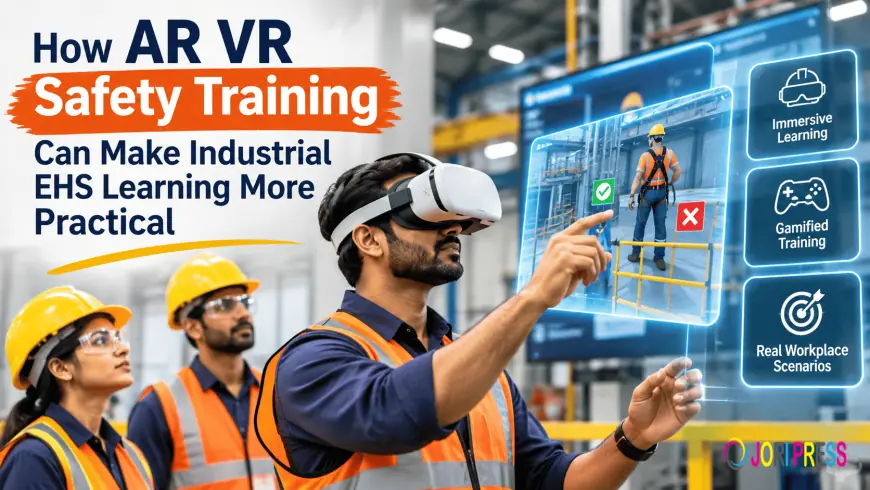
A worker may know that working at height requires proper precautions. But what happens when the work area changes, an unsafe condition appears or a job does not go as planned? Knowing a safety rule and applying it in the right situation are two different things.
This is one of the challenges with conventional EHS training. Employees may understand a topic during a classroom session, but they do not always get an opportunity to practise how they would respond to a realistic workplace situation.
AR VR safety training offers another way to approach this gap. It allows workers to explore simulated workplace conditions, recognise hazards and practise decisions in a controlled learning environment before encountering similar situations on site.
What Makes AR and VR Useful for EHS Training?
Virtual Reality (VR) places participants inside a computer-generated environment. They can look around, interact with a simulated workplace and respond to situations designed around specific job risks.
Augmented Reality (AR), on the other hand, adds digital information or visual guidance to a view of the real environment. Both technologies can support training, but their use depends on the task, learning objective and workplace requirements.
For example, virtual reality safety training solutions can help workers practise identifying hazards around machinery, navigating a simulated work area or responding to an emergency scenario without deliberately creating that hazardous condition in a live workplace.
The purpose is not to make training look technologically advanced. It is to give employees an opportunity to understand what a hazard looks like and consider what action should follow.
Where Can VR-Based EHS Training Be Used?
Different industries face different safety challenges, so training scenarios should reflect actual workplace activities.
-
Construction and infrastructure: Workers can practise recognising work-at-height risks, unsafe equipment handling and site hazards.
-
Manufacturing: Simulations can introduce machine safety, process-related risks and emergency response situations.
-
Oil and gas: Scenarios involving fire hazards, leaks and high-risk work conditions can be explored in a controlled environment.
-
Warehousing and logistics: Employees can practise identifying material-handling risks, movement hazards and unsafe operational practices.
This is where VR based EHS training becomes relevant. Instead of giving every employee the same generic scenario, organisations can select learning situations based on job roles and the risks present at their facilities.
Can Gamification Make VR Safety Training More Effective?
It can make participation more active, especially when the activity requires employees to think and make decisions rather than simply watch a demonstration.
Consider a simple hazard-identification exercise. A worker enters a simulated factory area and has to identify unsafe conditions before proceeding. The next activity might ask the participant to choose the appropriate control measure or arrange the correct sequence of safety steps.
This is where gamification can be introduced through:
-
Hazard-spotting challenges.
-
Scenario-based quizzes.
-
Safety decision-making tasks.
-
Team challenges and knowledge checks.
-
Feedback based on the accuracy of selected actions.
Good gamification should reward correct decisions and understanding, not simply the fastest response. Otherwise, participants may focus on completing the game instead of learning the safety procedure.
Interactive safety training with VR can combine these activities with realistic situations, making employees active participants in the learning process. Quizzes and activity-based exercises can also reinforce the learning after the simulation.
What Should Companies Check Before Introducing Digital Safety Simulations?
Buying VR equipment is not the first step. Organisations should identify which training problem they want to address.
A useful programme should consider the following:
-
Workplace relevance: Are the scenarios connected to actual hazards and job responsibilities?
-
Learning objective: Is the employee expected to recognise a hazard, follow a procedure or make an emergency decision?
-
Practical assessment: Can the organisation check whether participants understood the correct response?
-
Workforce suitability: Can employees comfortably use the equipment and understand the instructions?
-
Follow-up: Is there a plan to reinforce the learning through toolbox talks, demonstrations and workplace observation?
These checks matter when selecting industrial AR VR training solutions. A realistic simulation is useful only when it teaches something employees can apply to their work.
Does VR Replace Traditional Safety Training?
No. Workplace safety training using VR should complement existing EHS practices, not replace them.
Workers still need practical demonstrations, site inductions, equipment-specific instruction, toolbox talks, supervision and emergency drills wherever required. A virtual simulation cannot fully reproduce the physical conditions of operating machinery or carrying out a task on an actual site.
The learning should also be assessed beyond the simulation. Can employees identify the same hazards during a site observation? Do they understand the required procedure? Can they explain the correct response without relying on prompts from the software?
These are more meaningful questions than simply asking whether participants enjoyed the experience.
Vikaki's AR VR safety training approach includes high-risk task simulations, workplace scenario-based modules, interactive learning and practical safety assessments designed around workplace risks and job roles.
Ultimately, technology is only one part of effective EHS training. Its real value comes from helping employees recognise risks, think through their decisions and carry that understanding back to the workplace.
(For More: Vikaki.com)
Frequently Asked Questions
1. What is the difference between AR and VR safety training?
VR creates a simulated environment for immersive practice, while AR adds digital information or visual guidance to the real-world environment. Both can support different workplace learning requirements.
2. Is VR-based safety training suitable for factory workers?
Yes. It can be used for learning scenarios related to machine safety, process risks, emergency actions and hazard identification, provided the modules are relevant to the factory's operations.
3. Does gamification mean turning safety training into a game?
Not exactly. Gamification uses elements such as challenges, quizzes, feedback and progress to encourage participation. The main objective should remain correct hazard recognition and safe decision-making.
What's Your Reaction?
 Like
0
 Dislike
0
 Love
0
 Funny
0
 Angry
0
 Sad
0
 Wow
0