








































GTM Engineering vs RevOps: What's the Difference?
This guide explains how GTM Engineering and RevOps differ, where they overlap, and why many high-growth companies are investing in both to accelerate revenue in 2026.
Introduction
As B2B companies continue to modernize their sales strategies, two terms are becoming increasingly common: GTM Engineering and Revenue Operations (RevOps). While they are closely related, they serve different purposes within an organization. Many businesses assume they are interchangeable because both aim to improve revenue growth and operational efficiency. However, understanding the difference is essential when building a scalable go-to-market strategy.
What Is Revenue Operations (RevOps)?
Revenue Operations, commonly known as RevOps, is a business function that aligns sales, marketing, and customer success teams under a unified revenue strategy.
Its primary goal is to improve collaboration, streamline processes, and provide accurate reporting across the customer lifecycle. Instead of operating in separate departments, RevOps creates standardized systems that help every revenue team work toward shared business goals.
Typical RevOps responsibilities include:
- CRM administration and management
- Sales forecasting
- Revenue reporting
- Pipeline analysis
- Process documentation
- Performance dashboards
- Sales and marketing alignment
RevOps focuses on operational efficiency and ensuring every revenue-generating team works from consistent data and processes.
What Is GTM Engineering?
GTM (Go-To-Market) Engineering focuses on building the technical infrastructure that powers customer acquisition and sales execution.
Rather than managing reporting and business operations, GTM Engineering designs automated workflows that connect CRM systems, enrichment platforms, AI tools, and sales engagement software.
Its goal is to reduce manual work while helping sales teams generate more qualified pipeline.
A GTM Engineer typically works on:
- Lead sourcing and enrichment
- Workflow automation
- AI-powered outreach
- Intent data integration
- CRM automation
- Sales tool integrations
- Prospect qualification
Instead of managing revenue processes, GTM Engineering builds systems that make those processes faster and more scalable.
GTM Engineering vs RevOps: Key Differences
Although both functions support business growth, their responsibilities are different.
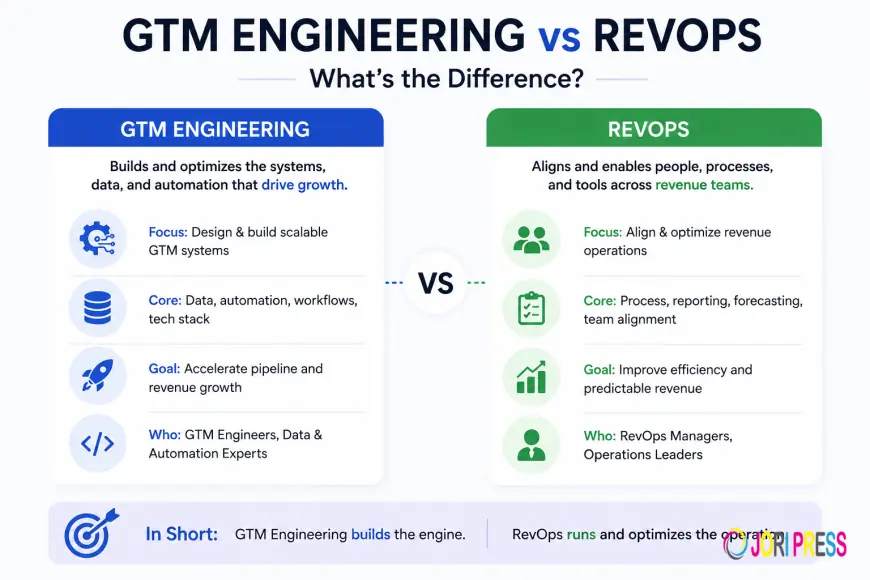
RevOps focuses on improving internal operations, reporting, forecasting, and team alignment.
GTM Engineering focuses on building automated systems that improve outbound prospecting, lead generation, and customer acquisition.
For example, a RevOps team may create a dashboard showing pipeline performance and sales conversion rates.
A GTM Engineer, on the other hand, builds the automated workflow that collects lead data, enriches contacts, triggers outreach campaigns, and updates the CRM automatically.
In simple terms:
- RevOps manages the revenue process.
- GTM Engineering builds the technology behind that process.
Where GTM Engineering and RevOps Work Together
Despite their differences, these functions complement each other.
RevOps provides the structure, reporting, and operational strategy that supports revenue growth.
GTM Engineering builds the automation and integrations needed to execute that strategy efficiently.
For example, marketing may generate inbound leads, GTM Engineering automatically enriches and routes those leads, while RevOps measures conversion rates and identifies opportunities for improvement.
When both teams work together, businesses benefit from cleaner data, faster workflows, and more accurate reporting.
Which One Does Your Business Need?
The answer depends on your stage of growth.
Early-stage startups often benefit more from GTM Engineering because they need efficient lead generation systems without hiring large sales teams.
Growing businesses with multiple revenue departments may prioritize RevOps to improve forecasting, reporting, and collaboration.
Many scaling SaaS companies eventually adopt both functions because they solve different business challenges.
If your biggest problem is manual prospecting, disconnected tools, or inefficient outbound campaigns, GTM Engineering will likely deliver the fastest impact.
If your challenge is inconsistent reporting, poor sales forecasting, or misalignment between departments, RevOps should become a priority.
Why Companies Are Investing in Both
Modern B2B organizations recognize that automation alone is not enough, and reporting without automation also has limitations.
By combining GTM Engineering with RevOps, businesses can:
- Improve sales productivity
- Build scalable outbound systems
- Maintain accurate CRM data
- Automate repetitive workflows
- Align sales, marketing, and customer success
- Make better revenue decisions using reliable data
Together, these functions create a complete revenue engine capable of supporting long-term business growth.
Conclusion
Although GTM Engineering and RevOps share the common goal of improving business growth, they solve different problems. RevOps focuses on operational alignment, reporting, and revenue management, while GTM Engineering builds the automated systems that power modern customer acquisition.
As B2B companies continue adopting AI, automation, and data-driven sales strategies in 2026, the relationship between these two functions will become even more important. Businesses that combine the operational discipline of RevOps with the technical capabilities of GTM Engineering will be better positioned to generate predictable pipeline, improve efficiency, and scale revenue successfully in an increasingly competitive market.
What's Your Reaction?
 Like
0
Like
0
 Dislike
0
Dislike
0
 Love
0
Love
0
 Funny
0
Funny
0
 Angry
0
Angry
0
 Sad
0
Sad
0
 Wow
0
Wow
0