




























From Raw Sensor Streams to Robot Intelligence: Understanding the Data Pipeline
Transform raw sensor streams into robot intelligence with synchronized, annotated, and validated multimodal data pipelines. Discover how Roborax enables better robotic training data.

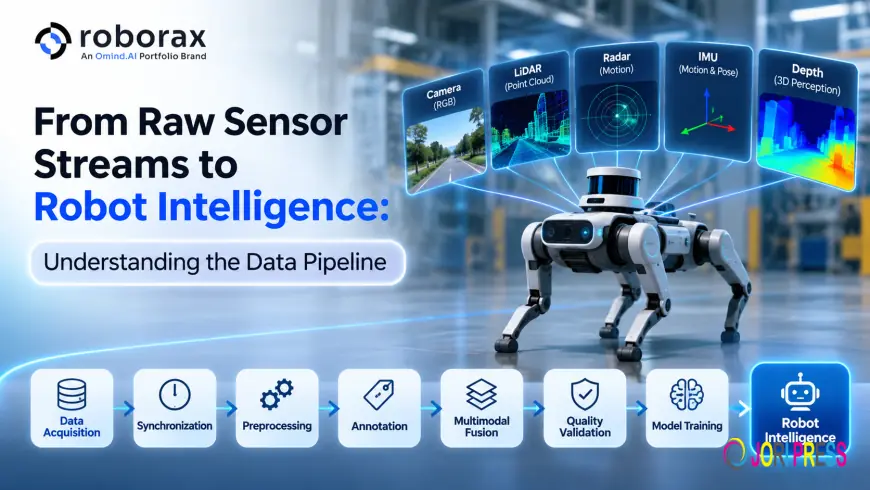
Robots are becoming increasingly capable of navigating complex environments, recognizing objects, manipulating physical items, and making autonomous decisions. However, these capabilities do not emerge from hardware or algorithms alone. Behind every intelligent robotic system is a structured data pipeline that transforms raw sensor measurements into meaningful information that machine learning models can understand and act upon.
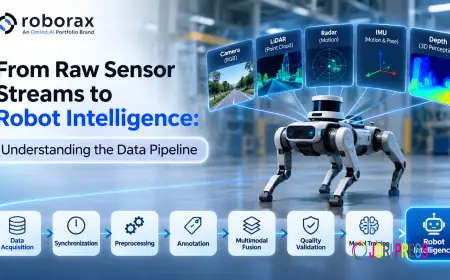
From cameras and LiDAR sensors to radar, IMUs, and force-torque sensors, modern robots continuously generate large volumes of multimodal data. Turning these raw streams into reliable robotic training data requires several interconnected processes, including data acquisition, synchronization, preprocessing, annotation, validation, and model training.
Understanding this pipeline is essential for robotics developers building perception systems, autonomous navigation solutions, and next-generation Physical AI applications.
1. Data Acquisition: Capturing the Physical World
The robotics data pipeline begins with sensor acquisition. Robots use multiple sensors to observe their surroundings, understand their position, detect obstacles, and interact with objects.
Common data sources include:
-
RGB Cameras: Capture visual information for object detection, classification, and scene understanding.
-
LiDAR Sensors: Generate three-dimensional point clouds for spatial mapping and obstacle detection.
-
Radar Sensors: Measure object distance and relative velocity, particularly in challenging visibility conditions.
-
IMUs: Record acceleration and angular velocity to support motion tracking and orientation estimation.
-
Depth Sensors: Provide distance information for spatial awareness and robotic manipulation.
-
Force-Torque Sensors: Capture physical interaction data during gripping, lifting, and manipulation tasks.
Each sensor produces data in different formats, frequencies, resolutions, and coordinate systems. Consequently, effective Multimodal Sensor Capture for Robotics requires standardized acquisition protocols that preserve the relationship between different sensor streams.
Without consistent data collection, downstream processing and model development can become significantly more complicated.
2. Data Synchronization: Connecting Multiple Sensor Streams
A robot may capture camera frames at 30 frames per second while its IMU records measurements at hundreds of samples per second. LiDAR and radar sensors may operate at entirely different frequencies.
These differences create synchronization challenges.
For a robot to understand an event accurately, its sensor measurements must represent the same moment or a precisely defined time interval. For example, when a robotic vehicle detects a moving pedestrian, its camera image, LiDAR point cloud, and radar measurements should correspond closely in time.
Synchronization typically involves:
-
Timestamp standardization across sensors.
-
Hardware or software clock alignment.
-
Temporal calibration and offset correction.
-
Frame-level and sequence-level data association.
-
Handling missing or delayed sensor measurements.
Accurate synchronization allows perception systems to combine information from multiple sources without introducing misleading spatial or temporal relationships.
This stage is particularly important for autonomous robots operating in dynamic environments.
3. Data Preprocessing: Transforming Raw Measurements
Raw sensor streams are rarely suitable for direct use in machine learning pipelines. They may contain noise, incomplete measurements, redundant information, and inconsistencies.
Preprocessing converts these unstructured or partially structured inputs into cleaner, model-ready datasets.
Typical preprocessing activities include:
Noise Reduction: Filtering unwanted signals from camera, LiDAR, radar, and inertial measurements.
Data Cleaning: Identifying corrupted frames, incomplete recordings, duplicate samples, and invalid sensor readings.
Normalization: Standardizing numerical ranges, measurement units, and data representations.
Coordinate Transformation: Converting sensor measurements into common reference frames to support accurate spatial interpretation.
Data Segmentation: Dividing continuous recordings into meaningful sequences, events, or task-specific segments.
For example, a warehouse robot's recording may contain thousands of frames covering navigation, obstacle avoidance, and object manipulation. Segmenting these recordings into task-specific sequences makes the resulting datasets more useful for targeted model training.
Effective preprocessing improves data consistency and reduces the likelihood of models learning from irrelevant or misleading information.
4. Data Annotation: Adding Meaning to Sensor Information
Although preprocessing improves data quality, robots still need meaningful labels to learn how to interpret their surroundings.
This is where data annotation becomes essential.
Annotation transforms raw sensor measurements into structured information that machine learning algorithms can use during supervised learning, evaluation, and perception development.
Depending on the robotic application, annotation may include:
-
2D bounding boxes for identifying objects in camera images.
-
3D bounding boxes for detecting objects in LiDAR point clouds.
-
Semantic segmentation for distinguishing roads, obstacles, pedestrians, and environmental surfaces.
-
Object tracking for maintaining identities across consecutive frames.
-
Pose estimation for understanding object orientation and movement.
-
Action and event labeling for identifying robotic activities and interactions.
-
Sensor-level labeling for identifying anomalies, missing signals, and measurement inconsistencies.
For example, a robotic arm learning to pick objects must understand object boundaries, grasp locations, spatial orientation, and interaction outcomes.
High-quality annotation ensures that these relationships are represented consistently across the training dataset.
Roborax supports robotics data workflows through structured annotation and multimodal data preparation, helping robotics teams develop datasets aligned with their specific perception and learning requirements.
5. Multimodal Data Fusion: Building a Unified Representation
Once individual sensor streams have been synchronized, processed, and annotated, they can be integrated into a unified representation.
Multimodal data fusion enables robots to combine complementary information from different sensors.
For instance, cameras provide rich visual details, while LiDAR contributes accurate depth measurements. Radar provides information about moving objects, and IMUs help estimate the robot's motion.
Combining these sources helps address the limitations of individual sensors.
Common fusion approaches include:
-
Early Fusion: Combining raw or minimally processed sensor data before feature extraction.
-
Intermediate Fusion: Integrating learned features extracted independently from different modalities.
-
Late Fusion: Combining predictions generated by separate sensor-specific models.
The appropriate approach depends on the robot's operating environment, computational resources, latency requirements, and perception objectives.
Well-organized multimodal datasets make it easier to train and evaluate fusion models under different operating conditions.
6. Dataset Validation and Quality Assurance
Even sophisticated data pipelines can produce unreliable datasets if quality assurance is overlooked.
Annotation inconsistencies, incorrect timestamps, missing sensor readings, and mislabeled objects can negatively affect model performance.
A structured quality assurance process should evaluate:
-
Annotation Accuracy: Whether object labels, boundaries, classifications, and tracking information are correct.
-
Temporal Consistency: Whether events and object identities remain consistent across sequential frames.
-
Sensor Alignment: Whether different modalities represent corresponding observations.
-
Data Completeness: Whether essential sensor measurements are available throughout the recording.
-
Dataset Diversity: Whether the data covers different environments, lighting conditions, object types, and operating scenarios.
Quality checks should be conducted throughout the pipeline rather than being restricted to the final dataset.
This approach helps identify problems early and reduces the cost of correcting errors during model development.
7. Model Training and Continuous Improvement
After validation, the prepared datasets can be used to train robotic perception, navigation, manipulation, and decision-making models.
Depending on the application, robotic training data may support supervised learning, imitation learning, reinforcement learning, and multimodal foundation model development.
For example, autonomous mobile robots can learn obstacle detection and navigation using synchronized camera and LiDAR recordings. Robotic manipulation systems can learn object handling through demonstrations containing visual, positional, and force-related information.
However, the pipeline does not end when a model is trained.
Models must be evaluated against unseen scenarios and real-world operating conditions. Their failures can reveal gaps in the original datasets, such as insufficient examples of unusual objects, unexpected movements, poor lighting, or sensor degradation.
These findings can guide additional data collection, annotation, and model refinement.
This continuous feedback loop makes the robotics data pipeline an evolving process rather than a one-time activity.
Conclusion: Building Intelligence Through Better Data Pipelines
Transforming raw sensor streams into robot intelligence requires more than collecting large volumes of data. It demands a systematic approach to acquisition, synchronization, preprocessing, annotation, multimodal fusion, validation, and model training.
Every stage contributes to the reliability of the final robotic system. Inconsistent timestamps, poor-quality annotations, incomplete recordings, or inadequate dataset diversity can undermine even advanced machine learning architectures.
As robotics and Physical AI continue to evolve, Multimodal Sensor Capture for Robotics will remain an important foundation for developing reliable perception and decision-making capabilities.
At Roborax, we help robotics teams strengthen their data foundations through robotics data collection, multimodal sensor capture, and structured annotation workflows. By transforming complex sensor recordings into organized, high-quality robotic training data, we support the development of intelligent robotic systems designed for real-world environments.
Build smarter robots with better data. Partner with Roborax to transform raw sensor streams into actionable robotic intelligence.
What's Your Reaction?
 Like
0
 Dislike
0
 Love
0
 Funny
0
 Angry
0
 Sad
0
 Wow
0