































From Food Truck to Pizza Trailer: Why Entrepreneurs Are Making the Switch
Food truck owners are increasingly switching to pizza trailers. Here's why the economics, throughput, and events-circuit demand are driving the shift and what operators give up in the trade.

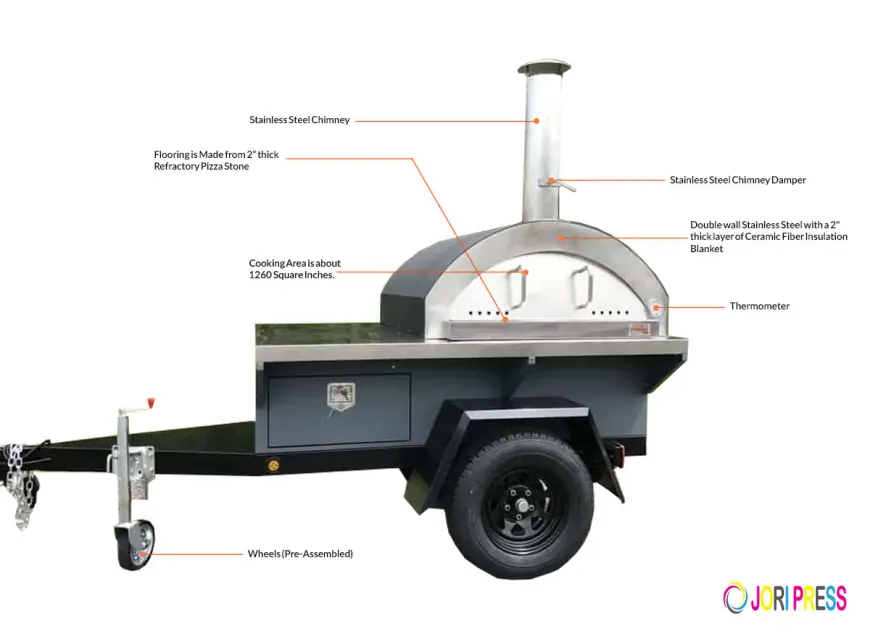
For most of the last two decades, the food truck was the default entry point into mobile food service. It was the symbol of the modern street-food entrepreneur cheap-ish to start, flexible, parked outside breweries and office parks, feeding the lunch rush. But quietly, over the past few years, a different vehicle has been pulling up to festivals, weddings, and weekend markets: the pizza trailer. And increasingly, the people behind the wheel are the same ones who used to run food trucks.
This shift isn't just a trend piece waiting to happen. It's a genuine change in how small food businesses are being built, and it says a lot about what's actually working and what isn't in mobile food service right now.
Table of Contents
- The Food Truck Model Has a Ceiling
- What a Pizza Trailer Actually Solves
- The Economics Nobody Talks About
- One Product, Infinite Margins
- The Events Circuit Changed the Math
- It's Not All Upside
- What This Shift Says About the Industry
- Frequently Asked Questions
The Food Truck Model Has a Ceiling
Food trucks made sense when the goal was maximum menu flexibility in a single footprint. Tacos, burgers, fusion bowls, coffee the truck format could, in theory, do almost anything. That flexibility was also its biggest constraint. A truck kitchen has to accommodate multiple cooking stations, multiple prep zones, and multiple types of equipment, all crammed into 200 square feet or less. Menus get trimmed not because customers want fewer choices, but because there's nowhere left to put another burner.
There's also the truck itself. A retrofitted truck is a truck first and a kitchen second — the chassis, the drivetrain, the fuel costs, and the maintenance headaches all belong to a vehicle that was never designed to be a commercial kitchen in the first place. When something breaks, it's rarely just the espresso machine or the fryer. It's the vehicle.
Enter the trailer. Pull it, park it, unhitch it, and the truck the actual vehicle goes back to being an ordinary truck. It can pick up supplies, run errands, or simply not be sitting idle at a job site burning depreciation while the kitchen isn't in use.
What a Pizza Trailer Actually Solves
The appeal isn't just "trailer instead of truck." It's what a trailer is being built around. Pizza, more than almost any other street food, rewards a single-purpose setup. One dough station. One topping line. One oven doing the actual work. There's no six-burner range, no deep fryer, no grill top competing for space just a compact, high-output workflow built around one product cooked one way.
That single-purpose design means a pizza trailer can be smaller, lighter, and cheaper to build out than a comparable food truck, while still producing far more units per hour. A two-person crew working a well-laid-out pizza trailer can realistically turn out 60 to 100 pizzas in a busy two-hour window a throughput that would require a much larger, much more expensive truck kitchen running a varied menu.
The Economics Nobody Talks About
Ask former food truck owners why they made the switch, and the conversation rarely starts with flavor or concept. It starts with spreadsheets.
Trucks depreciate like vehicles because they are vehicles. Engine wear, transmission issues, and routine maintenance eat into margins in ways that rarely show up in the initial business plan. A trailer, by contrast, largely depreciates like equipment slower, more predictably, and without the looming threat of an engine repair bill wiping out a month of profit.
Insurance tends to follow a similar pattern. Commercial auto policies for a truck-based kitchen are typically priced against the vehicle and the equipment inside it. A trailer, especially one that's towed by a separate, insurable vehicle, can sometimes be written up more like commercial equipment than a commercial vehicle which changes the math for a lot of first-time operators trying to get a policy that doesn't eat their entire margin before they've sold a single pizza.
None of this means trailers are automatically cheaper across the board. Startup costs vary widely depending on build quality, oven type, and customization. But the ongoing cost structure maintenance, insurance, depreciation tends to be more forgiving, which matters enormously for a business type where most failures happen in year one or two, not because the food was bad, but because the operating costs quietly outpaced revenue.
One Product, Infinite Margins
There's a reason so many chefs describe pizza as "the ultimate high-margin street food," and it comes down to ingredient cost versus perceived value. Flour, water, salt, and yeast are inexpensive. Cheese and toppings, bought in volume, stay inexpensive. And yet a well-made 12-inch pizza commands a price point that a customer will happily pay at a festival or brewery without blinking, because the format itself signals craft the visible dough-stretching, the open flame, the char on the crust.
Compare that to a food truck menu with five or six items, each requiring its own ingredient inventory, its own prep time, and its own food-safety considerations. The complexity that once looked like a strength "we can make anything" becomes an operational liability when a single, well-executed product can outperform it on both speed and margin.
The Events Circuit Changed the Math
Part of this shift also has to do with where mobile food businesses are actually making money. Daily street parking and lunch-rush foot traffic the bread and butter of the early food truck boom have gotten more competitive, more regulated, and in many cities, harder to permit for. Meanwhile, the private events circuit weddings, corporate parties, breweries, wineries, and neighborhood festivals has exploded, and it rewards exactly the kind of setup a pizza trailer offers: something visually compelling, fast enough to serve a crowd, and simple enough to run with a lean crew.
A live-fire pizza setup, in particular, doubles as entertainment. Guests gather around it. It photographs well. Event planners have started treating it less like catering and more like a feature of the event itself which means operators can charge event-based pricing rather than competing on a per-slice basis with every other lunch option on the block.
It's Not All Upside
None of this is a universal argument that trailers are simply "better." Trucks still offer something trailers can't: menu range. An operator who wants to build a brand around variety tacos one day, bowls the next, a rotating specials board is going to hit a wall with a single-purpose pizza setup fast.
Trailers also come with their own logistical wrinkles. They require a separate tow vehicle, which means either owning two vehicles or coordinating logistics around borrowing or renting one. Not every parking situation accommodates a trailer-and-tow combination as easily as a single truck. And detaching a trailer to free up the tow vehicle only works if there's somewhere safe and legal to leave the trailer parked and unattended.
There's also a skills question. Running a proper live-fire or high-heat pizza operation is its own craft, with its own learning curve around dough handling, oven temperature management, and timing under pressure. It's not automatically easier than running a truck — it's differently difficult.
What This Shift Says About the Industry
The move from food truck to pizza trailer isn't really about pizza, or trailers, or even entrepreneurship in the abstract. It's a signal of a broader shift in how small food businesses are being built: fewer generalists trying to do everything in a cramped kitchen, more specialists building lean, repeatable operations around one thing done exceptionally well.
That's not a new idea in the restaurant world it's the same logic behind the rise of single-product brick-and-mortar concepts over the last decade. What's new is seeing it play out on wheels, in driveways and parking lots and festival fields, one dough ball at a time.
Frequently Asked Questions
Is a pizza trailer cheaper to start than a food truck?
It depends on the build, but trailers generally avoid vehicle-related costs engine maintenance, transmission repair, and higher depreciation that make truck-based kitchens more expensive to operate over time, even if the upfront purchase price is similar.
Do you need a separate vehicle to tow a pizza trailer?
Yes. A trailer needs to be hitched to a truck or SUV with adequate towing capacity, which is either a cost to plan for upfront or a logistical step to coordinate if the tow vehicle is shared with another use.
Why is pizza specifically well-suited to a trailer format?
Pizza requires a narrow, repeatable workflow dough, toppings, one oven that fits naturally into a compact space, unlike multi-item menus that need several types of cooking equipment and prep zones.
Can a pizza trailer make more money than a food truck?
It can, largely due to higher throughput per labor hour and strong margins on a low-cost product, but revenue still depends heavily on location strategy, event bookings, and execution the format alone doesn't guarantee profitability. Investing in a reliable oven, like those from ilFornino, helps operators avoid downtime that eats into that margin advantage.
What's Your Reaction?
 Like
0
Like
0
 Dislike
0
Dislike
0
 Love
0
Love
0
 Funny
0
Funny
0
 Angry
0
Angry
0
 Sad
0
Sad
0
 Wow
0
Wow
0