








































Flexible Coupling Types and Their Industrial Applications
A jaw coupling is a flexible coupling designed to connect two rotating shafts.

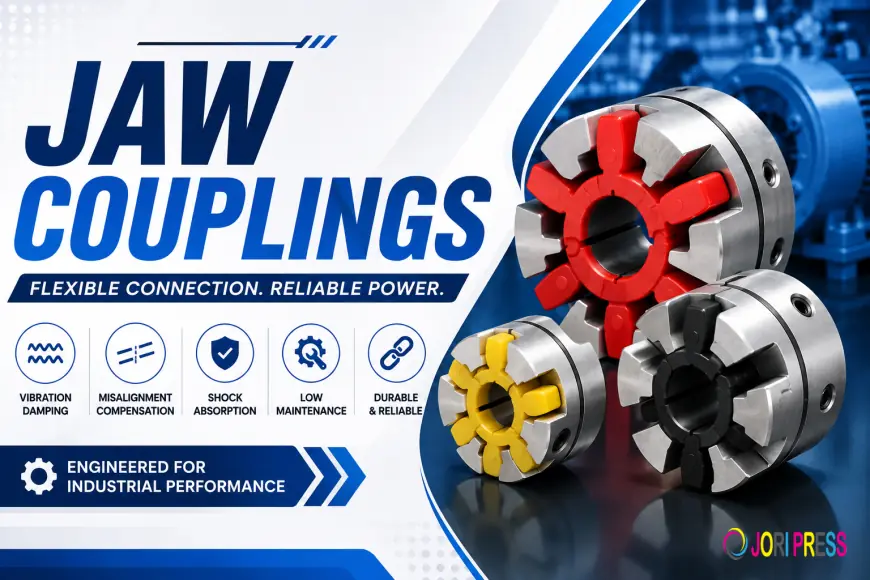
Jaw couplings are important mechanical power transmission components used to connect two shafts and transfer rotational power between them. They are commonly used in industrial machinery because they provide a practical combination of torque transmission, vibration absorption, and slight misalignment compensation. A typical jaw coupling consists of two metal hubs and an elastomer insert known as a spider positioned between the jaws.
The spider provides flexibility between the two hubs while the metal components transmit rotational force. This construction allows the coupling to absorb shocks and vibrations while maintaining a dependable connection between the driving and driven shafts. Jaw couplings are used in pumps, compressors, conveyors, printing machinery, textile equipment, automotive systems, food-grade machinery, and custom OEM applications.
What Is a Jaw Coupling?
A jaw coupling is a flexible coupling designed to connect two rotating shafts. Its primary purpose is to transmit torque while helping accommodate small amounts of shaft misalignment and reducing vibration.
The main components are two metal hubs and an elastomeric spider. The hubs have jaw-like extensions that fit around the spider. When the driving shaft rotates, the first hub transfers torque through the flexible spider to the second hub and the connected shaft.
This simple construction makes jaw couplings useful for many industrial drive systems. The elastomeric spider also acts as a cushion between the metal hubs, helping absorb shocks generated during machine operation.
How Do Jaw Couplings Work?
The operation of a jaw coupling is based on the interaction between the metal hubs and the flexible spider. One hub is attached to the driving shaft, while the other is attached to the driven shaft.
When the motor or other power source rotates the first shaft, its hub transfers the rotational force to the elastomer spider. The spider then transfers that force to the second hub and driven shaft.
Because the spider is flexible, it can absorb certain shocks and vibrations during operation. It can also accommodate slight angular, radial, and axial misalignments between the shafts.
This combination of flexibility and torque transmission helps protect connected machine components and supports smoother equipment operation.
Types of Jaw Couplings
Different machinery requirements call for different coupling designs. DeePee Rubber offers several types of jaw couplings for different operating conditions.
L Type Coupling
The L Type coupling is a standard jaw coupling intended for general-purpose machinery. It provides a straightforward connection between shafts while using an elastomeric spider to provide flexibility and vibration damping.
AL Type Coupling
The AL Type coupling is a lightweight aluminum option. Its reduced rotational mass can make it suitable for applications where lightweight construction is desirable.
SS Type Coupling
The SS Type coupling is manufactured using stainless steel and is designed for applications where corrosion resistance is important. It can also be suitable for certain food-grade machinery applications.
Curved Jaw Coupling
Curved jaw couplings are designed to provide smooth torque transmission and vibration damping. Their design can be suitable for machinery requiring dependable flexible power transmission.
Flexible Jaw Coupling
Flexible jaw couplings are designed to accommodate dynamic loads while transferring torque between shafts. Their flexible construction makes them suitable for rotating equipment.
Spider Coupling
Spider couplings use an elastomeric spider between the two hubs. Different spider materials and flexibility levels can be selected depending on torque, operating conditions, and application requirements.
Low Jaw Coupling
Low jaw couplings provide compact coupling solutions for equipment where installation space is restricted.
LC Type Coupling
LC configurations can be customized according to factors such as load, shaft dimensions, and alignment requirements.
Benefits of Jaw Couplings
Jaw couplings provide several advantages for industrial power transmission systems.
Vibration Absorption
The elastomeric spider absorbs shocks and vibrations generated during machine operation. This can help reduce the transmission of vibration to motors, bearings, shafts, and other connected components.
Misalignment Compensation
Shafts may not remain perfectly aligned during operation. Flexible jaw couplings can accommodate slight angular, radial, and axial misalignment, helping reduce additional stress on connected machinery.
Easy Installation
Jaw couplings have a relatively simple construction and do not require lubrication. This can make installation and routine maintenance easier compared with more complex coupling arrangements.
Compact Design
The compact construction of a jaw coupling allows it to fit into machinery where available installation space is limited.
Low Maintenance
The simple design and absence of required lubrication can help simplify maintenance. However, the elastomeric spider should still be inspected periodically for wear or damage.
Customization
Jaw couplings are available in different sizes, materials, configurations, and spider options. This allows the coupling to be selected according to the requirements of specific equipment.
Applications of Jaw Couplings
Jaw couplings are used in many industries where reliable shaft connection and flexible power transmission are required.
Textile Machinery
Textile equipment contains multiple rotating components that require consistent power transmission. Flexible couplings can help reduce vibration and accommodate minor alignment variations.
Conveyors and Packaging Systems
Conveyor and packaging equipment often operates continuously. A suitable coupling can help transmit power between motors and driven components while reducing shock transmission.
Printing Machines
Printing equipment requires controlled and consistent rotary movement. Flexible shaft connections can contribute to smoother machine operation.
Pumps and Compressors
Pumps and compressors depend on reliable connections between motors and driven shafts. Jaw couplings can transmit torque while helping manage vibration and slight misalignment.
Automotive Power Systems
Automotive and related power transmission systems can use flexible couplings to connect rotating components and manage dynamic loads.
Food-Grade Machinery
Stainless-steel jaw coupling configurations can be suitable for certain food-processing equipment where corrosion resistance and appropriate material selection are important.
Custom OEM Systems
Jaw couplings can also be incorporated into custom original equipment manufacturer systems where specific shaft sizes, torque requirements, and alignment conditions need to be considered.
Coupling Spider Materials
The elastomeric spider is a critical part of the coupling because it provides flexibility between the two hubs. Different spider materials can provide different performance characteristics.
Common materials used for coupling spiders include rubber, polyurethane, and other elastomers. DeePee Rubber's coupling information highlights rubber, polyurethane, and elastomer options for different coupling requirements.
Rubber spiders can provide flexibility for suitable applications, while polyurethane can offer increased wear resistance for applications with greater mechanical demands. The correct material should be selected according to the machine's torque, speed, temperature, and operating environment.
How to Select the Right Jaw Coupling
Choosing the correct jaw coupling requires consideration of several technical factors.
Torque
The coupling must be capable of handling the torque generated by the motor and driven equipment. Selecting a coupling that is too small can lead to excessive deformation or premature failure.
Shaft Size
The bore size of the coupling hubs must match the connected shafts. Keyways and other mounting requirements should also be considered.
Operating Speed
Rotational speed affects coupling performance. High-speed applications may require appropriate coupling sizing and balanced components.
Misalignment
Determine the expected angular, radial, and axial misalignment before selecting a flexible coupling.
Environment
Temperature, moisture, chemicals, dust, and other environmental conditions can affect the elastomer spider and metal hubs.
Spider Material
The correct spider material and hardness should match the application. A suitable spider can provide the required combination of flexibility, torque capacity, and vibration damping.
Jaw Coupling Maintenance
Although jaw couplings are designed for relatively simple maintenance, regular inspection is important. The spider should be checked for cracks, deformation, hardening, excessive wear, or other visible damage.
Shaft alignment should also be checked periodically. Excessive misalignment can place additional stress on the spider and reduce its service life.
The coupling hubs and fasteners should be inspected according to the equipment requirements. If the spider becomes worn or damaged, replacing it promptly can help prevent further damage to the coupling and connected machinery.
Proper installation is equally important. Correct shaft insertion, alignment, tightening, and component selection can contribute to reliable coupling performance.
Why Quality Matters
The performance of a jaw coupling depends on both the metal hubs and the elastomeric spider. Precision-machined hubs help provide accurate shaft connections, while a high-quality spider supports consistent torque transmission and vibration damping.
DeePee Rubber states that its jaw coupling range is manufactured in different materials and configurations, including aluminum, steel, stainless steel, and elastomeric spiders with different hardness levels. The company also highlights customization based on drawings, specifications, or samples.
Choosing a coupling from an experienced manufacturer can therefore help industries obtain products suited to their specific shaft, load, and operating requirements.
Conclusion
Jaw couplings are versatile flexible power transmission components that connect rotating shafts while helping absorb vibration, accommodate slight misalignment, and transmit torque efficiently. Their simple construction, consisting of two metal hubs and an elastomeric spider, makes them suitable for many industrial applications.
Different designs such as L Type, AL Type, SS Type, curved jaw, flexible jaw, spider, low jaw, and LC configurations provide options for different equipment requirements.
When selecting a jaw coupling, businesses should consider torque, shaft dimensions, rotational speed, misalignment, operating environment, and spider material. Regular inspection and correct installation can further improve service life.
For pumps, compressors, conveyors, textile machinery, printing equipment, automotive systems, food-grade machinery, and custom OEM applications, the right coupling can contribute to smoother operation, reduced vibration, better power transmission, and dependable machine performance.
What's Your Reaction?
 Like
0
Like
0
 Dislike
0
Dislike
0
 Love
0
Love
0
 Funny
0
Funny
0
 Angry
0
Angry
0
 Sad
0
Sad
0
 Wow
0
Wow
0