






































Coin vs Token: The $50K Mistake Most Startups Make in Crypto Development
Confused about coin vs token? Discover the real $50K mistake startups make in cryptocurrency development, plus honest costs, process, and vendor tips.

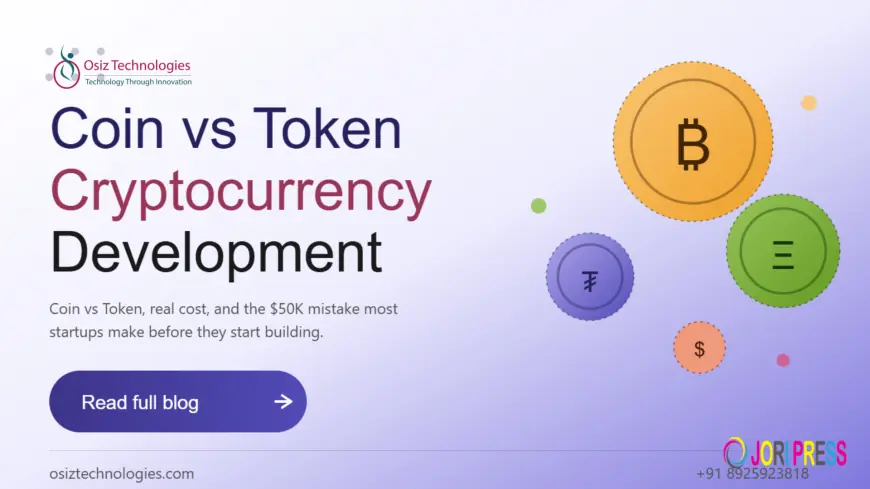
If you've started looking into cryptocurrency development for your startup, you've probably already hit your first wall: should you build a coin or a token? It sounds like a small technical detail. It isn't. Founders who get this wrong early often end up rebuilding their entire project from scratch months later, and that rebuild is usually where the real money disappears.
This one decision quietly shapes your budget, your timeline, and how investors see your project which is exactly why getting Cryptocurrency Development right from day one matters more than most founders expect.
Here's why this confusion happens, where startups actually lose money, and what realistic costs and vendor choices look like.
Coin vs Token: Why This Confuses Almost Every First-Time Founder
A coin runs on its own independent blockchain. Bitcoin is a coin. Ether is a coin. Building one means creating and maintaining an entire network consensus mechanism, nodes, security, the works. It's a massive undertaking, usually unnecessary unless your project genuinely needs its own blockchain infrastructure.
A token is built on top of an existing blockchain instead. Most startups doing Ethereum token development, for example, are issuing an ERC-20 token rather than building a new chain. It's faster, considerably cheaper, and lets you focus on what your project actually does instead of reinventing infrastructure that already exists and works.
Founders often hear "cryptocurrency" and assume they need a coin, because it sounds more legitimate, more "their own." Most startups, DeFi platforms, loyalty programs, fundraising projects only need a token. Building a coin when a token would do the job is one of the most expensive early decisions a founder can make.
Where the Money Actually Goes Missing
It rarely shows up as one big bill. It shows up in pieces, and a few patterns come up again and again:
-
Building starts before tokenomics and utility are clearly defined, so requirements shift mid-project and parts of the Smart Contract Development get redone.
-
Security audits get skipped to save money. A single unpatched vulnerability, like a reentrancy flaw, can let funds be drained after launch, at that point the cost isn't just the audit you skipped, it's the project's credibility.
-
ICO development moves ahead without legal review, and fundraising or exchange listings get blocked later because KYC/AML requirements weren't accounted for upfront.
Stack a few of these together across a project timeline and a figure like $50K in wasted spend isn't far-fetched. Not every project will hit that number - but it's a realistic outcome worth planning against, not a scare tactic.
What Real Cryptocurrency Development Costs Look Like
There's no single number that applies to every project. Anyone who quotes an exact figure without first understanding your scope should raise a flag. A few cost drivers tend to hold true across most projects though.
Building a custom coin with its own blockchain typically costs several times more than developing a token on an existing chain. Within token development, complexity drives price, a basic ERC-20 token with no custom logic costs far less than one with staking, vesting schedules, or custom transaction rules. A third-party security audit is one of the most commonly cut corners, even though it protects the rest of the investment. Compliance and legal review become necessary the moment you're planning any kind of public token sale. And post-launch costs, like exchange listing fees, often catch first-time founders off guard simply because they weren't part of the original quote.
Costs vary significantly by project scope, blockchain choice, and complexity. The points above are general guidance, not fixed quotes - confirm exact figures directly with a development partner after a proper scoping conversation.
How to Pick a Cryptocurrency Development Company Without Getting Burned
A good development partner prevents most of the mistakes above before they happen. A few things worth checking before signing anything:
-
Ask to see actual past projects, ideally with contracts you can verify on-chain, not just a portfolio page.
-
Confirm whether security audits are included or billed separately, who performs them, and whether you'll receive and own the audit report.
-
Check chain-specific experience. A team skilled in Ethereum token development isn't automatically equipped for a different blockchain with different tooling.
-
Be cautious of anyone promising a fixed, rock-bottom price before they've asked a single question about your tokenomics, use case, or compliance needs.
A company genuinely offering Crypto Token Development Services should be comfortable walking you through a past build in detail, including what went wrong and how it was handled. That kind of openness says more than any pitch deck.
Conclusion: So, Coin or Token?
Most startups don't need to reinvent blockchain infrastructure. They need a well-built, well-audited token and a development partner who asks more questions than they answer on the first call. The coin-vs-token decision, the budget, and the vendor you pick are all tied together, get the first one wrong, and it shapes everything that follows.
If you're still weighing which path fits your project, a proper scoping conversation before any contract is signed is usually what separates a clean build from a $50K lesson.
What's Your Reaction?
 Like
0
Like
0
 Dislike
0
Dislike
0
 Love
0
Love
0
 Funny
0
Funny
0
 Angry
0
Angry
0
 Sad
0
Sad
0
 Wow
0
Wow
0