






































Can Smarter Security Analytics Build a More Resilient Digital Japan?
Discover how AI-driven monitoring, integrated security platforms, and proactive threat detection are helping Japanese businesses strengthen cybersecurity and digital resilience.

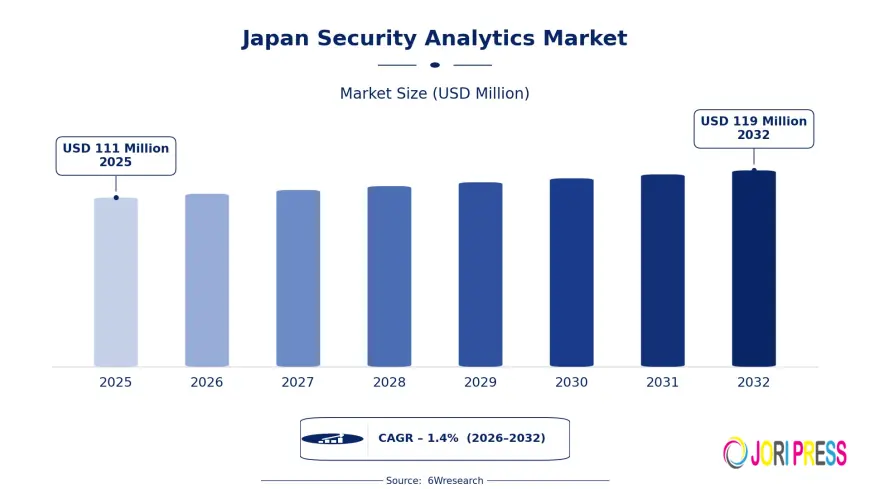
The Japan Security Analytics Market is becoming increasingly important as businesses modernize their operations, connect digital systems, and manage growing cybersecurity risks. From financial institutions and healthcare providers to telecommunications companies and manufacturers, organizations need stronger ways to identify suspicious activity, investigate incidents, and protect sensitive information. Security analytics helps transform large volumes of security data into actionable intelligence, allowing companies to make informed decisions and improve their overall cyber resilience.
Why Is Security Analytics Essential for Business Resilience?
Modern organizations operate across cloud platforms, corporate networks, employee devices, and third-party applications. Each connection can introduce vulnerabilities that conventional security tools may struggle to identify independently. Security analytics addresses this challenge by examining data from multiple sources and identifying patterns that could indicate a potential attack.
Japanese businesses can use these capabilities to improve their security operations in several ways:
-
Earlier threat detection: Analytics identifies unusual login attempts, suspicious data transfers, and abnormal network activity.
-
Improved incident investigation: Centralized security information helps teams understand the sequence of events surrounding an incident.
-
Reduced operational disruption: Faster identification of threats can help organizations limit damage and restore normal operations.
-
Better decision-making: Security teams can prioritize risks according to their potential business impact.
As digital dependency increases, these capabilities can help companies protect operational continuity while maintaining customer confidence.
How Are Different Industries Creating New Opportunities?
Demand for security analytics varies across industries, depending on the sensitivity of information handled and the complexity of their digital infrastructure.
Banking, Financial Services, and Insurance (BFSI): Financial institutions manage confidential customer records, payment transactions, and digital banking platforms. Security analytics can identify unusual transaction patterns, suspicious account access, and potential network intrusions. These capabilities complement fraud prevention and broader cybersecurity programs.
Telecommunications and IT: Telecom operators manage extensive networks and large volumes of digital traffic. Network security analytics can help identify abnormal traffic patterns, investigate potential intrusions, and strengthen monitoring across connected infrastructure.
Healthcare: Hospitals and healthcare organizations increasingly rely on electronic records, connected medical equipment, and digital administrative systems. Analytics can help detect unauthorized access and protect sensitive patient information while supporting secure service delivery.
Retail and e-commerce: Online retailers process payments, customer details, and account credentials. Security analytics can help identify suspicious access, automated attacks, and unusual activity across digital platforms.
Manufacturing and critical infrastructure: Connected equipment and industrial control systems introduce additional security considerations. Analytics can support monitoring across information technology and operational technology environments, helping organizations identify risks that could affect production.
What Role Will Artificial Intelligence Play?
Artificial intelligence and machine learning are expanding the capabilities of security analytics by helping teams examine large datasets and identify complex patterns. Instead of relying exclusively on predefined rules, analytics systems can learn from observed activity and flag deviations that deserve investigation.
Potential applications include behavioral analysis, automated alert prioritization, anomaly detection, and threat correlation. For example, a system may flag an account that accesses unfamiliar resources at an unusual time while simultaneously transferring an unexpected volume of data.
However, AI-driven security is not a complete substitute for human expertise. Poor-quality data, false positives, and incorrectly interpreted alerts can reduce effectiveness. Japanese organizations will need appropriate oversight, regular model evaluation, and clear procedures for investigating flagged incidents.
What Challenges Could Slow Market Adoption?
Despite its benefits, security analytics adoption can be difficult for organizations with limited budgets or insufficient cybersecurity expertise. Implementation may require integration with existing infrastructure, data normalization, specialist training, and continuous system maintenance.
Key challenges include:
-
High implementation costs: Advanced platforms and supporting infrastructure can create financial pressure, particularly for smaller businesses.
-
Shortage of skilled professionals: Organizations need personnel who understand cybersecurity, data analysis, and incident response.
-
Complex legacy environments: Older systems may not easily integrate with modern analytics platforms.
-
Privacy and compliance requirements: Companies must manage security information responsibly and follow applicable data protection obligations.
-
Alert fatigue: Excessive or low-priority alerts can overwhelm teams and delay responses to genuine threats.
Vendors that offer scalable deployment, straightforward integration, transparent pricing, and managed services may be better positioned to address these concerns.
Why Will Cloud-Based and Integrated Platforms Matter?
Cloud-based security analytics can provide flexibility for organizations that need to monitor distributed teams, remote users, and changing digital workloads. Depending on their security requirements, businesses can choose cloud-based, on-premises, or hybrid deployment models.
Integrated platforms also offer an opportunity to connect information from endpoint protection, network monitoring, cloud security, and identity management tools. A more unified view can help security teams investigate incidents without repeatedly switching between disconnected systems.
Nevertheless, organizations must evaluate data residency, access controls, vendor reliability, and integration requirements before selecting a deployment model. The right solution should align with business needs rather than simply follow a technology trend.
What Should Businesses Prioritize Next?
Organizations seeking to strengthen security analytics should begin by identifying their most critical assets, evaluating existing monitoring capabilities, and defining measurable security objectives. Useful performance indicators include time taken to detect incidents, response speed, false-positive rates, and the number of recurring vulnerabilities resolved.
Businesses should also invest in staff training, incident-response exercises, and collaboration between IT, security, compliance, and operational teams. These measures help ensure that analytics insights translate into practical action.
Conclusion
The Japan Security Analytics Market offers organizations an important pathway toward stronger digital resilience. Growing connectivity, complex cyber threats, and the need for reliable data protection are increasing the value of intelligent security monitoring. Although implementation costs, talent shortages, and integration challenges remain significant considerations, AI-enabled detection, integrated platforms, and scalable services can help businesses improve visibility and respond more effectively to emerging risks. Organizations that combine suitable technology with skilled personnel and clear security processes will be better prepared to protect their operations in an increasingly connected economy.
Who We Are
About 6Wresearch: 6Wresearch is a commercial strategy and growth advisory firm founded in 2011 and headquartered in New Delhi, India, with partners across Southeast Asia and the Middle East & Africa. The firm has delivered over 20,000 commercial engagements for over 2,000 organizations, including Fortune 500 companies, government agencies, and multilateral institutions such as the World Bank and the Asian Development Bank. Backed by proprietary market research and advanced analytics, 6Wresearch combines sector expertise with data-driven intelligence to help organizations navigate market complexity and drive sustainable growth. These capabilities explain why organizations trust 6Wresearch Global Market Research & Consulting Firm for reliable commercial insights and confident decision-making.
Our Proprietary Platform: 6W Export GTM
6W Export GTM is 6Wresearch's proprietary trade intelligence and go-to-market platform, built on UN Comtrade data and enhanced with 6Wresearch's in-house analytical and simulation models, including system dynamics-based forecasting. Unlike broad, sector-level market sizing tools, 6W Export GTM operates at the individual product level down to specific HS codes and micro-segments to identify precise, actionable export opportunities by country and product pair, including markets where trade currently does not exist. This granular, simulation-driven approach allows 6W Export GTM to surface opportunities that sector-wide analysis typically misses, positioning it among a small number of platforms globally offering this depth of product-and-country-specific export intelligence.
What's Your Reaction?
 Like
0
Like
0
 Dislike
0
Dislike
0
 Love
0
Love
0
 Funny
0
Funny
0
 Angry
0
Angry
0
 Sad
0
Sad
0
 Wow
0
Wow
0