



































12 AI SEO Tools That Track Your Brand’s Presence in Generative Search Results
Summary: Explore 12 AI SEO tools that help track brand mentions, citations, recommendations, and competitor visibility across generative search platforms like ChatGPT, Perplexity, and Gemini. Meta Title: 12 AI SEO Tools for Generative Search Visibility Meta Description: Discover 12 AI SEO tools to track brand mentions, citations, recommendations, and competitor visibility across generative search results.
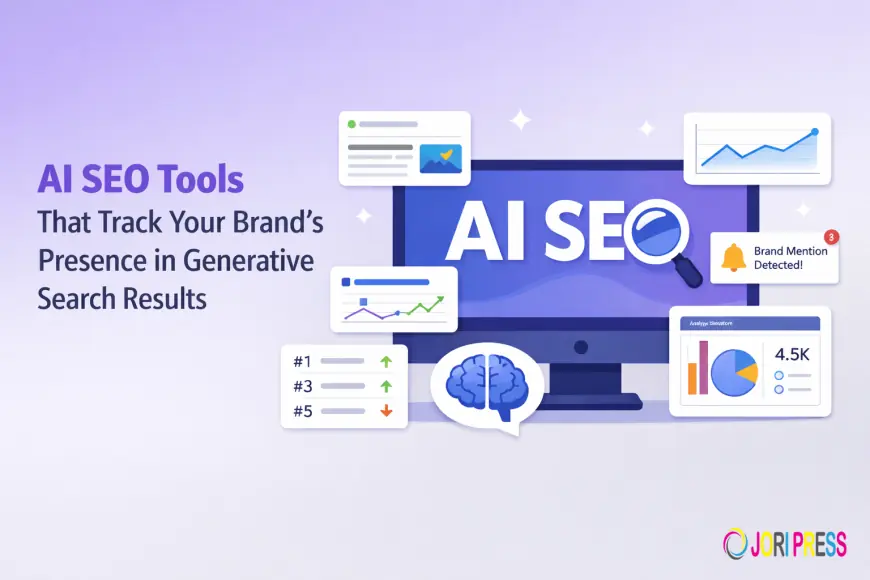
Search visibility is no longer limited to rankings.
As generative AI platforms reshape how users discover information, brands are being summarized, compared, and recommended in AI-generated answers. That creates a new layer of discoverability - one that traditional SEO tracking tools were not designed to measure.
For marketers, SEO professionals, founders, and agencies, the question is shifting from:
“Where do we rank?”
to
“Are we being cited and recommended inside generative search results?”
This article explores what generative search visibility means, how it differs from traditional SEO tracking, and 12 tools that help monitor and improve brand presence in AI-driven environments.
What Is Generative Search Visibility?
Generative search visibility refers to how often - and how favorably - your brand appears inside AI-generated answers.
When users ask platforms like ChatGPT, Perplexity, or Gemini a question, they may receive:
-
Summaries of key information
-
Comparisons of vendors
-
Recommended tools or providers
-
Step-by-step explanations referencing specific brands
If your brand is included in those responses, you gain influence—even without a click.
If you’re excluded, visibility disappears at the decision stage.
Traditional SEO Tracking vs. AI Answer Tracking
Traditional SEO tools measure:
-
Keyword rankings
-
Organic traffic
-
Backlinks
-
Technical performance
-
SERP features
AI answer tracking measures:
-
Brand mentions inside generated responses
-
Recommendation frequency
-
Comparative positioning
-
Sentiment or framing within summaries
-
Query-level inclusion or exclusion
Rankings tell you where you appear in search results.
AI tracking tells you whether you are being interpreted, summarized, and recommended.
These are related - but not identical - visibility layers.
Evaluation Criteria for AI SEO Tools
When assessing AI SEO tracking tools, consider:
-
AI Platform Coverage: Does it track across multiple generative engines?
-
Query-Level Tracking: Can you monitor specific prompts?
-
Brand & Competitor Monitoring: Does it compare inclusion across brands?
-
Actionable Insights: Does it connect visibility gaps to content improvements?
-
Technical & Authority Analysis: Does it identify structural limitations affecting inclusion?
-
Reporting & Workflow Integration: Can teams operationalize the data?
With that framework, here are 12 tools currently shaping AI SEO visibility tracking.
1. Track My Visibility (TMV)

Overview
Track My Visibility (TMV) is a specialized AI search visibility platform focused specifically on generative answer inclusion.
Key Features
-
Tracks brand mentions and recommendations inside AI-generated answers
-
Monitors competitor presence across prompts
-
Identifies technical, on-page, and off-page gaps
-
Links AI visibility signals to real pages and queries
-
Provides prioritized, actionable recommendations
Best For
Organizations that want structured, query-level insight into generative search presence - not just rankings.
Limitations
Focused specifically on AI visibility rather than full traditional SEO suites.
2. Profound

Overview
Profound focuses on generative engine optimization (GEO), tracking how brands appear across AI-generated environments.
Key Features
-
Prompt-level monitoring
-
Competitive comparison
-
Sentiment and positioning analysis
Best For
Enterprise brands monitoring generative brand positioning.
Limitations
May require higher budgets and enterprise workflows.
3. BrightEdge
Overview
BrightEdge has introduced AI tracking capabilities alongside its established SEO platform.
Key Features
-
AI-driven search insights
-
Integrated ranking and content recommendations
-
Enterprise dashboards
Best For
Large organizations are already using BrightEdge for traditional SEO.
Limitations
AI tracking may be part of a broader suite, not a standalone generative analysis tool.
4. Semrush

Overview
Semrush has expanded into AI search tracking features alongside traditional SEO monitoring.
Key Features
-
Keyword tracking
-
Competitive analysis
-
AI-related visibility insights
-
Content optimization tools
Best For
Agencies and teams seeking hybrid traditional + AI search data.
Limitations
AI answer tracking depth varies depending on feature rollout.
5. Ahrefs

Overview
Ahrefs primarily focuses on backlinks and rankings, but is adapting to AI search analysis.
Key Features
-
Authority tracking
-
SERP monitoring
-
Competitive research
Best For
Teams strengthening authority signals that influence AI inclusion.
Limitations
Not purpose-built for generative answer monitoring.
6. Similarweb

Overview
Similarweb provides traffic intelligence and digital market insights.
Key Features
-
Traffic source analysis
-
Competitive benchmarking
-
Emerging AI channel visibility tracking
Best For
Market-level visibility trends.
Limitations
Less granular at the individual AI prompt level.
7. Sistrix

Overview
Sistrix offers visibility indexes and search performance analysis.
Key Features
-
Visibility scoring
-
Competitive domain tracking
-
SERP feature monitoring
Best For
European markets and structured SEO benchmarking.
Limitations
Limited direct generative AI answer tracking.
8. seoClarity

Overview
seoClarity integrates AI insights into enterprise SEO workflows.
Key Features
-
AI-powered keyword insights
-
Content optimization
-
Enterprise analytics dashboards
Best For
Large SEO teams that that require workflow integration.
Limitations
AI answer inclusion tracking may be part of broader analytics.
9. Conductor

Overview
Conductor blends content intelligence with SEO performance data.
Key Features
-
Content recommendations
-
Search performance monitoring
-
AI-assisted optimization
Best For
Content-driven organizations aligning SEO and editorial strategy.
Limitations
Not primarily designed for AI answer citation monitoring.
10. DemandSphere

Overview
DemandSphere offers enterprise SEO analytics with evolving AI features.
Key Features
-
Keyword intelligence
-
Market visibility tracking
-
Content optimization insights
Best For
Enterprise brands managing multi-location or global SEO.
Limitations
Limited standalone generative search visibility focus.
11. Brand24

Overview
Brand24 specializes in brand monitoring across digital channels.
Key Features
-
Brand mention tracking
-
Sentiment analysis
-
Online visibility alerts
Best For
Tracking brand conversations influencing authority signals.
Limitations
Does not directly monitor AI-generated answer inclusion.
12. SparkToro

Overview
SparkToro provides audience and influence intelligence.
Key Features
-
Audience research
-
Source discovery
-
Influencer identification
Best For
Understanding authority ecosystems that may influence AI training data.
Limitations
Indirect impact on generative answer visibility.
Strategic Considerations When Choosing a Tool
Not every organization needs a specialized AI tracking platform immediately. Consider:
-
How dependent is your industry on comparison queries
-
Whether AI answer engines influence early-stage buyer research
-
How frequently your brand is recommended or excluded
-
The maturity of your existing SEO stack
In competitive SaaS, fintech, health, or B2B technology markets, generative inclusion is already influencing buyer decisions.
The Emerging Visibility Model
Generative search introduces a layered visibility structure:
-
Ranking visibility (traditional search)
-
Citation visibility (being referenced in AI summaries)
-
Recommendation visibility (being named as a solution)
Tracking only the first layer leaves blind spots.
The organizations adapting fastest are those treating AI answer inclusion as a measurable performance channel - not a theoretical future concern.
Final Thoughts
AI-driven search is not replacing traditional SEO. It is expanding it.
Brands must now monitor:
-
Where they rank
-
Where they are cited
-
Where they are recommended
-
Where competitors dominate
Tools will continue evolving as generative search matures. But the strategic shift is already clear: visibility now includes interpretation.
The brands that measure how they are summarized - not just how they are ranked - will be better positioned in a search ecosystem increasingly shaped by AI.
What's Your Reaction?
 Like
0
Like
0
 Dislike
0
Dislike
0
 Love
0
Love
0
 Funny
0
Funny
0
 Angry
0
Angry
0
 Sad
0
Sad
0
 Wow
0
Wow
0