







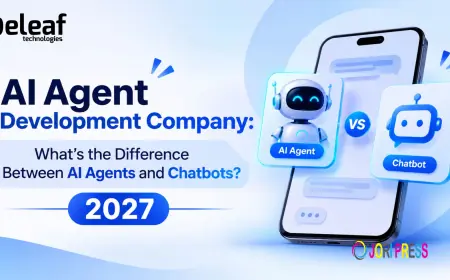
































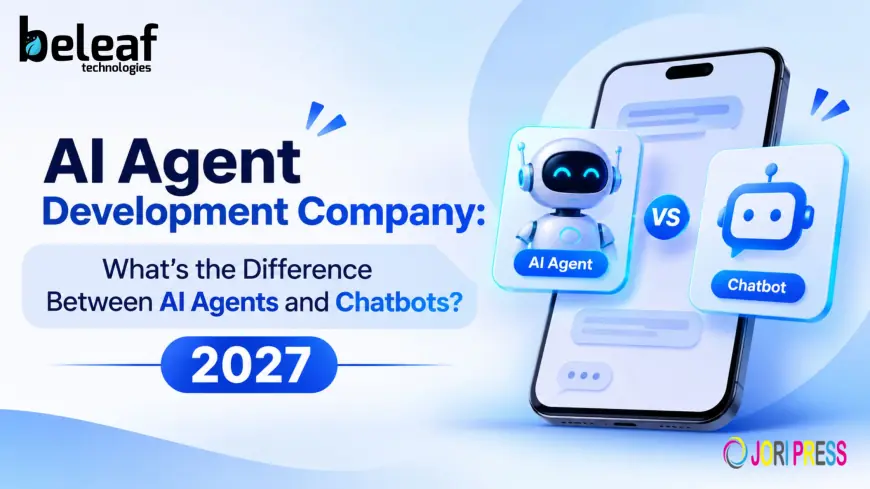
AI Agent Development Company: What's the Difference Between AI Agents and Chatbots? 2027

Imagine asking a chatbot to book a meeting, research a topic, or solve a business problem. It may explain the steps, but can it actually complete the task on its own? This is where an AI agent development company comes into the picture. As artificial intelligence advances in 2027, understanding the difference between AI agents and chatbots is becoming important for businesses and everyday users.
What Are AI Chatbots and How Do They Work?
AI chatbots are software applications designed to communicate with people through text or voice. They understand questions, process language, and provide relevant answers based on their training and available information. For example, when a customer asks about an order, a chatbot can explain the delivery status or share basic product information.While traditional chatbots operate based on fixed rules, modern conversational AI solutions use large language models (LLMs) to interpret various queries and deliver more natural, human-like responses . However, chatbots generally focus on conversations. They may need additional integrations or human support to complete tasks beyond answering questions.
What Makes AI Agents Different from Chatbots?
The main distinction between AI agents and chatbots lies in their ability to perform tasks independently. A chatbot mainly responds to user instructions, whereas an AI agent can understand a goal, plan the required steps, use connected tools, and work toward completing a task. For instance, a chatbot can guide users through the process of arranging a meeting. An AI agent can check calendar availability, identify a suitable time, and create the meeting when it has the required permissions. AI agents can also remember relevant context, evaluate information, and adjust their actions based on results. However, their independence depends on their design, permissions, tools, and safety limits.
How Does Custom AI Agent Development Work?
Custom AI agent development begins by identifying a specific problem that needs to be solved. Developers then design an agent around that purpose rather than creating a general-purpose system.
The process usually involves several steps:
-
Goal identification: Understand what the agent needs to accomplish.
-
Model selection: Choose an appropriate LLM for understanding and reasoning.
-
Tool connection: Connect APIs, databases, and external applications.
-
Memory setup: Provide relevant information and conversation context.
-
Testing: Check accuracy, reliability, and decision-making.
-
Deployment: Introduce the agent into the required environment.
This approach helps create agents that perform specific tasks while following clearly defined business requirements.
What Role Do RAG and Generative AI Integration Play?
An AI agent needs reliable information to make useful decisions. This is where RAG (Retrieval-Augmented Generation) becomes valuable. RAG allows an AI system to retrieve information from selected documents, databases, or knowledge sources before generating an answer. Instead of depending only on information learned during training, the system can use relevant external data. Generative AI integration adds another important capability. It helps agents understand instructions, generate responses, summarize information, and support complex tasks. For example, an AI research agent can collect information from approved sources, organize findings, and prepare a summary. RAG helps it refer to relevant documents, while the language model helps explain the results clearly.
What Are the Various Categories of AI Agents?
AI agents can support different departments depending on their responsibilities and available tools.
-
Customer Support AI Agents: Answer customer questions, track requests, and assist with common issues.
-
AI Sales Agents: Organize leads, prepare follow-ups, and support customer communication.
-
AI Research Agents: Gather information, compare sources, and summarize findings.
-
AI Coding Agents: Assist with writing code, identifying errors, and suggesting improvements.
-
AI Finance Agents: Organize financial information and support reporting and analysis.
-
AI HR Agents: Help with recruitment coordination, employee questions, and administrative tasks.
Each agent needs different instructions, data access, and permissions. Their effectiveness depends on how well they are designed for their particular responsibilities.
How Does Multi-Agent System Development Improve Task Management?
Some tasks are too complex for a single AI agent. They may require research, analysis, communication, and decision-making at different stages. Multi-agent system development addresses this challenge by allowing multiple specialized agents to work together. For example, an online business might use one agent to collect customer information, another to analyze customer requirements, and a third to prepare a response. Each agent handles a specific responsibility and shares relevant results with the others. These Multi-Agent Systems can improve task coordination and divide complex workflows into smaller activities. However, they also require proper communication, supervision, and error management to prevent incorrect results from spreading between agents.
Why Are AI Agent Integration, Security, and Monitoring Important?
An AI agent becomes more effective when it can interact with existing business applications. AI agent integration connects these systems with tools such as CRM platforms, databases, payment systems, and internal software. However, providing agents with access to business information also brings important security responsibilities. AI security and monitoring help organizations manage these risks through role-based access, secure API communication, data protection, privacy policies, human approval for sensitive actions, activity tracking, performance monitoring, and regular testing to identify errors or unexpected behaviour. AI agents should not have unlimited access to critical systems. Setting clear boundaries and maintaining human supervision helps ensure reliability and accountability.
What Will the Future of AI Agents Look Like in 2027?
AI agents are moving beyond simple question-and-answer interactions toward more practical, task-oriented applications. Chatbots will continue to play an important role in communication, while AI agents will increasingly support workflows that involve multiple steps and connected tools. Still, AI agents are not perfect. They can misunderstand instructions, produce inaccurate information, or make incorrect decisions. Businesses need to evaluate their capabilities carefully instead of assuming that greater automation always means better results. Understanding how these technologies work helps people make informed decisions about their applications. The real value of artificial intelligence is not simply how intelligently a system responds, but how responsibly and reliably it helps people solve everyday problems.
What's Your Reaction?
 Like
0
 Dislike
0
 Love
0
 Funny
0
 Angry
0
 Sad
0
 Wow
0