






































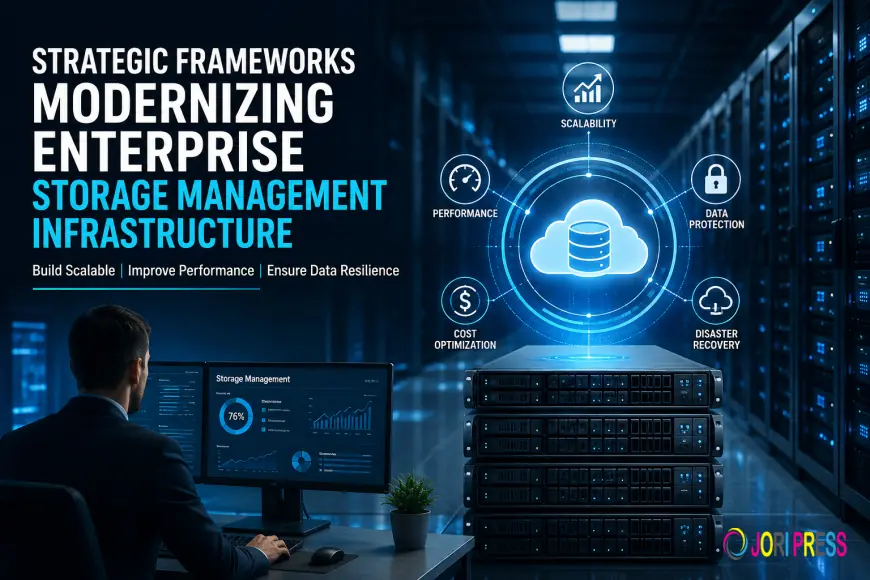
Strategic Frameworks Modernizing Enterprise Storage Management Infrastructure
Modern digital transformations demand unprecedented agility, continuous operational uptime, and total architectural efficiency.

Introduction
Modern digital transformations demand unprecedented agility, continuous operational uptime, and total architectural efficiency. As modern IT ecosystems shift toward high-concurrency computing, hybrid infrastructures, and distributed artificial intelligence workloads, managing mass volumes of raw information has become a core business imperative. Enterprise storage management sits directly at the center of this technological paradigm shift, transitioning from simple hardware capacity provisioning to an active, unified data service platform. Organizations now handle petabytes of structured and unstructured records spread across on-premises data centers, edge computing environments, and multiple public cloud providers. Without a coherent management blueprint, unstructured data growth rapidly leads to operational complexity, performance bottlenecks, elevated cloud spend, and expanded security vulnerabilities. Establishing a resilient infrastructure requires IT leaders to adopt modern data classification methods, autonomous policy enforcement, and proactive cyber storage defenses designed to guarantee business continuity.
The Evolution of Modern Infrastructure Architecture
Traditional IT models relied heavily on isolated, siloed storage arrays that required manual allocation and continuous localized monitoring. Today, modern infrastructure requires unified systems capable of scaling throughput horizontally across block, file, and object architectures without service interruptions. Enterprise storage management simplifies these environments through virtualized software abstraction, enabling administrators to pool physical drives from disparate vendors into single, manageable operational pools. Software-defined storage architectures decouple control mechanisms from physical underlying hardware, empowering organizations to automate provisioning based on real-time application demands. Furthermore, high-performance flash media powered by native non-volatile memory express protocols has dramatically lowered access latencies for mission-critical databases and real-time processing pipelines. By automating resource allocation based on exact workload characteristics, engineering teams eliminate performance drag while maximizing physical rack usage and operational efficiency.
Implementing Automated Data Lifecycle Management Policies
Storing every piece of organizational data on high-performance flash arrays creates unsustainable financial liabilities and wastes primary infrastructure capacity. Efficient enterprise storage management depends on structured lifecycle governance policies that continuously track, evaluate, and migrate datasets according to access frequency and operational value. Hot data tiers leverage high-speed NVMe storage arrays to deliver immediate responsiveness for transactional workloads and active business intelligence queries. Warm storage tiers handle semi-active files, operational archives, and analytics data lakes using cost-effective object repositories. Cold and deep archive tiers automatically ingest historical records, long-term backups, and compliance documentation into highly economical immutable storage environments. Automated telemetry platforms continuously analyze data access patterns, seamlessly transitioning idle blocks off primary arrays to secondary cloud or object repositories without disrupting end-user access or requiring manual intervention from IT administrators.
Strengthening Cyber Resilience and Immutable Security Defenses
Data governance and cyber storage capabilities are no longer optional add-ons; they form the frontline defense against sophisticated ransomware attacks and unexpected system failures. Robust enterprise storage management frameworks integrate zero-trust architecture, multi-factor authentication, and granular role-based access controls across all storage endpoints. End-to-end encryption protocols must protect critical files both at rest within physical drives and in transit across internal networks or public cloud connections. To withstand active ransomware threats, modern storage platforms utilize immutable snapshot configurations that write data in a write-once-read-many format. These locked snapshots prevent unauthorized deletion, encryption, or alteration from external malicious actors or compromised internal accounts. Combined with automated behavioral monitoring tools that detect anomalous file modification spikes in real time, organizations ensure continuous operational survival and rapid point-in-time recovery without paying cyber ransom demands.
Optimizing Hybrid and Multi-Cloud Ecosystem Performance
Operating within isolated cloud infrastructure creates vendor lock-in, unpredictable egress fees, and fragmented data visibility. Strategic enterprise storage management implements unified multi-cloud management control planes that abstract regional cloud boundaries and establish seamless data mobility. Global namespace technologies allow applications to access datasets stored across local private servers and public cloud hyperscalers through a single, consistent directory interface. Continuous synchronization engine pipelines ensure critical database replicas remain consistent across multiple geographic regions to meet strict recovery time objectives and disaster recovery compliance standards. Advanced storage monitoring solutions apply predictive analytics to identify performance bottlenecks, compute path latency, and storage consumption trajectories before capacity limits cause application downtime. Ultimately, adopting a unified operational model yields optimal agility, allowing business applications to run wherever cost, performance, and compliance criteria are best satisfied.
What's Your Reaction?
 Like
0
Like
0
 Dislike
0
Dislike
0
 Love
0
Love
0
 Funny
0
Funny
0
 Angry
0
Angry
0
 Sad
0
Sad
0
 Wow
0
Wow
0