
































How Print Farm Management Software Increases Printer Utilization Across Enterprise 3D Printing Operations
Learn how print farm management software improves printer utilization through centralized oversight, automated queues, and workflow optimization.

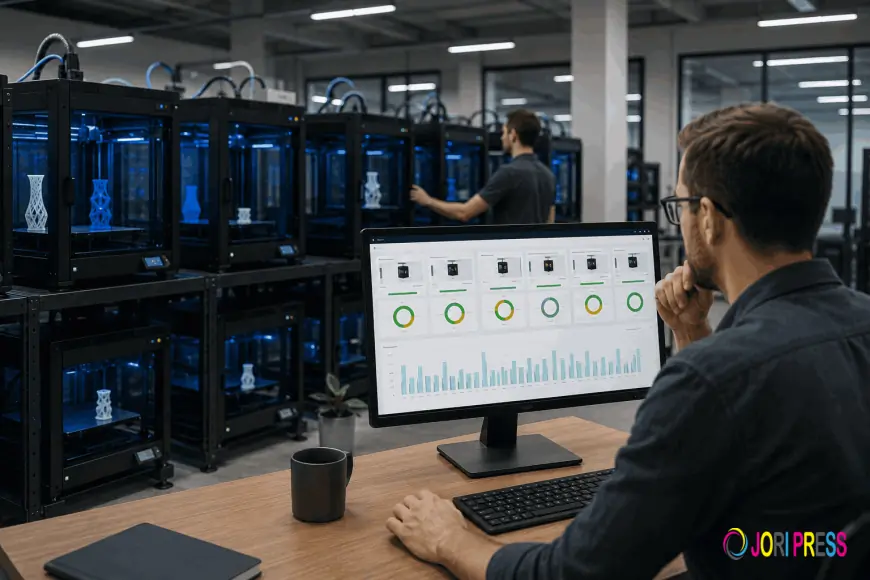
Enterprise additive manufacturing environments depend on consistent printer availability, efficient workflow coordination, and centralized operational oversight. As organizations expand their 3D printing capabilities across departments and locations, managing printer utilization becomes increasingly difficult without dedicated software infrastructure.
Many enterprises still rely on fragmented workflows, manual scheduling, and isolated printer management processes. These limitations often lead to unnecessary printer downtime, inefficient queue handling, and reduced production efficiency.
Top 3D print farm software helps organizations improve utilization by centralizing workflows, automating scheduling, and providing visibility across distributed printer fleets.
Why Enterprise Print Farms Require Centralized Management Software
Large-scale print environments often involve multiple users, printer models, departments, and production priorities operating simultaneously. Without centralized management, organizations may struggle to maintain consistency across additive manufacturing workflows.
Common operational challenges include:
-
Idle printers waiting for manual job assignments
-
Workflow delays caused by disconnected systems
-
Limited visibility into printer availability
-
Queue conflicts between departments
-
Inconsistent slicing and print preparation
-
Difficulty coordinating distributed production environments
Centralized print farm software addresses these challenges by consolidating management into a single operational environment.
Enterprise platforms typically provide:
-
Unified printer dashboards
-
Centralized queue management
-
Cloud-based slicing workflows
-
Remote job submission
-
User permission controls
-
Real-time operational visibility
This structure improves coordination across engineering teams, production operators, educational labs, and enterprise manufacturing environments.
How Print Farm Management Software Improves Fleet Utilization
Printer utilization depends heavily on how efficiently jobs move through the production workflow. Manual scheduling and fragmented oversight often leave machines idle while operators coordinate print assignments.
Modern management platforms improve utilization through automation and workflow orchestration.
Key utilization benefits include:
Automated Queue Management
Centralized queue systems automatically route print jobs to available machines. This reduces downtime between print cycles while improving workflow efficiency across the fleet.
Benefits include:
-
Faster job distribution
-
Reduced printer idle time
-
Improved scheduling consistency
-
Better workload balancing
Cloud-Based Slicing Standardization
Cloud-based slicing environments help organizations maintain consistent print settings across multiple printers and users.
Standardized slicing workflows improve:
-
Print consistency
-
Processing efficiency
-
Operational reliability
-
Workflow scalability
This also reduces configuration errors that may interrupt production schedules.
Remote Monitoring and Oversight
Remote visibility allows administrators to monitor printer activity across multiple locations without being physically present at each device.
Remote monitoring capabilities typically support:
-
Live printer status tracking
-
Print progress visibility
-
Failure detection alerts
-
Queue monitoring
-
Centralized operational oversight
These tools help organizations maintain higher printer availability while reducing unnecessary production interruptions.
Reducing Printer Downtime Across Enterprise Print Farms
Printer downtime directly impacts production efficiency and operational costs. Even small interruptions across large fleets can significantly reduce total output over time.
Enterprise print farm software helps minimize downtime through proactive monitoring and centralized management.
Key advantages include:
-
Automated failure detection
-
Early identification of print issues
-
Remote troubleshooting capabilities
-
Maintenance tracking visibility
-
Faster response to operational problems
Instead of relying on manual supervision, operators receive alerts when issues occur. This allows teams to respond more quickly, preventing failures from disrupting larger production schedules.
Centralized oversight also improves maintenance coordination across printer fleets, helping organizations maintain more consistent uptime.
Why Enterprises Invest in Centralized Print Farm Management
As additive manufacturing operations continue to scale, organizations increasingly require infrastructure capable of supporting large user bases and distributed production workflows.
Modern enterprise print farm software supports:
-
Multi-user coordination
-
Distributed manufacturing environments
-
Remote operational management
-
Secure cloud accessibility
-
Hardware agnostic compatibility
-
Workflow standardization across facilities
Platforms such as 3DPrinterOS combine cloud slicing, queue management, remote monitoring, live printer oversight, and centralized workflow management within a single platform. The software is designed specifically for organizations managing complex additive manufacturing operations across multiple users, printers, and locations.
Organizations operating enterprise print farms increasingly prioritize software platforms that improve utilization, reduce downtime, and streamline additive manufacturing workflows across the entire production environment.
Contact 3DPrinterOS for centralized management systems that maximize printer availability while supporting more scalable, reliable, and efficient 3D printing operations.
What's Your Reaction?
 Like
0
Like
0
 Dislike
0
Dislike
0
 Love
0
Love
0
 Funny
0
Funny
0
 Angry
0
Angry
0
 Sad
0
Sad
0
 Wow
0
Wow
0