







































10 Benefits of Custom eLearning Development for Large Enterprises
Explore 10 benefits of custom eLearning development for large enterprises, from employee engagement to scalable and effective workforce training.

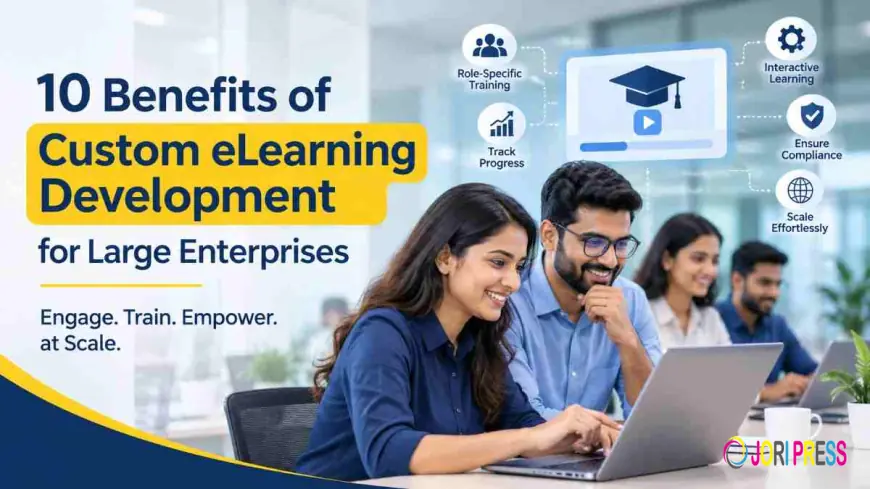
Training employees across a large organisation comes with several challenges. Different departments have different skill requirements, employees work across multiple locations, and business processes continue to evolve. Standard training courses may cover general concepts, but they do not always address an organisation's specific workflows, policies or performance expectations.
This is where custom eLearning development becomes valuable. It enables enterprises to create digital learning experiences based on their workforce requirements, industry standards and business objectives.
From interactive training modules and simulations to multilingual courses and personalised learning paths, custom eLearning gives organisations greater control over how employees acquire and apply knowledge.
Here are 10 key benefits of custom eLearning development for large enterprises.
1. Delivers Role-Specific Training
Employees in different departments require different knowledge and skills. A sales professional needs product and customer-handling training, while a manufacturing employee may need technical and workplace safety instructions.
Custom eLearning allows organisations to develop training modules based on specific job roles, responsibilities and skill levels.
For example, an enterprise can create separate learning programs for new employees, team leaders, technical staff and senior managers. This makes training more relevant and helps employees focus on the knowledge required for their responsibilities.
2. Improves Employee Engagement
Generic training materials can make learning less interesting, particularly when employees have to go through lengthy presentations or text-heavy courses.
Custom eLearning makes training more engaging by incorporating different learning formats, such as:
-
Interactive quizzes and assessments.
-
Gamified learning activities and challenges.
-
Scenario-based learning and branching exercises.
-
Animated explainer videos.
-
Interactive videos and simulations.
These elements encourage employees to participate rather than passively consume information. When training reflects familiar workplace situations, employees can also connect learning concepts with their daily responsibilities.
3. Supports Consistent Training Across Multiple Locations
Large enterprises often operate across different cities, states and countries. Delivering the same quality of training to every employee can be difficult through traditional classroom-based methods.
Custom eLearning provides a standardised approach to training delivery. Organisations can develop approved learning modules and distribute them across departments and locations.
Multilingual content, subtitles and localised examples can further improve accessibility for geographically distributed teams.
This is particularly useful for organisations that need consistent onboarding, product training, compliance education and standard operating procedure (SOP) training.
4. Makes Employee Onboarding More Efficient
Large organisations frequently hire employees across multiple departments and locations. Without a structured onboarding process, new hires may receive inconsistent information or depend heavily on managers for basic guidance.
Custom eLearning helps standardise onboarding through structured digital learning programs.
These can include company introductions, workplace policies, product knowledge, role-specific instructions, process demonstrations and assessments.
Employees can complete modules at their own pace while managers can monitor progress. This reduces repetitive training efforts and helps new employees understand their responsibilities more efficiently.
5. Simplifies Compliance and Regulatory Training
Compliance training is an important requirement for enterprises operating in regulated industries such as banking, insurance, healthcare and manufacturing.
Employees need to understand company policies, industry regulations, workplace safety requirements and ethical practices.
Custom eLearning allows organisations to develop training around their actual policies, regulatory obligations and workplace scenarios.
For instance, a financial services company can create interactive modules covering data protection, fraud prevention, workplace ethics and customer information security.
Training content can also be updated when regulations or internal policies change, helping employees access relevant information.
6. Provides Flexibility and Scalability
As organisations grow, their training requirements increase. A learning solution that works for a few hundred employees may not be sufficient for thousands of learners.
Custom eLearning supports scalable workforce development by allowing organisations to expand existing training programs, introduce new modules and accommodate additional employee groups.
Modular course structures make it easier to update individual topics without redesigning an entire learning program.
Enterprises can also deliver training through desktop and mobile devices, giving employees greater flexibility to access learning materials around their work schedules.
7. Improves Knowledge Retention Through Practical Learning
Completing a training course does not necessarily mean employees can apply what they have learned at work.
Custom eLearning addresses this gap by incorporating practical learning activities that help employees understand real-world situations.
Scenario-based exercises, software simulations and interactive demonstrations allow learners to practise decisions and processes in a controlled environment.
For example, employees can practise handling customer complaints, operating software systems or responding to workplace safety situations.
This approach makes training more application-oriented and helps employees build confidence before performing tasks independently.
8. Enables Better Training Measurement and Reporting
Large enterprises need to understand whether their training investments are producing meaningful results.
Custom eLearning programs can include assessments, progress tracking and reporting capabilities through LMS integration.
Training teams can evaluate:
-
Course completion rates.
-
Assessment scores and knowledge gaps.
-
Employee participation and engagement.
-
Learning progress across departments.
-
Performance in specific training modules.
These insights help L&D teams identify areas where employees need additional support and determine which training materials require improvement.
Organisations can also connect learning metrics with relevant business indicators, such as productivity, error reduction and compliance performance, to assess broader training impact.
9. Strengthens Brand Identity and Organisational Culture
Training is also an opportunity to communicate an organisation's values, standards and workplace expectations.
Custom eLearning allows enterprises to incorporate their brand colours, visual identity, terminology, internal examples and communication style into training materials.
For example, onboarding courses can introduce company values and workplace culture, while leadership training can reflect the organisation's management principles.
This creates a more consistent learning experience and helps employees connect training with the organisation they work for.
10. Offers Long-Term Value Through Reusable Learning Content
Although custom eLearning development may require a higher initial investment than purchasing ready-made courses, it offers greater control over content and future updates.
Organisations can reuse learning assets, modify existing modules and develop additional courses based on changing business requirements.
For example, an existing product training module can be updated when a company introduces new features. Similarly, compliance courses can be revised to reflect updated internal policies.
This reduces the need to recreate training materials from the beginning and supports the long-term development of enterprise learning programs.
How to Choose the Right Custom eLearning Development Partner
The effectiveness of a custom eLearning program depends on more than the technology used to create it. Enterprises should evaluate a development partner based on:
-
Instructional design expertise: Ability to convert complex information into structured and engaging learning experiences.
-
Technology capabilities: Experience with authoring tools, interactive videos, simulations and LMS-compatible content.
-
Industry understanding: Familiarity with enterprise training requirements and industry-specific learning needs.
-
Scalability: Ability to develop content for large and geographically distributed workforces.
-
Content maintenance: Support for reviewing and updating courses as business requirements change.
Choosing a partner with the right combination of instructional design and development capabilities helps organisations build training programs that remain relevant over time.
Frequently Asked Questions
1. What is custom eLearning development?
Custom eLearning development involves creating digital training content tailored to an organisation's business goals, employee roles, processes and learning requirements. It can include interactive courses, videos, simulations, assessments and gamified learning activities.
2. Why do large enterprises need custom eLearning?
Large enterprises need custom eLearning to deliver relevant and consistent training across departments, locations and employee levels. It also helps address specific skill gaps, compliance requirements and operational training needs.
3. Is custom eLearning better than off-the-shelf training?
Custom eLearning is more suitable when organisations need training based on their internal processes, products, policies and job roles. Off-the-shelf courses can be more practical for general topics that do not require organisation-specific content.
4. Can existing training materials be converted into custom eLearning courses?
Yes. Existing presentations, PDFs, classroom training materials and other learning resources can be converted into interactive digital courses. This allows organisations to modernise their training content without developing everything from scratch.
Conclusion
Custom eLearning development gives large enterprises a practical way to address diverse workforce training requirements while maintaining consistency and flexibility. From role-specific learning and compliance training to interactive simulations and performance measurement, it supports employee development at scale.
With the right instructional design approach and development partner, organisations can transform existing training materials into engaging digital learning experiences that align with their business objectives.
Stratbeans helps enterprises develop customized eLearning content tailored to their workforce and training requirements. From interactive Articulate courses and gamified learning to simulations, microlearning and multilingual content, Stratbeans supports organisations in building effective digital training experiences.
What's Your Reaction?
 Like
0
 Dislike
0
 Love
0
 Funny
0
 Angry
0
 Sad
0
 Wow
0