




































The Silhouette of the Somme: The Evolution and Design of the World War I British Uniform
Discover the history, design, and evolution of the World War I British uniform. From the iconic M1902 khaki Service Dress and Pattern 1908 webbing to the legendary Brodie helmet, learn how the British Tommy's gear adapted to survive the grueling trenches of the Western Front. Explore museum-grade reproductions crafted with historical precision by Replicamilitary.
When the British Expeditionary Force (BEF) crossed the English Channel in August 1914, they marched into history wearing what was arguably the most practical combat gear of its time. While European armies took the field in bright blue coats, red trousers, or traditional leather helmets, the British Tommy was clad from head to toe in drab, earthy tones. Over the next four years, the world war i british uniform would undergo subtle modifications to survive the horrific realities of industrial trench warfare, becoming an enduring symbol of resilience.
For modern historians, media productions, and museum curators, reproducing the exact texture, weight, and fit of this legendary gear is vital. At Replicamilitary, we specialize in crafting museum-grade reproductions of the ww1 british soldier uniform, ensuring that the bravery of the Great War generation is preserved with total historical accuracy.
The Birth of Khaki: The M1902 Service Dress
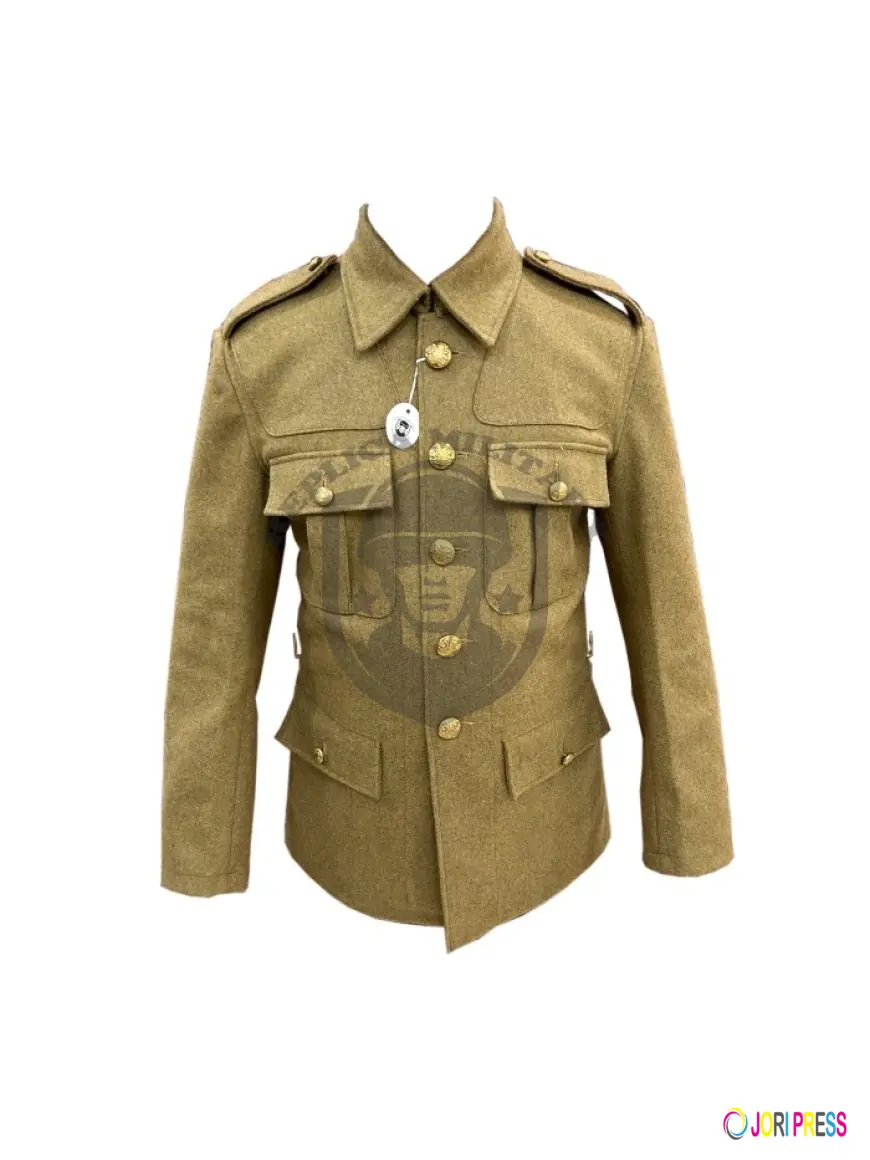
The foundational layer of the world war i british uniform was the M1902 Service Dress. Introduced following the hard-learned lessons of the Second Boer War, where bright uniforms made British soldiers easy targets for sharpshooters, this uniform embraced concealment.
The color was "khaki"—a word derived from the Persian word for dust or earth. This muddy, olive-drab hue was achieved by blending specific ratios of brown, green, and yellow wool fibers.
The Tunic and Trousers
The M1902 tunic was a heavy wool jacket featuring a stiff, stand-up collar, a four-button front closure, and rifle patches reinforced on the shoulders to absorb recoil. It featured four deep external pockets designed to carry personal items, rations, and field dressings. Underneath the tunic, soldiers wore a collarless grey flannel shirt. The matching wool trousers were held up by braces and tailored to be loose around the thighs for mobility, narrowing at the calves.
Adapting to the Trenches: Key Components of the Kit
As the conflict bogged down into a static war of attrition, the uniform had to adapt. The standard kit of a ww1 british soldier uniform was defined by three distinctive elements that helped them survive the mud, cold, and flying shrapnel.
1. The Pattern 1908 Web Infantry Equipment
Unlike continental armies that favored heavy, rigid leather webbing, the British adopted tight-weave cotton canvas webbing. The P08 system was a revolutionary piece of engineering. It distributed weight evenly across the shoulders and waist, carrying up to 150 rounds of ammunition, a water bottle, an entrenching tool, a haversack, and the long pattern 1907 bayonet. It was strong, flexible, and didn't rot as quickly as leather when submerged in trench mud.
2. Puttees
Wrapped tightly from the ankle to just below the knee, puttees were long strips of heavy woolen cloth. They served a vital dual purpose: they provided excellent ankle support during long marches across uneven terrain and prevented mud, debris, and water from slipping into the soldier's leather ankle boots.
3. The Brodie Helmet (The "Tin Hat")
In 1914, soldiers wore soft woolen trench caps. However, by 1915, shrapnel wounds to the head were causing catastrophic casualties. Enter John Leopold Brodie’s patented steel helmet. Introduced in late 1915, this shallow, wide-brimmed steel bowl protected soldiers from air-bursting shrapnel shells dropping from above. It instantly altered the iconic silhouette of the British Tommy.
Experience True History with Replicamilitary
The fabric of the original world war i british uniform was made from coarse, heavy-weight kersey wool. It was scratchy, dense, and naturally water-resistant—qualities that are nearly impossible to find in modern off-the-rack textiles. Over the last century, surviving original uniforms have become exceedingly fragile, turning stiff and brittle with age.
At Replicamilitary, we bridge the gap between past and present. We source custom-woven, heavy-weight wool that perfectly replicates the exact weight, scratchy texture, and unique olive-drab color of the original M1902 Service Dress. Every garment features historically accurate brass General Service buttons, correct interior lining fabrics, and period-accurate stitching methods.
Whether you are putting together a living history display, gearing up for a centenary reenactment, or building a high-fidelity museum exhibition, our commitment to detail ensures your uniform looks, feels, and performs exactly like it did on the Western Front. Explore our collection at Replicamilitary and bring history to life.
What's Your Reaction?
 Like
0
Like
0
 Dislike
0
Dislike
0
 Love
0
Love
0
 Funny
0
Funny
0
 Angry
0
Angry
0
 Sad
0
Sad
0
 Wow
0
Wow
0