









































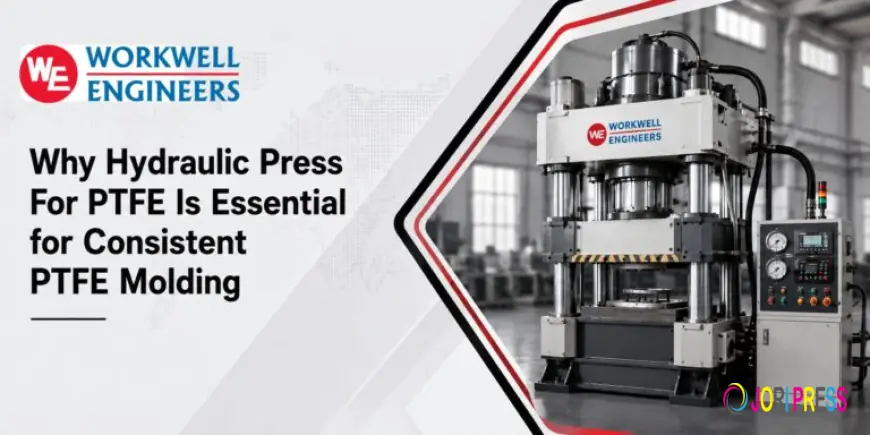
Why Hydraulic Press For PTFE Is Essential for Consistent PTFE Molding

There is a strong demand for advanced PTFE (Polytetrafluoroethylene) parts. Using the outstanding features offered by PTFE, like resistance to chemical and heat impacts as well as low friction coefficient, is useful in many industries including chemical processing, electrical insulation, aerospace, automotive, medicine and food processing. However, manufacturers need to obtain proper machines in addition to good material in order to produce such high-quality parts.
Among the machines that are used to provide good and reliable results in the molding process, it is worth mentioning the Hydraulic Press for PTFE because it allows applied controlled pressure, provides consistent compression of the material used in production and ensures quick cycles of production. Being different from many other types of plastics, PTFE requires special Hydraulic Presses to produce high-quality products that have the correct dimensions.
The present article reviews the necessity of the Hydraulic Press for PTFE in producing high-quality PTFE parts.
Getting to Know PTFE Molding
PTFE’s distinct molecular structure and extremely high melt viscosity do not allow it to be molded with traditional injection mold methods. Instead, companies resort to a process called compression molding, in which PTFE powder is placed in the mold cavity and compressed under specific pressure and later goes through a sintering procedure.
Practically speaking, the compression molding process is widely used for manufacture of:
- PTFE sheets, PTFE rods, PTFE tubes, PTFE bushes, PTFE seals, PTFE gaskets, PTFE custom engineering components.
Such products’ quality depends greatly on the ability to control pressure along the process.
Why Is It Important to Do Everything the Same Way in PTFE Molding?
Any company producing PTFE products should pay great attention to making sure the products comply with required specifications. Even minimal pressure or shape deviations lead to rejecting some of the products.
The use of a suitable Hydraulic Press for PTFE allows avoiding a variety of problems like:
- Unequal density of the material.
- Air bubbles.
- Surface defects.
- Mistakes in dimensions.
- Internal cracks.
- Material waste.
Consistent manufacturing leads to greater reliability of the product and less costs for production.
How a PTFE Hydraulic Press Guarantees Results
Looking for consistent PTFE molding? Discover why hydraulic presses make all the difference. Read more on workwellengineers.com
What's Your Reaction?
 Like
0
Like
0
 Dislike
0
Dislike
0
 Love
0
Love
0
 Funny
0
Funny
0
 Angry
0
Angry
0
 Sad
0
Sad
0
 Wow
0
Wow
0