





































Who Is Eligible for the Research Catalyst Grant from UofT India Foundation? (Research Grants in India Explained)
Looking for research grants in India? Learn who is eligible for the Research Catalyst Grant, how much it pays, and how to apply with a U of T partner.
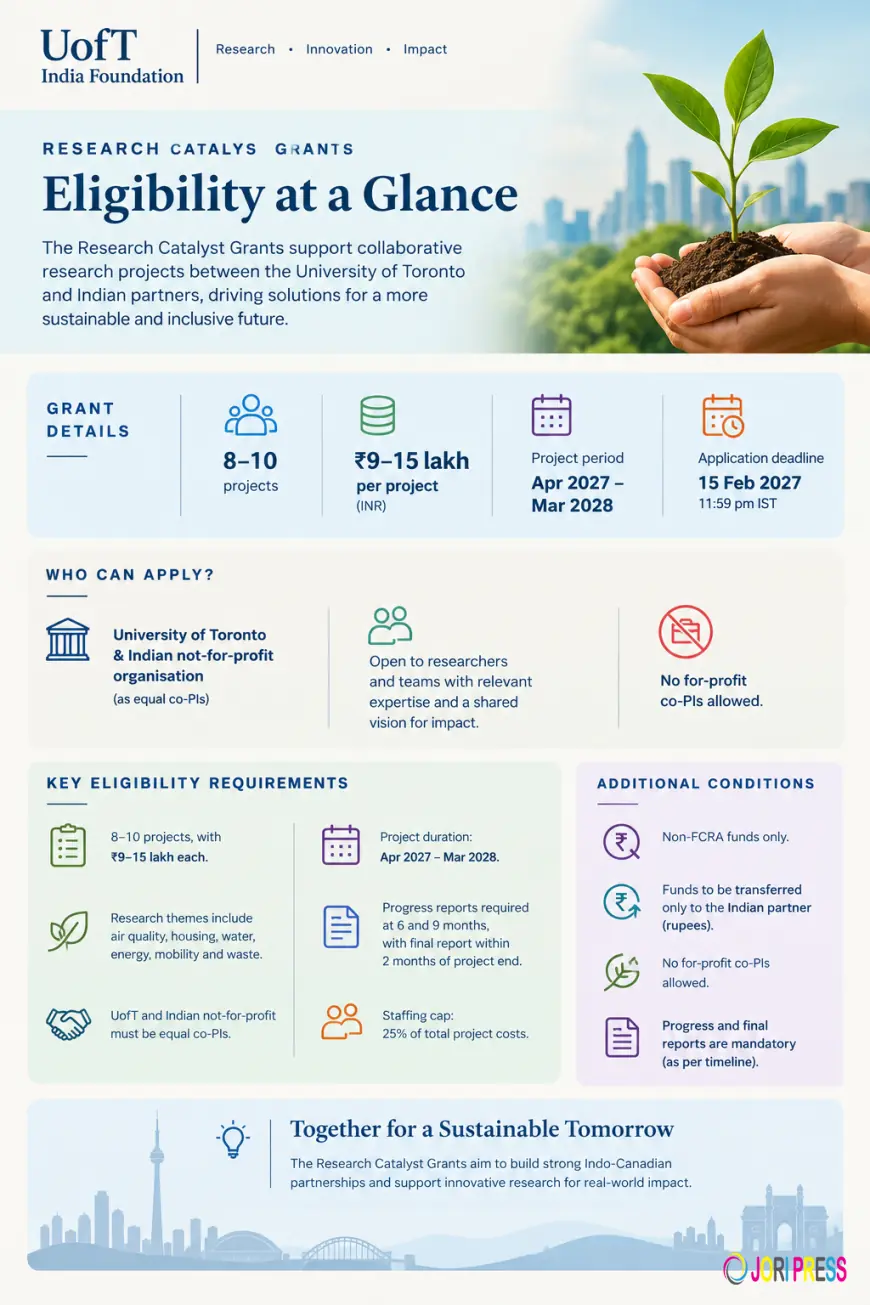
Looking for research grants in India that fund international collaboration? The Research Catalyst Grant from the UofT India Foundation backs joint projects between University of Toronto researchers and Indian partners, including NGOs and government bodies. This guide explains Research Catalyst Grants eligibility, funding, eligible costs and how to apply.
Quick answer: To meet Research Catalyst Grants eligibility rules, your team needs at least one University of Toronto co-PI and one co-PI from a not-for-profit or public organization based in India. The project must improve the sustainability or climate resilience of Indian cities. For-profit and industry co-PIs are not eligible in the current round.
What Is the Research Catalyst Grant?
The Research Catalyst Grant is a seed-funding program run by the UofT India Foundation (UTIF) with the University of Toronto and its School of Cities. It supports new or existing collaborations on urban sustainability in cities of every size, from small towns to megacities. Eligible themes include air quality, water and sanitation, energy, mobility, housing, waste and urban planning.
About the UofT India Foundation
Established in 2023, the UofT India Foundation is the University of Toronto’s research and entrepreneurship centre in India. Based in Mumbai and launched with Tata Trusts, it connects U of T with Indian academic, non-profit, government and entrepreneurial partners to co-create solutions for more sustainable cities.
Research Catalyst Grants Eligibility: Who Can Apply?
A proposal must meet all five conditions:
- Two co-PIs: at least one from U of T and one from an Indian partner organization.
- U of T co-PI status: they must meet the university’s Principal Investigator definition and hold an appointment for the full grant period.
- Indian co-PI: they must be employed full-time by a partner organization based in and operating in India.
- Letter of support: a signed letter on the Indian organization’s letterhead describing its role, desired outcomes and grant-management experience.
- Relevant experience: both co-PIs must have demonstrated experience working on the problem the project addresses.
Can NGOs, Government Bodies or Companies Apply?
NGOs and government bodies can apply. The Indian partner can be a university, research centre, NGO, civil society organization, foundation or government body. Non-academic co-PIs need strong project and team management skills, and field experience or technical expertise counts equally with academic research credentials.
Companies are the exception. For-profit and industry co-PIs cannot act as co-PIs or hold grant funds in this round.
How Much Funding Does the Grant Offer?
In the 2026-27 cycle, 3 to 5 projects received INR 9 lakh to 15 lakh each (roughly CAD 15,000 to 25,000) for work between April 2026 and March 2027. Funds are paid in tranches, in INR, to the Indian partner organization, never to individuals.
What Costs Does the Grant Cover?
Eligible costs include:
- Fieldwork, including consumables, research assistant allowances, participant honoraria, data platforms and local IRB fees
- Extra India-based staffing (up to 25% of the budget)
- Economy travel and hotels within India
- Capacity-building, publication and dissemination
- Equipment (up to 5%) and administration (up to 7%)
Ineligible costs include anything spent outside India, replacement teaching costs, co-PI time, scholarships, tuition and conference attendance.
How Are Proposals Evaluated?
Reviewers score five areas: partnership quality and equity, clarity and relevance of the research problem, potential impact, research approach and ethics, and timeline and budget. Long-term sustainability is encouraged but not mandatory.
Deadline and How to Apply
The 2026-27 deadline was February 16, 2026, and the 2025-26 call closed on February 15, 2025. If that pattern holds, the next call may open around the start of the year, but check the School of Cities page for confirmed dates. Late applications are not accepted.
Submit two files: a PDF containing your proposal, both CVs (five pages maximum each) and the letter of support, plus a separate Excel budget sheet. The proposal covers background, methodology, outputs and impact, team roles, sustainability and timeline.
5 Tips to Strengthen Your Application
- Start partner conversations months early; UTIF offers matchmaking.
- Show the Indian partner helps design the project.
- Name a specific city and measurable outputs, such as policy briefs or publications.
- Keep every budget line inside India.
- Secure the signed letter of support early.
FAQs
Can I apply without a partner?
No. You need both co-PIs, but UTIF helps connect partners.
How many applications can I submit?
Up to two, on different themes or research questions.
What reporting is required?
Progress reports at six and nine months, and a final report within two months of closing.
Conclusion
The Research Catalyst Grant is a strong option among research grants in India for teams working on urban sustainability with a Canadian partner. Understanding Research Catalyst Grants eligibility before you start saves time. Line up a U of T co-PI, a qualifying Indian partner and a letter of support, then build a focused, India-based budget. Confirm current terms on the official UofT India Foundation page before applying.
Source: UofT India Foundation Research Catalyst Grants 2026-27 call for proposals (School of Cities, University of Toronto).
What's Your Reaction?
 Like
0
Like
0
 Dislike
0
Dislike
0
 Love
0
Love
0
 Funny
0
Funny
0
 Angry
0
Angry
0
 Sad
0
Sad
0
 Wow
0
Wow
0