






































What 17 Years in Marketing Taught Me About Leadership
Ashish Singh Somvanshi shares honest lessons from 17 years in marketing and how they shaped his approach to leadership, team building, and entrepreneurship.
I never set out to become a leader.
I set out to become good at marketing. I wanted to understand why some brands grew and others didn't, why some campaigns worked and most didn't, and what separated the businesses that built real momentum from the ones that kept starting over every quarter.
Seventeen years later, I've realized that most of what I learned about marketing was actually about leadership. The two things are more connected than most people acknowledge — and the lessons from one have shaped how I approach the other in ways I didn't expect.
The First Thing Marketing Teaches You About Leadership Is Listening
Good marketing starts with understanding people. Not what you want to say to them — what they actually need to hear. That distinction sounds small but it changes everything about how you approach communication.
I spent the early part of my career learning how to craft messages. The right words, the right channels, the right timing. And those things matter. But the marketers and leaders I've seen struggle most are the ones who are so focused on their message that they stop paying attention to the response.
Real listening in marketing means looking at what people do, not just what they say. A customer who says they love your product but never comes back is telling you something important. A lead who opens every email but never responds to a call is telling you something too.
Leadership is the same. The people on your team will rarely tell you directly when something isn't working. They'll show you — through the quality of their work, through their energy levels, through the questions they ask or stop asking. Learning to read those signals, rather than waiting for someone to hand you a problem statement, is one of the most valuable things marketing trained me to do.
Clarity Is Not a Nice-to-Have — It's the Job
In marketing, unclear positioning kills campaigns before they start. If you can't articulate in one sentence why someone should choose you over every other option available to them, no amount of budget or creative execution will save you. The market is too noisy and people's attention is too scarce.
I learned this the hard way on a campaign early in my career. We had a great product, a reasonable budget, and a talented creative team. The campaign flopped. When we dug into why, the answer was embarrassingly simple — we hadn't been clear about who we were talking to or what we were promising them. Every piece of communication was trying to appeal to everyone, which meant it connected with no one.
The parallel in leadership is direct. Teams that don't have clarity on what they're working toward, why it matters, and what success looks like will work hard and still underdeliver. Not because they're not capable — because they're spending energy filling in gaps that the leader should have filled first.
One of the things I've become most deliberate about as a founder is making sure the people around me know exactly what we're trying to do and why. Not in a mission statement way — in a practical, daily clarity kind of way. What are we optimizing for this quarter? What does a good outcome look like? What are we willing to sacrifice and what are we not?
That kind of clarity doesn't come naturally. You have to work at it. But it's the foundation everything else is built on.
Consistency Beats Intensity Every Time
Marketing taught me to be skeptical of peaks.
A campaign that produces a spectacular month followed by a mediocre one hasn't built anything. The brands that grow over time are the ones that show up consistently — with relevant communication, with reliable quality, with a clear reason for their audience to keep paying attention.
The same thing is true of leadership. The most effective leaders I've worked with and learned from aren't the ones who give the most inspiring speeches or who generate the most energy in a room. They're the ones who are consistent. Who do what they say they'll do. Who give the same quality of attention to their team on a difficult Tuesday as they do on a good Friday.
People build trust through pattern recognition. They watch what you do across time and circumstance, and they form a picture. That picture — more than any individual action — determines whether they'll follow you when things get hard.
I think about this a lot in how I lead my own teams. The goal isn't to be spectacular. It's to be reliable. To be the kind of leader whose behavior people can predict, not because I'm rigid, but because my values are consistent even when my decisions have to be flexible.
The Leader's Job Is to Make Others Better, Not to Be the Best
This one took me the longest to learn.
For most of my career, my identity was tied to being good at what I did. I was the person who understood the strategy, who could read a campaign's performance and know what to fix, who had seen enough situations to have an instinct for what would work.
That identity, while useful for individual contribution, is a trap for leadership.
The moment I started building teams, I had to confront something uncomfortable — my job was no longer to be the best marketer in the room. My job was to make the marketers around me better. To give them the context, the resources, and the space to develop their own instincts. To let them make decisions, including decisions I might have made differently, because the cost of being right was less important than the value of their growth.
It's still something I work on. The pull toward doing rather than enabling is strong, especially when you care about quality and have a clear picture of what good looks like. But the businesses and teams that scale are the ones where capability is distributed, not concentrated in one person.
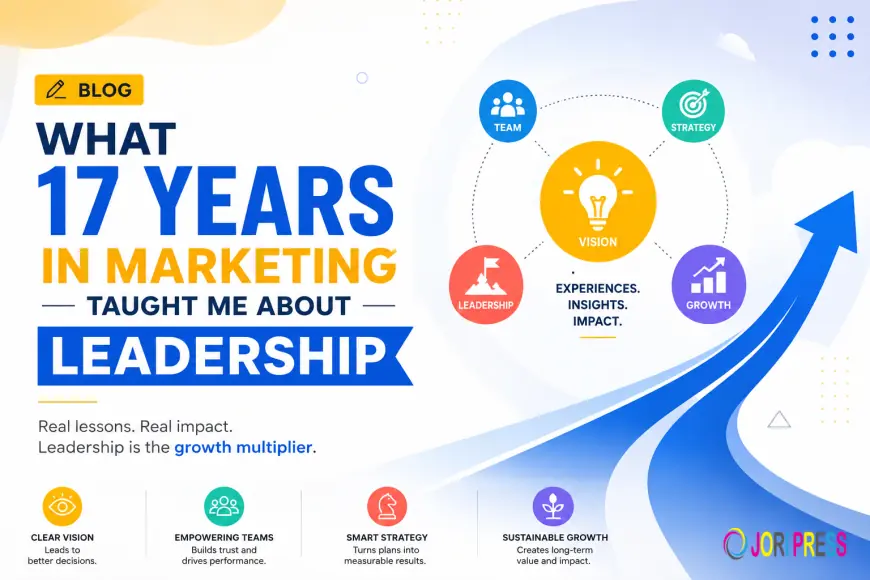
Leadership, I've come to believe, is really just a form of long-term marketing. You're building trust, communicating clearly, staying consistent, and trying to create something that outlasts any individual campaign — or any individual leader.
What's Your Reaction?
 Like
0
Like
0
 Dislike
0
Dislike
0
 Love
0
Love
0
 Funny
0
Funny
0
 Angry
0
Angry
0
 Sad
0
Sad
0
 Wow
0
Wow
0