




































Visual Effects Course: What Happens Before a Shot Reaches Compositing?
Before compositing, a shot passes through tracking, roto, 3D, FX and rendering. See what a good visual effects course in Kolkata should teach.
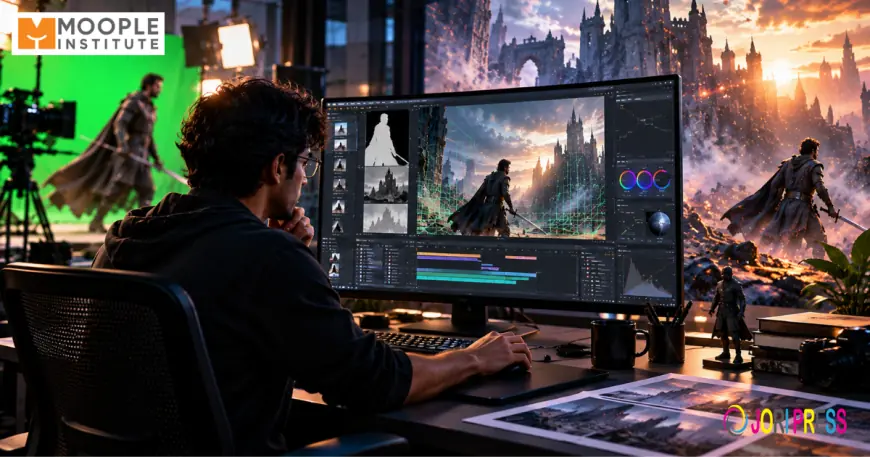
A shot that looks effortless on screen has usually passed through half a dozen departments before a compositor touches it. If you’re comparing a visual effects course, that journey is the real syllabus. Compositing is the finish line, and the craft that decides whether a shot works happens upstream.
What does a visual effects course teach?
A visual effects course teaches you to create digital elements (environments, creatures, simulations, cleanup work) and merge them convincingly with live-action footage. Compositing is the final assembly. Most of your learning happens in the stages before it.
The pipeline, stage by stage
1. Plate prep and roto. The “plate” is the raw footage. Artists note the lens, frame rate and grain, then clean it up. Rotoscoping isolates actors or objects frame by frame, and paint work removes wires, rigs and stray crew members.
2. Tracking and matchmove. To make a CG object sit in a real scene, the software must recreate the real camera’s movement in 3D. A weak track is the classic reason a digital object seems to float.
3. Asset building. Modelling, UV unwrapping, texturing and look development create the object. Rigging adds controls so animators can move it.
4. Animation and FX. Animators give characters and objects believable motion. FX artists simulate smoke, fire, water and destruction, which is where physics-based thinking matters.
5. Lighting and rendering. Lighters match the CG to the plate’s light direction, colour and softness. The render is then split into layers (diffuse, specular, depth, ID mattes) so the compositor can adjust each one without re-rendering.
|
Stage |
Question it answers |
Common tools |
|
Roto and paint |
What needs to be isolated or removed? |
Silhouette, Nuke |
|
Matchmove |
Where was the real camera? |
3DEqualizer, PFTrack |
|
Assets |
What does the object look like and how does it move? |
Maya, Blender, Substance |
|
FX |
How do smoke, fire and water behave? |
Houdini |
|
Lighting/render |
Does it match the plate? |
Arnold, Redshift, Blender Cycles |
Why this matters when comparing 3D animation and visual effects courses
Many 3D animation and visual effects courses lead with software buttons. A better approach is to teach the pipeline first. A compositor who understands why a depth pass exists fixes problems faster and talks to the 3D team in their own language. It also helps you decide where you fit: precise and patient (roto, matchmove), artistic (lighting, look dev), or technical (FX, pipeline).
How to choose a visual effects course in Kolkata
Students travel to Kolkata’s institutes from Baguiati, Barasat, Berhampore, Chandannagar, Chowringhee, Jodhpur Park, New Alipore, Sealdah, Serampore, Sonarpur and beyond, so check these points before committing:
-
Pipeline coverage: roto, tracking, 3D, FX and compositing, not just one tool.
-
Shot-based projects: you should finish with breakdowns showing each stage of your work.
-
Hands-on lab time: rendering and simulation need practice, not just lectures.
-
Mentor background: ask what production experience your instructors have.
-
A visible syllabus: duration, software and fees should be clear before you enrol.
Frequently asked questions
1. Do I need to draw well to join a visual effects course?
Not necessarily. Roto, tracking, FX and compositing reward patience and technical thinking. Drawing helps most in concept and texture work.
2. What is the difference between VFX and 3D animation?
Animation creates motion for characters and objects. VFX integrates CG with live footage, including tracking, simulations and compositing. They overlap in 3D, which is why many students explore both.
3. Which stage should beginners start with?
Roto and paint, then tracking. They build an eye for how real footage behaves, and that skill carries into every later stage.
4. Is compositing the same as editing?
No. Editing arranges shots in sequence. Compositing combines layers within a single shot.
5. What computer do I need?
Needs vary by software and project. Ask the institute what the lab provides before buying hardware.
6. Can I learn VFX after 12th or during college?
Yes. Most students in this field start at 18 to 30, and entry is typically through a portfolio rather than a specific degree.
7. How long does it take to become job-ready?
It depends on the course depth and your practice hours. Judge a programme by the quality of the portfolio you’d leave with, not by promises.
Conclusion
Compositing gets the credit, but the shot is won or lost in tracking, assets, FX and lighting. When you evaluate any visual effects course, ask how thoroughly it covers those stages. To see how Moople Institute structures its programme, visit the VFX course in Kolkata page and check the syllabus, duration and admission details.
What's Your Reaction?
 Like
0
Like
0
 Dislike
0
Dislike
0
 Love
0
Love
0
 Funny
0
Funny
0
 Angry
0
Angry
0
 Sad
0
Sad
0
 Wow
0
Wow
0