

































Popular European Countries Where UberEats Clone Has Strong Market Potential
Launch your food delivery business with an UberEats clone app featuring online ordering, restaurant management, delivery partner apps, and real-time order tracking.

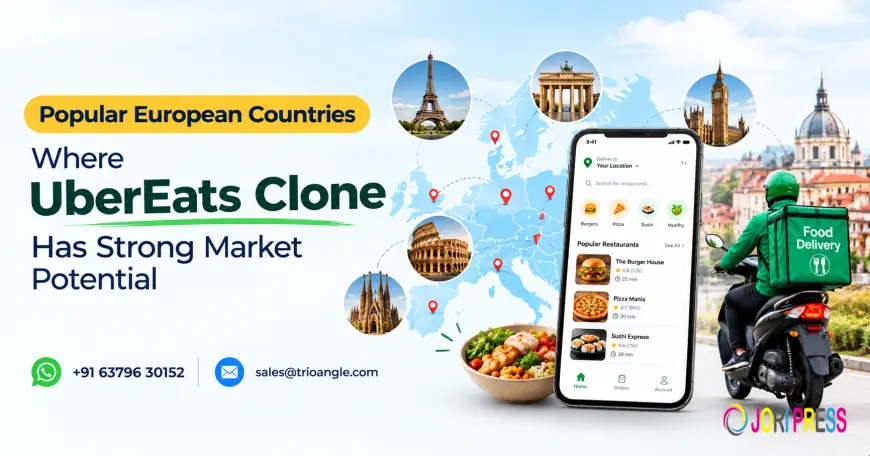
Ordering food through an app is now part of everyday life in many European cities.
Yes! Many people across Europe prefer ordering food from apps for convenience. This is because the current European food delivery market is not the same everywhere.
Customer habits, payment preferences, restaurant density, and delivery operations vary from one country to another. For entrepreneurs planning to build an UberEats clone platform, these differences matter.
Hence, this blog discusses top European countries where startups and entrepreneurs like you can start your food delivery platform like UberEats.
Popular European Countries To Launch a Food Delivery Platform
Let’s dive into this topic and learn more about the European countries where you can launch your food delivery app.
United Kingdom
The United Kingdom has a well-established online food ordering market. Customers in London and other large cities are already comfortable using mobile applications to order meals from restaurants in their area.
The market also has a wide mix of restaurants. Customers can find everything from independent takeaway shops to large restaurant chains through delivery platforms. This gives a new food delivery business several possible directions.
A new platform could focus on a particular city, restaurant category, or customer group instead of trying to compete across the entire country from day one. Restaurant discovery, menu management, online payments, order tracking, and delivery coordination would form the basic structure of the application.
The UK accounted for 20.6% of Europe's food platform-to-consumer delivery market value in 2025, according to Mordor Intelligence, making it an important market to consider.
Germany
Germany is another major market for food delivery services. Berlin, Munich, Hamburg, and Frankfurt have large urban populations and established digital ordering habits. Research published in 2026 places Germany among the leading European countries for online grocery delivery.
Germany is also important beyond restaurant delivery. In recent times, online grocery ordering is becoming a larger part of the broader digital delivery market.
For businesses entering Germany, the delivery model needs to fit the local market. Restaurant partnerships, delivery zones, and pricing all affect how the platform operates. A city-based approach can help a new service understand demand before expanding into other areas.
That gives businesses the option to start with restaurant meals and later add groceries, convenience products, or other local delivery services.
France
France has a strong restaurant industry and a large urban customer base. Paris is an obvious market for digital food ordering, while cities such as Lyon, Marseille, and Toulouse also have active restaurant communities.
A food delivery application in France can connect local restaurants with customers while giving restaurant owners tools to manage orders and menus. Customers can browse nearby restaurants, select dishes, pay through the application and receive delivery updates.
Businesses entering France also need to study local operating requirements. Delivery costs, labour rules and city regulations can affect the way a platform works. A business model that performs well in one European country may need changes before it is introduced in France.
Spain
Spain is another market worth watching. Madrid, Barcelona, Valencia and other large cities have a strong restaurant culture and growing use of digital services.
Spain is particularly interesting when looking beyond restaurant meals. Online grocery delivery is also developing quickly, with current research projecting strong growth for the Spanish market.
This opens the possibility of building a broader delivery platform rather than limiting the service to prepared food. A business could begin with restaurants and add grocery stores, bakeries, supermarkets, or other local merchants later.
Italy
Italy brings a different set of opportunities because food preferences are strongly connected with local restaurants and regional cuisine.
Rome, Milan, Naples, and Turin have large customer bases and many independent food businesses. A delivery application can bring these restaurants together in one place while allowing customers to order from different parts of the city.
The platform does not need to follow a single restaurant model. It could include restaurants, cafes, bakeries, dessert shops, and takeaway businesses. Local menu categories and restaurant types can be adjusted according to the city where the service operates.
For an entrepreneur, understanding the local food culture may be just as important as choosing the technology behind the application.
Netherlands
The Netherlands is a smaller market compared with some of Europe's larger countries, but its digital infrastructure and urban population make it relevant to food delivery businesses.
Amsterdam, Rotterdam, The Hague and Utrecht are potential locations for a city-focused delivery service. A smaller geographic starting point can also make it easier to manage restaurant partnerships and delivery operations.
The Netherlands is included among the major country segments in current European food platform research, alongside the UK, Germany, France, Italy and Spain.
A new business could use this market to test a focused delivery concept by using an UberEats clone script before expanding into additional cities.
What to Look For in an UberEats Clone?
Building a food delivery platform involves more than creating an ordering screen. Several groups need to use the system every day. Mobile applications are especially important in this market.
According to Mordor Intelligence, mobile applications are estimated to represent 89.2% of Europe's food platform-to-consumer delivery market by device in 2025.
Customers need an application for finding restaurants, checking menus, placing orders, making payments, and tracking deliveries. Restaurant owners need their own interface to update menus, receive orders, manage availability, and check earnings.
Delivery partners need access to assigned orders, customer details, navigation, and delivery status. The admin panel brings these activities together and gives the business control over users, restaurants, delivery partners, commissions, payments, and other operations.
Starting With One Market
Europe offers several possible markets for a food delivery business, but it is key to focus on one country at first and then expand the platform to other regions/countries.
Because one step at a time! Remember that
The UK, Germany, France, Spain, Italy, and the Netherlands each have different customer expectations and operating conditions. A business can start in one city, build its restaurant network, understand order patterns, and improve its delivery process before moving into another location.
An UberEats clone app can provide the core structure for this model. The application can be adapted with local payment methods, delivery settings, restaurant categories, and other requirements based on the selected market.
The technology is only one part of the business. Restaurant relationships, delivery operations, customer service, and knowledge of the local market will also shape how the platform develops.
In a Nutshell
Hope this blog gives you some insights on which European countries are worth launching your online food delivery platform in 2026.
With the help of a feature-rich UberEats clone script, entrepreneurs can easily kickstart their dream platform in a few days; starting with a clear location and a focused service model can make the first stage easier to manage.
Talk to Our Experts:
WhatsApp - +91 63796 30152
Email ID - sales@trioangle.com
What's Your Reaction?
 Like
0
Like
0
 Dislike
0
Dislike
0
 Love
0
Love
0
 Funny
0
Funny
0
 Angry
0
Angry
0
 Sad
0
Sad
0
 Wow
0
Wow
0