





































The Magnet Test: Can a Simple Magnet Really Spot Fake Gold?

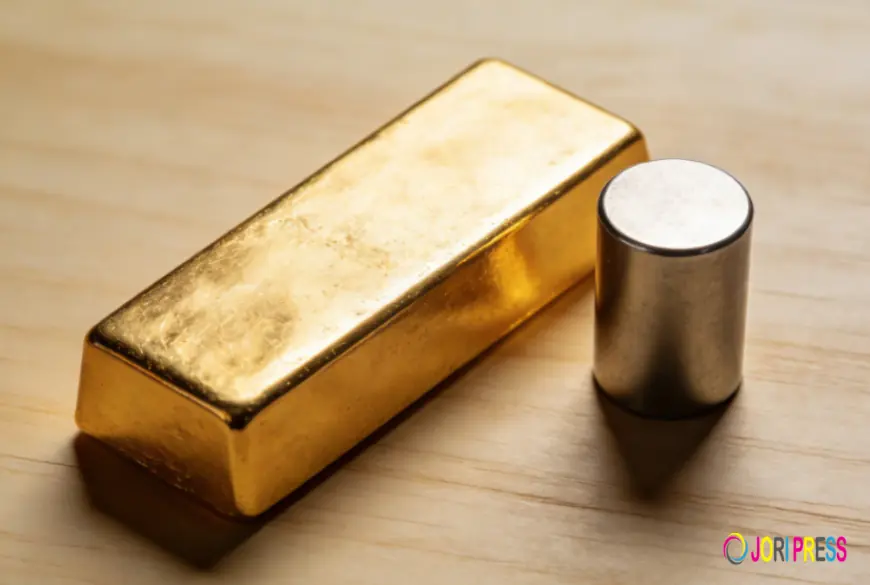
We’ve all seen it in movies or online videos: someone holds a strong magnet up to a gold coin or a piece of jewelry. If it sticks, it’s fake. If it doesn’t, it’s "real."
But as any materials scientist or professional jeweler will tell you, the relationship between gold and magnetism is far more nuanced than a simple "yes" or "no." Relying solely on a magnet test could lead you to toss out a valuable heirloom—or worse, buy a high-quality fake.
Here’s what you need to know about the science of gold and magnetism.
1. Pure Gold is Actually "Anti-Magnetic"
In technical terms, pure gold is diamagnetic. This means that instead of being attracted to a magnet, it actually creates a very weak repulsive field when placed near one. However, this effect is so subtle that you can’t feel it with your hands.
If your "gold" bar jumps toward a magnet, you’re likely looking at a core of iron, nickel, or cobalt hidden beneath a thin layer of gold plating.
2. Why "Real" Gold Might Sometimes React
Here is where it gets tricky. Most gold used in jewelry isn't 24K (pure). It is alloyed with other metals to make it harder and more durable.
-
White Gold: Often contains nickel or manganese, which can exhibit slight magnetic properties.
-
10K or 12K Gold: Because these contain a higher percentage of base metals (like copper or silver), their reaction to high-powered neodymium magnets can be unpredictable.
3. The Danger of the "False Negative"
The biggest myth is that if it doesn’t stick, it must be real. Sophisticated counterfeiters now use non-magnetic metals like Tungsten or Lead to mimic the weight and density of gold. Neither of these will stick to a magnet, but neither of them is gold.
Beyond the Magnet: How to Be Sure
While a magnet is a great first step in your "detective work," it is far from a definitive laboratory test. To truly understand how gold interacts with magnetic fields—including the fascinating Eddy Current effect used by professional metal sorters—you need to look at the physics.
We’ve put together a specialized guide to settle this debate once and for all. Explore the full breakdown here:
In this guide, you’ll learn:
-
The difference between Ferromagnetic and Diamagnetic materials.
-
Why specific gold alloys react differently to magnets.
-
The most reliable professional methods for testing gold purity.
What's Your Reaction?
 Like
0
Like
0
 Dislike
0
Dislike
0
 Love
0
Love
0
 Funny
0
Funny
0
 Angry
0
Angry
0
 Sad
0
Sad
0
 Wow
0
Wow
0