







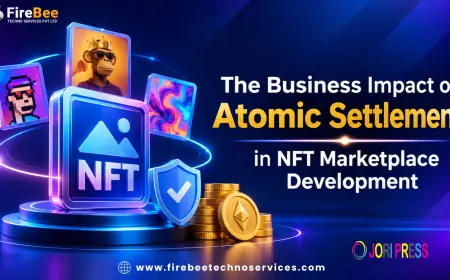





























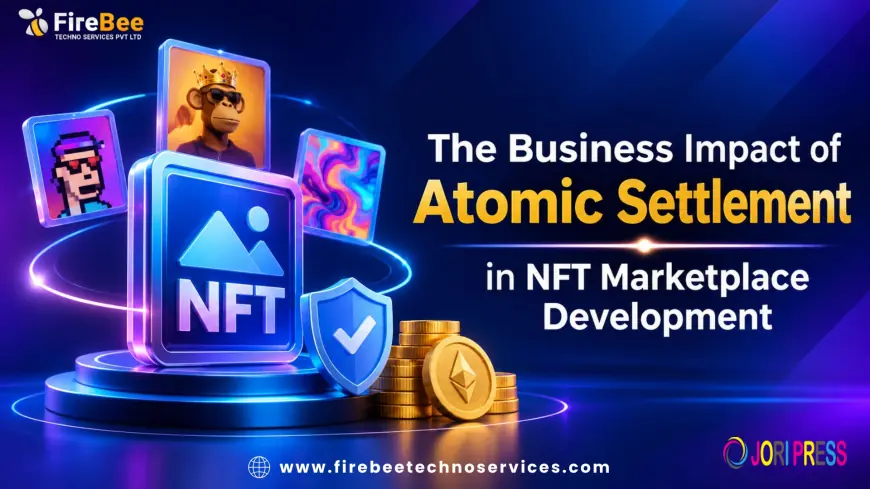
The Business Impact of Atomic Settlement in NFT Marketplace Development
Atomic settlement in NFT Marketplace Development prevents partial transactions by coordinating asset transfers and payments. Explore its business benefits for secure and reliable marketplace operations.

Transaction integrity is crucial for the profitability of NFT marketplace development. Where ever your users buy, sell or trade digital assets, every transaction should be completed without compromising the supply of ownership of digital asset on one hand and payment on the other hand. The problem of partial completion of transactions will lead to complex marketplaces which raise a lot of controversies, wrongs in asset ownership records and financial drifts. Atomic settlement helps to avoid such issues by making all operation related to a single transaction completed together or rolled back to the beginning.
Understanding Atomic Settlement in NFT Marketplace Transactions
Atomic settlement is a mode of executing a series of linked operations as a single operation. In an NFT marketplace, the linked operations can be transferring an NFT, paying, updating the ownership information, and recording the transaction.
For example, if a buyer buys an NFT, the marketplace must facilitate both the transfer of the payment to the seller and the change of ownership of the asset. If the payment is made but the asset does not change hands, the transaction results in a problematic situation. Atomic settlement can eliminate this.
This strategy becomes especially crucial when the marketplace is connected with multiple other blockchain networks, smart contract interactions, and multiple payment methods. It creates a deterministic transaction result between connected systems.
Preventing Partial Execution Through Atomic Transaction Logic
There is partial execution when one of the parts of the transaction has gone through while another related transaction gets unsuccessful. It can also be due to unavailability of balance, failure of smart contract or network failure.
Atomic transaction logic solves these issues with transaction coordination and rollback. Smart contracts define the conditions needed to complete the transaction. If any of those conditions aren't met, then the operation is reverted back to the previous state.
NFT Marketplace Development Developers are required to define the rules of transaction validation, execution dependency, and state consistency. These are used to maintain the consistency between asset transfer and payment transaction.
This also simplifies the process of troubleshooting failed transactions for marketplaces with high transaction volumes. It offers a more robust case for processing transactions.
Business Benefits of Reliable NFT Transaction Settlement
Nano settlement brings quantifiable operational benefits to NFT market businesses. Its influence is not limited to processing transactions alone, but also covers finance, the assurance customers have in your business, and the operation of your platform.
Transfer coordination will help reduce instances where buyers pay for an NFT but don't receive it, or sellers transfer an asset but don't get paid.
Performing payments uniformly ensures better data is available on payment execution, ownership and settlement history aiding reconciliation and financial reporting.
Marketplace administrators do not need to intervene when dependent transaction operations don't succeed. Marketplace operators have to spend fewer resources on dealing with disputes over transactions.
Consistent settlement results allow your business to hold more confidence in your buyers, sellers, creators, and other institutional players.
The advantages are more applicable as marketplace sellers increase their transaction volume and engage in more complex commercial structures.
Developing Atomic Settlement Into NFT Marketplace Architecture
Building atomic settlement requires proper architecture planning, not just a new function added to the existing smart contract. An NFT Marketplace Development Company must analyze how they will hold interactions, pay for transactions, transfer assets, and record their ownership.
Each transaction should have well-defined execution boundaries. Smart contracts will need to check for ownership rights, payment obligations, asset possession, and requirements before performing the transaction.
It should address: confirmation lag times on the blockchain, transactions failures, duplicate requests and external payment controls. Idempotent processing ensures duplicate requests will not lead to undesired effects, and transaction monitor would help identify and resolve incomplete or rolled-back transactions.
Atomicity in market places with off-chain payment providers or multiple ledgers In these types of market places, developers may use escrow, compensating transactions, or cross-chain settlement protocols, since the atomic blockchain transaction itself cannot enforcibly execute atomically on multiple external ledgers.
A good architecture facilitates easy monitoring, management and extension of settlement behavior as business needs change.
Conclusion
When developing a reliable NFT marketplace, atomic settlement is an architectural element that can offer several benefits to the stable operation of your business. By facilitating the execution of payment processing and digital asset transfer in a synchronized manner, it may eliminate risks associated with partial settlement, which ultimately enhances the user experience of your marketplace. These benefits of stable transaction settlement and reconciliation ultimately help you develop a scalable marketplace.
What's Your Reaction?
 Like
0
 Dislike
0
 Love
0
 Funny
0
 Angry
0
 Sad
0
 Wow
0