

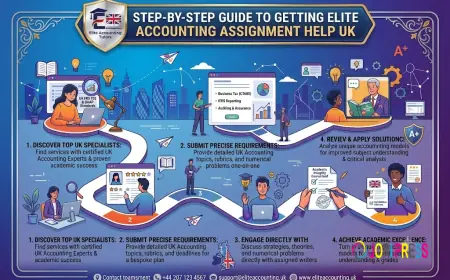



































Step-by-Step Guide to Choosing Accounting Assignment Help UK
Not sure how to pick Accounting Assignment Help you can trust? Follow this practical 8-step guide to check quality, pricing, privacy and more.
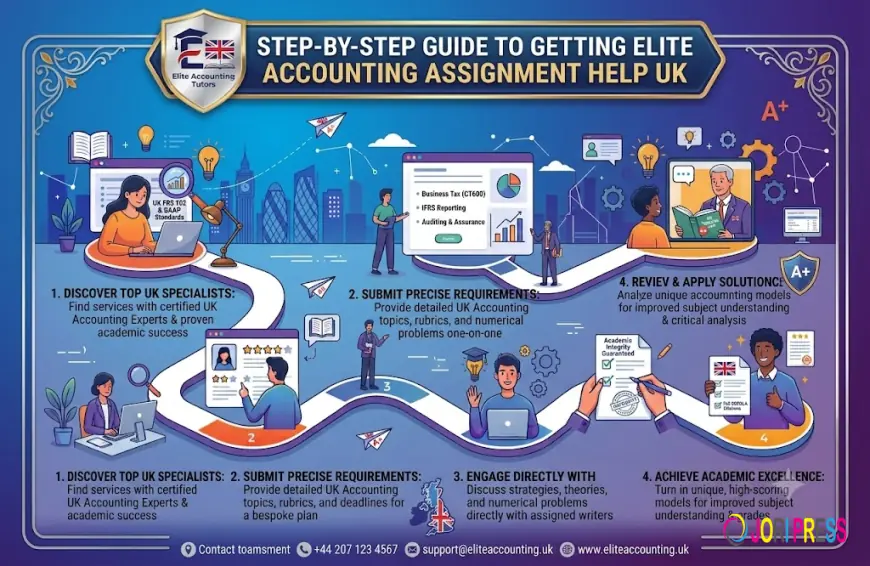
It's 11pm, the deadline is Friday, and your balance sheet refuses to balance. Sound familiar? Plenty of students reach this point, and many start searching for Accounting Assignment Help the same night. That's a sensible move, but only if you choose well. Some services are run by qualified accountants who know what a UK marker wants. Others are content mills with a polished website and nothing behind it. This guide walks you through eight clear steps so you can tell the difference before you pay anyone a penny.
Why Do So Many UK Students Look for Accounting Help?
Accounting is cumulative, so one missed concept follows you around. If you never properly understood accruals in term one, your adjustments in term two fall apart, and by the time group cost allocation turns up you're underwater.
Then there's the workload. Many students juggle part-time jobs, placements and three other modules. Add the pressure of rules that change (tax thresholds, reporting standards, company law updates) and it's easy to see why people look for outside support. Asking for help isn't a character flaw. The real risk is picking the wrong kind of help.
Step 1: What Do You Actually Need Help With?
Before you open a single website, get specific. "I need help with accounting" is too vague to be useful, and a vague brief gets a vague result.
Ask yourself which of these fits best:
- Understanding a topic, such as consolidated accounts or depreciation methods
- Checking your own work, where you've done the answer and want feedback
- Worked examples you can study and learn the method from
- Full support on a big piece like a case study or dissertation chapter
Write down your module, the level (foundation, undergraduate, postgraduate, professional), the word count, the marking criteria and the deadline. Keep your university's rules open in another tab too. Some institutions allow tutoring and proofreading but treat submitting someone else's work as your own as misconduct. Knowing that line first protects you.
Step 2: Who Is Actually Doing the Work?
This is where most students skip ahead, and it's the step that matters most. A good service tells you who its experts are. Look for writers with accounting or finance degrees, and ideally professional study or qualifications such as ACCA, ICAEW, CIMA or AAT.
Don't settle for "our team of experts" on a homepage. Ask direct questions. What's the writer's background? Have they marked or taught at UK level? Can they handle your specific topic, say IAS 16 or partnership accounts?
If the service dodges those questions or replies with a canned line, that tells you plenty. Honest providers are happy to explain who they use, because it's their main selling point.
Step 3: Do They Understand UK Standards and Marking?
Accounting isn't identical everywhere. A writer trained mainly on US GAAP might hand you a perfectly tidy answer that's wrong for your course. UK students typically work with IFRS, UK GAAP and FRS 102, plus HMRC rules for tax modules and the Companies Act for company reporting.
Test this early. Ask a short, pointed question such as which framework suits a small UK company's accounts, and see whether the answer sounds confident and correct. Pay attention to small things too:
- Pound sterling, not dollars, in worked examples
- UK terminology ("debtors" and "stock" still appear in plenty of UK courses alongside "receivables" and "inventory")
- Harvard or other referencing styles your department asks for
- Awareness of how UK markers reward working shown, not just final figures
A service that gets these details right has probably done this a lot.
Step 4: How Should You Read Reviews?
Five-star ratings on a company's own site prove very little. Go to independent places: Trustpilot, Google reviews, Reddit threads, student forums. Then read like a sceptic.
Two hundred glowing reviews that all sound the same, posted within the same fortnight? Suspicious. A mix of ratings with specific comments ("my tutor explained the cash flow statement clearly and the work was on time") is much more believable. Also read the bad reviews. Look at how the company responded. A calm, specific reply suggests a real business. Silence or aggression suggests the opposite.
One extra trick: search the company name with the words "complaint" or "refund". Ten minutes of digging can save you a lot of money.
Step 5: How Much Should Accounting Assignment Help Cost?
Price varies with level, deadline, length and complexity. A first-year bookkeeping exercise costs less than a postgraduate financial analysis, and a 12-hour turnaround costs more than a two-week window. That part is normal.
What should worry you is a price far below everyone else's. Qualified accountants don't work for pennies, so a rock-bottom quote often means an inexperienced writer, recycled content or a bait-and-switch with hidden extras later.
Get quotes from three or four providers and ask what's included. Does the price cover revisions? Is there a plagiarism report? Are working notes included? Pick the best value, not the cheapest number. If a company won't give you a clear quote before payment, walk away.
Step 6: Can You Test Them First?
Yes, and you should. Reputable providers will let you start small or share a sample of previous work. If you're nervous, order something minor first, perhaps a single question or a review of a draft paragraph, before handing over a 3,000-word case study.
When you see a sample, check the substance, not the formatting. Are the calculations correct and clearly laid out? Does the explanation make sense to a student, not just another accountant? Is the reasoning visible? A good sample teaches you something. A bad one just looks professional.
This small trial also shows you how the team communicates, which brings us to the next point.
Step 7: What Happens With Originality and Your Privacy?
Accounting work gets checked by software and by human markers, so originality matters. Ask whether the work is written from scratch for you and whether they provide a similarity report. Be wary of anyone who sells "ready-made" answers, because those can be sold to several students.
Privacy matters just as much. You're sharing your name, university, module code and sometimes login details or marking feedback. Check the privacy policy, look for secure payment options and never share your university password. A trustworthy company asks for the assignment brief, not your account.
Also confirm the payment route. Established card processors and similar methods give you some protection if something goes wrong. Bank transfers to a personal account or odd payment methods are a red flag.
Step 8: How Good Is Their Communication and Support?
Send a message and time the reply. Slow answers before you've paid will only get slower after. You want real people who answer questions properly, explain what's included and tell you honestly if a deadline is unrealistic.
Check the practical terms as well:
- Revisions: how many, how long you have to ask, and whether they're free
- Deadlines: what happens if work arrives late
- Refunds: the conditions, written in plain language
- Direct contact: can you speak to the writer or tutor with follow-up questions?
A clear, fair policy shows confidence. Vague or hidden terms usually show the opposite.
What Red Flags Should Make You Walk Away?
Sometimes a quick checklist saves you from yourself at 11pm. Step away if you see any of these:
- Promises of a guaranteed first-class grade (nobody can honestly promise that)
- No named qualifications or no way to verify them
- Pressure to pay immediately, "today only" discounts, countdown timers
- No contact details beyond a web form
- Refusal to share a sample or answer a technical question
- Requests for your university login
- Reviews that all read as though one person wrote them
One red flag might be a bad day. Three or four is a pattern.
How Can You Use Help to Actually Learn the Subject?
Here's the angle most guides skip. The best Accounting Assignment Help should leave you more capable, not more dependent. If you only collect finished answers, you'll hit the exam hall with nothing in your head, and exams are where accounting students most often come undone.
Try this approach instead:
- Attempt the question yourself first, even badly
- Compare your attempt with a worked solution and mark the exact step where you went off track
- Ask the expert to explain that one step in plain English
- Redo a similar question from scratch a few days later without notes
This turns a one-off purchase into revision material. A trial balance you've struggled through and then understood sticks far better than one you've only read. Used this way, outside support works like a tutor sitting beside you, which is what the most sensible students want from it.
One more habit worth building: keep a small "mistakes log". Every time a markers' comment or an expert's note shows you've slipped (forgot the prepayment, misclassified a cost, ignored a tax adjustment), write it down in one line. Before each new assignment, skim the list. It takes two minutes and prevents the same errors repeating. By the end of the module you'll have a personalised cheat sheet that no textbook could give you.
So, Which Option Is Right for You?
There's no single best provider for everyone. A first-year student who needs clear worked examples has different needs from a postgraduate preparing a complex group consolidation, and a part-time student fitting study around a job may need flexible timing above all else.
Use your answers from the steps above as a scorecard. Rate each provider out of five on expertise, UK knowledge, reviews, price clarity, originality, privacy and support. The one with the best overall mix usually wins, even if it isn't the cheapest or the flashiest. Trust your instincts too. If a service feels pushy, evasive or too good to be true, it probably is.
Final Thoughts
Choosing support for your accounting studies doesn't need to feel risky. Decide what you need, check who's doing the work, confirm they know UK standards, read reviews with a sharp eye, compare prices fairly, test with something small, protect your privacy and look closely at support terms. Do that, and you'll avoid most of the traps that catch students at the last minute.
Most important, treat any help as part of your learning, not a replacement for it. Whether you're after a quick explanation of a tricky topic or detailed guidance on a major piece of coursework, the right partner will be open, qualified and clear about what you're getting. Take your time with that first search for assignment help UK, ask the awkward questions up front, and you'll be far more likely to find a service worth keeping for the rest of your degree.
Visit Now - primeassignmenthelp.co.uk
What's Your Reaction?
 Like
0
 Dislike
0
 Love
0
 Funny
0
 Angry
0
 Sad
0
 Wow
0