




































Solar for Apartments vs Independent Houses: What Actually Works Better?
Solar is becoming a practical choice for Indian homeowners who want to reduce electricity bills and depend less on grid power.
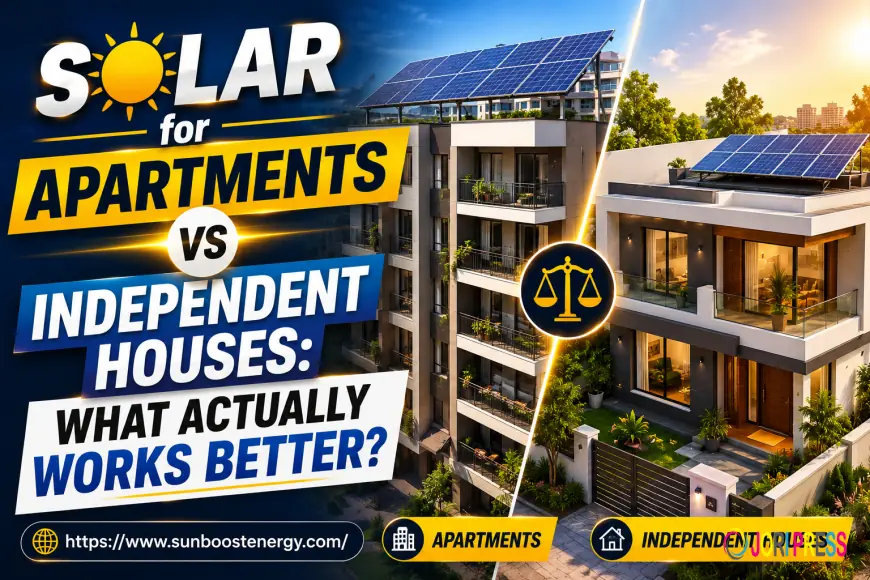
Solar is becoming a practical choice for Indian homeowners who want to reduce electricity bills and depend less on grid power. But the experience of installing solar on an independent house is quite different from installing it in an apartment building.
An independent homeowner usually controls the entire roof and electricity connection. Apartment residents, on the other hand, share the roof with other families and must consider society approvals, common-area consumption and available space.
So, which property type works better for solar? The answer depends on roof ownership, electricity usage, and how the system will be used.
Quick Answer
Independent houses generally offer more control over system size, panel placement, and electricity usage. Apartments can also benefit from solar, especially when the system is installed for common area loads such as lifts, water pumps, lighting, and security equipment.
Neither option is automatically better. The most suitable choice depends on the property’s roof space, energy requirements and decision-making process.
Solar for Independent Houses: How Does It Work?
Homeowners with independent properties can install a Rooftop Solar System designed around their own electricity consumption. The power generated can support household appliances such as fans, lights, refrigerators, air conditioners.
Because the homeowner controls the roof, the process is usually straightforward. They can decide the system capacity, panel placement, inverter type and whether battery backup is required.
Main Benefits for Independent Houses
- Greater control over the available roof
- System sizing based on one household’s consumption
- Easier decision-making and approval
- Direct benefit from the electricity generated
- Flexibility to consider battery storage
- Easier monitoring of generation and usage
For example, a family can review its recent electricity bills, available shadow-free roof area and future needs before choosing a 3kW, 4kW, 5.5kW Solar System or another suitable capacity.
Possible Limitations
An independent house may still have limited usable space because of shaded areas, terraces, or nearby buildings. The roof condition and structure must also be checked before installation.
Homeowners should avoid selecting capacity based only on their highest electricity bill. Consumption patterns across different seasons provide a more realistic picture.
Solar for Apartments: What Are the Options?
Installing solar in an apartment building requires a different approach. The rooftop is usually treated as a common area, so one resident may not have the authority to use it without approval from the housing society or apartment association.
In many buildings, solar is installed to support shared electricity needs rather than individual flats. Common applications include:
- Lifts
- Parking-area lights
- Staircase and corridor lighting
- Security systems
- Clubhouse facilities
- Society office equipment
Installing solar panels for an apartment can help reduce society’s common electricity expenses. The benefit may then be reflected in lower maintenance costs, depending on how the association manages and distributes the savings.
Can Solar Power Individual Flats?
It may be possible in some buildings, but it is not always simple. The feasibility depends on roof rights, available space, electrical design, metering arrangements, and local distribution-company requirements.
A large apartment building may not have enough roof area to meet the full electricity demand of every flat. Dividing limited space fairly among residents can also be challenging.
That is why many housing societies begin with common-area consumption. It gives residents a shared benefit and makes system planning easier.
Which Option Usually Delivers Better Results?
For personal control and direct electricity-bill savings, an independent house usually has the advantage. The homeowner can design the system around their consumption and make decisions without waiting for a group approval.
For apartments, solar works particularly well when society has considerable daytime common-area consumption. Lifts and shared facilities often operate during daylight hours, allowing more solar electricity to be used as it is generated.
The result depends less on the type of building and more on whether the system matches the actual consumption. Poor sizing can lead to disappointing results in both houses and apartments.
How Much Solar Capacity Does the Property Need?
Start by reviewing electricity bills from different seasons. Note the number of electricity units consumed, the daytime load and any planned additions such as air conditioners, electric vehicles or new shared facilities.
A solar power calculator can provide an initial capacity estimate based on electricity usage. However, the final recommendation should also consider roof area, shading, panel orientation, and the property’s electrical setup.
Apartment societies should review common-area bills separately from residents’ individual bills. This makes it easier to identify the load that the shared solar system is expected to support.
What Should You Check Before Installing?
Whether you own a house or live in an apartment, check the following before making a decision:
- Usable and shadow-free roof space
- Roof condition and structural suitability
- Current and future electricity consumption
- Panel and inverter specifications
- System monitoring features
- Installation workmanship
- Product and service warranties
- Maintenance and after-sales support
- Required permissions and documentation
Apartment societies should also agree on system ownership, maintenance responsibility, and how the financial benefit will be managed.
Final Verdict: Which One Works Better?
Independent houses are usually better suited to personalised solar installations because homeowners have greater control over the roof, system capacity and electricity usage.
Apartments can still achieve meaningful results when residents work together and use solar for common-area loads. The right question is not simply “house or apartment?” It is whether the property has suitable roof space, a clear electricity requirement, and a properly planned installation.
Sunboost Energy provides end-to-end solar support for independent homes, apartments, flats and housing societies across India. The process starts with assessing the property, electricity consumption, and available roof area before recommending a suitable solution.
What's Your Reaction?
 Like
0
Like
0
 Dislike
0
Dislike
0
 Love
0
Love
0
 Funny
0
Funny
0
 Angry
0
Angry
0
 Sad
0
Sad
0
 Wow
0
Wow
0