







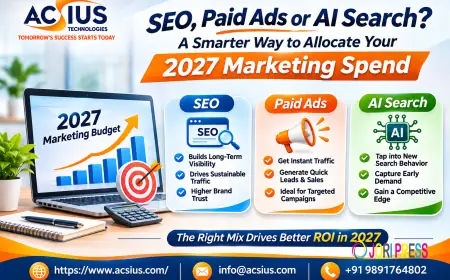


































SEO, Paid Ads or AI Search? A Smarter Way to Allocate Your 2027 Marketing Spend
Working with an experienced provider of PPC Services India can help you structure campaigns, tighten targeting, improve landing pages, and track conversions properly, so your ad budget works harder instead of simply buying more expensive clicks.

Most marketing budgets are built the same way: take last year's numbers, add a small increase, and divide the money between the same channels. That approach worked when search was stable. In 2026, it is risky. AI-generated answers are changing how people click, advertising costs keep climbing in many markets, and a new channel, visibility inside AI assistants, is growing from a very small base.
This guide offers a simpler way to think about the decision. Instead of asking which channel is best, you will learn to sort your spending into three buckets, protect what already works, and run small, measurable tests on what might work next. It is general marketing guidance, not financial advice, so check any plan against your own numbers.
What the 2026 Data Tells Us
Before you move any money, it helps to know what is actually happening. Recent research gives a useful, if imperfect, picture.
AI answers are reducing some clicks. Studies by Ahrefs and a randomized experiment by researchers at the Indian School of Business and Carnegie Mellon found lower organic click-through rates on queries that show an AI Overview. SEOcrawl's analysis of more than 16,000 sites reported that Google organic clicks fell about 15 percent year over year. Results vary by method and topic, and some data suggests partial stabilization.
AI assistants send a small but growing share of visits. SE Ranking's 2026 research found AI platforms account for roughly 0.32 percent of website traffic, up from about 0.02 percent in 2024, while organic search accounts for around 42.75 percent. Google still sends well over a hundred times more visitors than all AI assistants combined.
Paid costs are drifting upward. WordStream and LocaliQ's 2026 benchmarks put the average search cost per click at about $5.42, compared with about $5.26 a year earlier, with an average conversion rate near 8.18 percent. Other studies report larger increases. Indian markets differ from US figures, so use your own account data as the real benchmark.
The takeaway is not panic. It is balance: traditional search still dominates volume, ads are getting costlier, and AI visibility is early but worth watching.
The Three-Bucket Method
Instead of splitting your budget by channel name, split it by purpose. This keeps decisions tied to outcomes.
Bucket 1: Protect (the core, roughly half to two-thirds of spend)
This money keeps your proven sources of revenue running. It includes the pages that already rank and convert, the campaigns with profitable returns, your Google Business Profile, and the technical health of your website. If a channel reliably produces customers at an acceptable cost, it belongs here.
Bucket 2: Grow (about a quarter to a third of spend)
This money expands what is working. Examples include new content on topics where you already have authority, additional keywords in profitable ad groups, new location pages, or improved conversion rates on high-traffic pages. Growth spending is based on evidence from your own data, not on trends.
Bucket 3: Test (about 5 to 15 percent of spend)
This money funds experiments: AI visibility tracking, new ad platforms, a different content format, or a new market. Tests should be small, time-limited, and tied to a clear question and a success measure. If a test works, it graduates to the Grow bucket. If it does not, you stop and move on.
These percentages are starting points, not rules. A new business with little proven revenue may spend more on growth and testing, while an established business with stable results can lean more heavily on protection.
Step 1: Audit What Is Actually Working
Before you decide on a split, review the last twelve months of data. Answer these questions:
- Which channels produced customers, not just clicks, and at what cost?
- Which pages and campaigns drive the most conversions?
- How is branded search trending? Rising brand demand is a healthy sign.
- Where did traffic fall, and was it on simple informational queries or on high-intent pages?
- Which parts of your website have technical or content problems that waste existing traffic?
Be honest about attribution. People often discover a brand through one channel and convert through another, so last-click reports can undervalue organic and AI visibility. Use assisted conversions and customer surveys where you can.
Step 2: Understand What Each Channel Is For
Each channel does a different job, and judging them by the same yardstick leads to poor decisions.
Organic SEO remains the base because it builds assets you own. Google says its AI features rely on indexed, high-quality pages and follow standard SEO fundamentals, so strong content, technical health, and authority help in more than one place.
Paid ads are the fastest lever. They are especially useful when you need leads soon, when you are launching something new, or when you want to learn which messages convert before investing in long-term content. Judge them by cost per customer and return on spend rather than cost per click alone. Working with an experienced provider of PPC Services India can help you structure campaigns, tighten targeting, improve landing pages, and track conversions properly, so your ad budget works harder instead of simply buying more expensive clicks.
AI search visibility is the newest channel. It focuses on making your brand easy for AI systems to understand and cite, which overlaps heavily with good SEO. Volumes are small today, but some studies report that AI-referred visitors engage longer or convert at higher rates, though results from a single site may not apply to yours.
Step 3: Treat AI Visibility as a Measured Experiment
Because AI search is early and hard to measure, it fits naturally into the Test bucket. A sensible first experiment is simple and low-cost:
- Choose 20 to 30 priority questions your customers ask.
- Check them regularly in AI Overviews, AI Mode, ChatGPT, Gemini, and Perplexity, and record whether your brand appears or is cited.
- Improve the pages behind those topics. Lead with direct answers, add original insight, show real authorship, and keep facts current.
- Track the results. Watch AI citations, branded search, and referral visits from AI tools where your analytics can separate them.
- Review after a quarter. If you see progress or revenue signals, increase the budget. If not, adjust the approach.
Be cautious about measurement. Google reports clicks from AI Overviews and AI Mode as ordinary organic clicks, and third-party tracking tools use sampling, so figures are estimates. For brands that want structured support, a specialist offering AI SEO Services India can monitor brand mentions across AI platforms, identify content gaps, and recommend improvements. No honest provider can guarantee citations, so treat any promise of that kind as a red flag.
Step 4: Do Not Overlook Local Visibility
If you serve customers in specific areas, local search deserves a place in your Protect or Grow bucket. Local queries often show maps, business profiles, and reviews, which can make them more resilient to AI summaries than general informational searches. They also tend to show strong buying intent, since people searching for a nearby service often want to act quickly.
The basics are straightforward: a complete and accurate Google Business Profile, consistent business details across directories, genuine reviews with thoughtful replies, and unique location pages with real local information. Businesses with several branches or service areas often use dedicated local seo services India to manage profiles, citations, reviews, and location content at scale. For many small and mid-sized companies, this is one of the most cost-effective parts of the whole plan.
Step 5: Set Rules for Moving Money
A smart budget is flexible, but flexibility without rules turns into guesswork. Decide in advance what evidence will trigger a change:
- Increase a channel when cost per customer stays below your target for at least two review periods and there is room to scale.
- Reduce a channel when costs exceed your target with no clear improvement after fixes.
- Graduate a test when it produces a measurable result, such as qualified leads, rising branded searches, or improved conversion rates.
- Stop a test when it fails to move its success measure by the end of its time limit.
- Pause and investigate when a sudden change appears, such as a traffic drop after an algorithm update, before reacting.
Write these rules down and review them quarterly. It prevents emotional decisions, like cutting SEO after one slow month or doubling ad spend because a competitor did.
Sample Splits for Different Situations
These are illustrations to help you think, not recommendations. Adjust them to your goals and data.
Established business with steady organic traffic. Protect the organic foundation and profitable campaigns, grow content around proven topics, and keep a small test budget for AI visibility. A rough pattern might be 55 percent protect, 33 percent grow, and 12 percent test.
New business that needs leads quickly. Put more weight on paid media for early demand, invest steadily in website and content foundations, and test cautiously. For example, 40 percent protect (basics and early winners), 45 percent grow (paid and content), and 15 percent test.
Local service business. Concentrate on local search, reviews, and targeted ads, with a modest test budget. For example, 60 percent protect, 30 percent grow, and 10 percent test.
Ecommerce store. Balance product and category SEO, shopping and search ads, and an experimental line for AI discovery, since AI referrals have shown strength in shopping categories. For example, 50 percent protect, 35 percent grow, and 15 percent test.
How to Measure Everything Fairly
A fair comparison needs consistent measurement across channels. Build a simple dashboard with:
- Cost per lead and cost per customer by channel.
- Revenue or pipeline value by source where possible.
- Organic impressions, clicks, and branded search growth from Search Console.
- Conversion rate by channel and page type.
- AI citations and AI referral visits, using tools and analytics settings that separate AI sources where available.
- Assisted conversions, to see how channels support one another.
Compare trends over months, not days. Search results and AI features change often, and short-term swings can mislead.
Common Budgeting Mistakes to Avoid
- Funding ads by starving SEO, or the reverse. The channels support each other over time.
- Spending big on AI hype. Start small, measure, and scale only with evidence.
- Judging ads by cost per click. Focus on profit per customer.
- Ignoring website quality. Weak pages waste both paid and organic traffic.
- Expecting instant organic results. Plan for a longer runway.
- Locking in a rigid annual plan. Build in quarterly reviews.
- Relying on a single study. Compare sources and check your own data.
Final Thoughts: Allocate by Purpose, Not by Habit
The smartest 2027 budget is not the one with the perfect percentage split. It is the one built on evidence, protected where results are proven, expanded where growth is likely, and tested carefully where the future is uncertain. Review your data, set clear rules for moving money, and revisit the plan every quarter. That discipline will serve you better than any trend.
If you would like expert help building a balanced search and advertising plan for 2027, ACSIUS can support you with audits, content strategy, technical optimization, paid media, local visibility, and AI-focused improvements through clear, ethical, results-driven methods. Contact ACSIUS today to build a marketing budget that is grounded in your data and ready for what comes next.
What's Your Reaction?
 Like
0
 Dislike
0
 Love
0
 Funny
0
 Angry
0
 Sad
0
 Wow
0