





























Robotic Systems for Investment Casting: Modern Foundries Achieve Better Precision, Consistency, and Productivity
Robotic systems for investment casting improve precision, consistency and productivity in modern foundries, Automated robotic shell building solutions by Laxminarayan Technologies ensure uniform quality, scalable production and reduced labor dependency

Investment casting has historically relied on a high degree of discipline, daily scheduling, oversight and close scrutiny of each step to achieve a successful cast product. As an example, wax pattern creation through processing the wax, forming the ceramic shell, eliminating wax and pouring the molten metal are all functions that have an effect on the overall quality of the cast created. Among all these steps, forming the shell has traditionally had one of the highest amounts of labor used and was one of the more process-sensitive steps in making a cast product. Recent years have shown that the introduction of robotic systems for investment casting has solved many of the issues that have plagued the modern foundry in their quest for greater consistency, scalable volume and production standards.
Robotics are not replacing human skilled artisans; they are enhancing them. Robotics have introduced repeatability, increased accuracy and structured methodologies into the shell creation phase of investment casting, thereby allowing foundries to produce reliable and repeatable results regardless of increasingly complex part geometries and growing quality expectations. Robotic shell creation technologies, such as Laxminarayan Technologies' solutions, combine advanced automation with practical factory floor experience.
The Automation of Investment Casting Has Become a Necessity
Investment casting companies have historically relied on various manual processes, such as dipping the shell in a slurry, draining the excess liquid, applying stucco, and allowing the shell to dry before using it to produce a part. An experienced operator can produce consistent, high-quality investment castings; however, manual operations introduce variability due to the operator's technique (or lack), the fatigue of the previous operator, changes in the atmosphere around the shop (temperature/humidity/etc.), or the pressure of the production schedule. Variability introduces defects that may only be seen after pouring metal.
As investment casting becomes increasingly common, manufacturers are also facing numerous new challenges and issues that require automation:
• Increased demand for complex and thin-walled castings
• Reduction of lead times and shortening of delivery schedules
• Increased labour costs combined with a decreasing number of skilled labour available for employment
• Increased ability to produce castings with a consistent, repeatable quality throughout production runs
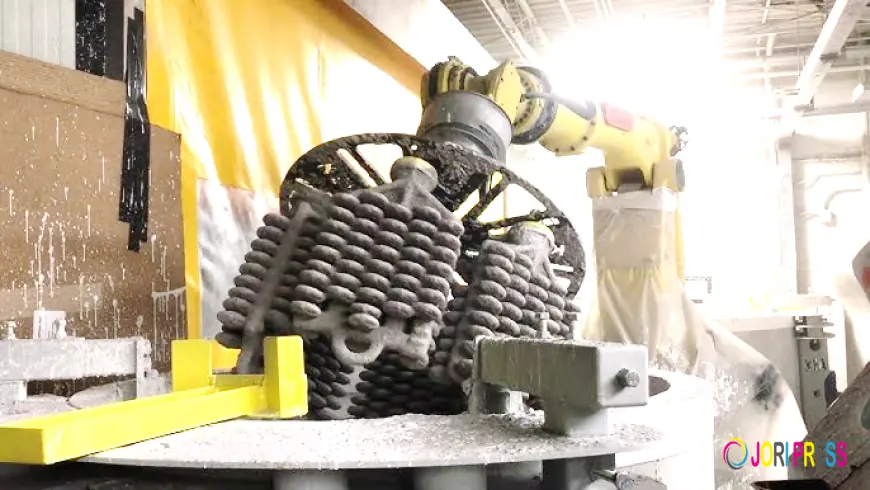
Robotic systems used in investment casting address these unique challenges by automating the most important aspects of the shell-building process. Robotic arms are programmed to follow the exact same path to repetitively create the same type of coating on every wax assembly. The automation solutions developed by Laxminarayan Technologies focus on creating a consistent coating on all wax assemblies while allowing flexibility to produce parts of varying sizes and production volumes.
Understanding Investment Casting Robotic Systems
At their core, investment casting robotic systems integrate industrial robots into the shell building workflow. These systems are engineered to perform essential operations such as:
- Dipping wax trees into ceramic slurry
- Controlled rotation and drainage for uniform coating
- Stucco application using fluidized beds or rain sanding systems
- Smooth transfer between dipping, stucco, and drying stations
In this setup, the robot becomes a precise extension of the process rather than a simple handling tool. Parameters such as movement speed, immersion angle, dwell time, and withdrawal rate are carefully defined and consistently repeated. Achieving this level of control through manual methods alone is extremely challenging, especially at higher production volumes.
Accuracy and Consistency of Robotic Shell Building
Robotic shell building is especially beneficial due to its accuracy. Unlike humans who may rush, tire or change how they make shells from one cycle to the next, robots execute each dip in accordance with the same pre-programmed sequence, thereby producing shells with uniform thickness throughout all components created from each batch of shell materials. The benefit of uniformity in shells includes:
• Stronger shell
• More uniform permeability
• More accurate dimensions in final casting
The aerospace, automotive, medical and other high-value industries require a high level of consistency in their shell material. Therefore, even a slight variation in quality may be converted into scrap, require additional processing time, or lead to a customer refusing a product. Robotic systems offered by Laxminarayan Technologies will help minimize those risks by ensuring uniformity of all steps needed to produce and deliver a completed shell.
Improved Process Control and Data Consistency
Automation also brings clarity to process control. Once shell building is automated, it becomes measurable and repeatable. Cycle times, dip durations, and handling sequences are fixed and documented, making it easier to maintain standards across shifts and production runs.
This structured approach helps foundries:
- Maintain consistent quality regardless of operator changes
- Train new personnel more efficiently
- Identify root causes when defects occur
- Scale production without compromising quality
In many facilities, robotic shell building forms part of a broader move toward smart manufacturing, where equipment performance and process data support quality assurance and continuous improvement initiatives.
The Advancement of Complex Geometries Through Accurate Axis of Rotation (AOR) and Cylindrical Axis of Rotation (CAR)
The increasing complexity of castings has made shell building by hand increasingly difficult due to the complexity of deep cavities, undercuts, thin areas, and complex internal channels that require careful management when dipping and draining to avoid air entrapment or uneven coating on the casting. The use of robotic systems is particularly beneficial for these types of geometries, since robotic systems can easily rotate and position wax assemblies at consistent angles, allowing smooth flow of slurry and uniform drainage through even the most difficult to access internal geometries. Because of this capability, foundries are able to safely accept complex projects that would normally carry a significant amount of risk. Solutions offered by Laxminarayan Technologies have been developed to provide flexibility and accommodate a broad range of casting designs.
Stable, Consistent Production and Reduced Reliance on Skilled Labour
While the need for experienced shell builders will continue to exist, their ability to be recruited and retained will become more difficult. Robotic systems that utilise investment casting technology will reduce the dependence on skilled labour for the repetitive and demanding physical work involved in the manufacturing process while continuing to value the knowledge gained from experience.
In addition to the repetitive nature of the dipping operations, the skilled personnel will have the ability to focus on the following areas:
• Slurry formulation and control
• Process improvements and optimisations
• Quality assurance and troubleshooting
• Supervision and Maintenance of Equipment
The robotic systems will deliver a consistent and stable output during the shift, without the fluctuations experienced in the manual operation, which will improve the planning of production and provide confidence in being able to deliver products in a timely manner.
Cleanliness Improvements and Increased Worker Safety
As a result of the ceramic slurry, stucco dust and the wear and tear caused by the repeated handling of heavy wax assemblies, employees working in Shell building face increased burdens on their bodies over time, which could lead to injuries as well as other health issues.
The introduction of robotics for dipping the wax pattern into a ceramic slurry and applying stucco reduces the employee’s exposure to the conditions found in the shell building as they only need to monitor the actions of the robot, instead of performing the strenuous manual work that was formerly required. This creates a cleaner, safer and more orderly shell room that meets current safety and workplace standards.
Scalability for Growing Foundries
For foundries planning future expansion, robotic shell building provides a clear and reliable path to scalability. Once a robotic system is programmed and validated, increasing output depends on scheduling and throughput rather than additional labor training.
Multiple robots can be integrated into a single shell building line, operating alongside controlled drying rooms and slurry management systems. This modular approach, supported by system integrators like Laxminarayan Technologies, allows foundries to expand capacity while maintaining consistent quality.
Integration with Existing Foundry Equipment
Modern investment casting robotic systems are designed to integrate seamlessly with existing foundry infrastructure. They can work with:
- Existing slurry tanks and stucco beds
- Automated drying tunnels or controlled drying rooms
- Transfer systems and conveyors
- Process monitoring and control software
This flexibility makes robotic shell building suitable
not only for new installations but also for established foundries seeking to modernize specific process stages without a complete plant overhaul.
The capital outlay to implement robotic systems will be greater than with traditional manual equipment, however, in the long run there will be an oversized benefit with robotic systems through lower scrap rates, better yields, less rework and consistent production efficiency. Overall these factors lead to positive returns on investment for your business.
In addition to providing positive returns on investment through factors such as scrap rates, yields, rework levels and production efficiency. Automation provides foundries with the additional benefit of protecting foundries from shortages of labour and rising wages thereby providing businesses with a more resilient and future-ready operation.
Through the implementation of robotic shell building using well engineered solutions provided by Laxminarayan Technologies, robotic shell building should not be seen merely as an upgrade to an existing piece of equipment but rather an investment strategy for the business.
summary
In the process in determining how to implement an investment casted product is incredibly complex because it is very important to have high accuracy and repeatability from one piece to the next. As the market continues to change, so will the way we produce investment casted products through using technology, such as robotic systems used in the investment casting process - especially systems created and designed by Laxminarayan Technologies. These robotic systems enable foundries to achieve the necessary level of precision and consistency required to manufacture casted products without sacrificing the quality or dependability of those products.
Robotic Systems are able to introduce repeatability, process management, and scalable automation to shell construction, thereby providing a means to improve the efficiency, quality, and sustainability of today’s foundries. For any manufacturer who wishes to produce more efficiently, produce the best quality and establish sustainable growth will find by adopting robotic shell building they have access to a strategic advantage.
What's Your Reaction?
 Like
0
Like
0
 Dislike
0
Dislike
0
 Love
0
Love
0
 Funny
0
Funny
0
 Angry
0
Angry
0
 Sad
0
Sad
0
 Wow
0
Wow
0