



































Professional Bug Sweeping vs Consumer Detectors: What Is the Difference?
Compare consumer bug detectors with professional TSCM inspections to understand their capabilities, limitations, and bug-sweeping options in Mumbai.
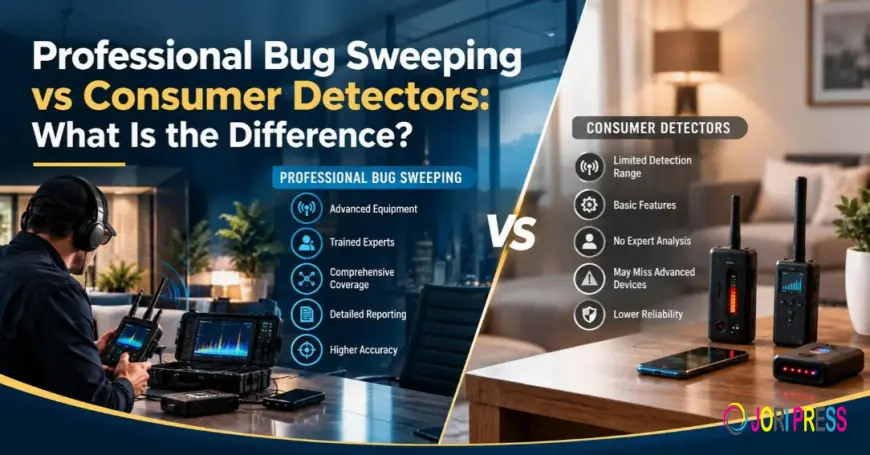
Concerns about hidden cameras, listening devices, or other unauthorized monitoring can lead people to consider consumer bug detectors available online. These gadgets may offer a convenient starting point, but their capabilities vary significantly, and interpreting their alerts is not always straightforward.
A professional Technical Surveillance Countermeasures assessment takes a more systematic approach. Rather than relying on a single detector or signal reading, it may combine physical inspection, suitable technical instruments, and careful evaluation of findings within the scope of the assignment.
For individuals, business owners, executives, and organizations in Mumbai, understanding the difference between consumer bug detectors and professional bug sweeping can help determine which approach is appropriate for a particular concern.
What Are Consumer Bug Detectors?
Consumer bug detectors are commercially available devices designed to help users identify certain indicators that may be associated with electronic monitoring equipment. Depending on the model, they may detect radio-frequency (RF) activity, provide alerts when a signal changes, or use optical methods to help locate some camera lenses.
But not all consumer devices work the same way. Their detection range, sensitivity, supported frequencies, operating conditions, and ability to distinguish relevant signals can vary considerably.
Some devices may alert users to ordinary wireless activity from mobile phones, Wi-Fi routers, Bluetooth accessories, and other nearby electronics. These alerts do not automatically indicate the presence of a hidden surveillance device.
Consumer detectors can have a limited role in preliminary awareness, but their readings should not be treated as proof that surveillance is occurring—or as confirmation that a room, vehicle, or office is free from monitoring equipment.
What Is Professional Bug Sweeping?
Professional bug sweeping in Mumbai is an inspection process used to assess a specific environment for potential technical surveillance concerns. It is commonly associated with Technical Surveillance Countermeasures (TSCM), a field that combines appropriate inspection techniques with technical evaluation.
Depending on the assignment, a professional assessment may cover offices, boardrooms, residential properties, meeting rooms, vehicles, or other relevant spaces.
The inspection approach is selected according to the environment, the concern being investigated, the agreed scope, and the limitations of the available methods.
A professional TSCM assessment may include:
- Physical inspection: Examining accessible areas, fixtures, furnishings, equipment, and objects for relevant irregularities.
- RF spectrum analysis: Evaluating radio-frequency activity using suitable instruments and interpreting signals in context.
- Technical equipment checks: Assessing relevant electronic devices, connections, and other accessible components where appropriate.
- Optical inspection methods: Using suitable techniques to investigate potential camera-related concerns when relevant to the assignment.
- Evaluation of findings: Considering whether observed indicators warrant further examination rather than treating every unusual reading as suspicious.
- Reporting and recommendations: Documenting findings within the agreed scope and explaining appropriate next steps.
Not every inspection requires every method. The techniques used should be appropriate to the environment and the specific concern rather than based on a fixed checklist alone.
Professional Bug Sweeping vs Consumer Detectors: Key Differences
|
Factor |
Consumer bug detectors |
Professional TSCM assessment |
|
Purpose |
Preliminary checks using the device's available functions |
A structured assessment of defined technical surveillance concerns |
|
Inspection methods |
Depends on the individual gadget |
May combine physical inspection and multiple suitable technical methods |
|
Signal interpretation |
Alerts may require the user to distinguish ordinary activity from relevant signals. |
Findings are evaluated in the context of the environment and inspection scope. |
|
Coverage |
Limited to the device's capabilities and how it is used |
Determined by the agreed scope, access, methods, and environmental conditions |
|
Physical examination |
Usually limited or not included |
May form an important part of the inspection |
|
Reporting |
Often provides basic indicators or alerts |
May provide documented findings, limitations, and recommendations |
|
Limitations |
May miss devices outside its capabilities or operating conditions. |
Also subject to technical, environmental, access, and scope-related limitations |
The main distinction is not simply the price or sophistication of the equipment. It is the overall inspection process, the suitability of the methods, and the quality of the interpretation.
1. Detection Capability Depends on the Equipment
Consumer bug detectors are not interchangeable. Some focus primarily on RF signals, while others include additional functions such as lens-reflection detection. A device designed to identify certain radio transmissions may be unsuitable for investigating a concern involving a device that is silent during the inspection.
Professional TSCM work can draw on different instruments and inspection techniques selected for the circumstances. For example, RF analysis may be relevant when investigating radio-frequency activity, while physical inspection may help assess objects or components that cannot be evaluated through signal analysis alone.
Even a professional inspection cannot guarantee the detection of every possible device. Results depend on the equipment involved, its operating state, the inspection conditions, accessibility, and the methods applied.
2. Understanding Alerts Requires Context
One of the challenges of consumer bug detectors is interpreting their alerts.
Modern offices and homes contain numerous devices that transmit or receive signals. Wi-Fi networks, smartphones, wireless peripherals, and other everyday electronics can create RF activity that a detector may register.
An alert therefore requires context. It may reflect ordinary electronic activity rather than a surveillance concern.
Professional assessment focuses on evaluating relevant indicators instead of relying on an isolated signal reading. The objective is to determine whether a finding warrants further investigation, taking into account the instrument used, the environment, and other available observations.
This distinction matters because an unexplained alert should not automatically be interpreted as evidence of monitoring.
3. Physical Inspection Can Provide Important Additional Information
Electronic detection is only one part of a potential TSCM assessment. Some concerns may require physical examination of accessible objects, fixtures, equipment, or areas identified during the initial assessment.
A consumer gadget may offer little or no assistance with these checks, depending on its design.
Professional bug sweeping can incorporate physical inspection alongside appropriate technical methods. This broader approach helps ensure that the assessment is not based exclusively on the presence or absence of detectable RF signals.
The scope of any physical examination should be agreed in advance, and access restrictions should be documented where they affect the inspection.
4. Professional Assessments Consider Limitations
A useful inspection is not defined by confident claims alone. It should also explain what was examined, which methods were used, and what could not be established.
For example, RF measurements may be affected by surrounding wireless activity, while a device that is inactive or not transmitting may not produce a detectable signal during a particular test. Physical access limitations can also affect the areas that can be assessed.
A professional report should distinguish observed findings from assumptions, identify relevant limitations, and avoid making conclusions that the available evidence cannot support.
This is especially important for businesses and individuals who need a clear record of the work performed and practical guidance on any follow-up actions.
5. Which Approach Is Appropriate for Your Situation?
The right approach depends on why you are concerned and what you need to establish.
When a consumer detector may be useful
A consumer device may be suitable for basic experimentation or preliminary awareness when its capabilities are understood. Users should follow the manufacturer's instructions and avoid interpreting alerts as definitive evidence.
It should not be relied upon as the sole basis for concluding that surveillance equipment is present or absent.
When professional bug sweeping may be appropriate
A professional assessment may be worth considering when:
- A business is preparing for sensitive meetings or reviewing the suitability of a boardroom.
- An executive has a specific, credible concern about a workspace or vehicle.
- A property owner wants a structured assessment of a defined area.
- Repeated detector alerts remain unexplained and require contextual evaluation.
- An organization needs findings and limitations documented for internal review.
- A preliminary assessment is insufficient to address the concern or establish an appropriate next step.
The decision should be proportionate to the circumstances. An unexplained signal or unusual object alone is not proof that surveillance is taking place.
Professional Bug Sweeping Services in Mumbai
Mumbai's commercial offices, corporate meeting spaces, residences, and business environments can present different technical inspection requirements. A suitable assessment starts with defining the concern, identifying the areas to examine, and selecting methods that fit the assignment.
Trace Point India provides TSCM and bug-sweeping services for individuals, businesses, and organizations. Depending on the agreed scope, an assessment may incorporate physical inspection, relevant technical instruments, evaluation of potential findings, and recommendations based on the work performed.
The purpose is to provide a structured, technically informed assessment—not to create alarm from unexplained signals or promise that every possible device can be detected.
If you are comparing consumer bug detectors with a professional inspection, start by identifying the specific concern and the type of environment involved. This makes it easier to determine whether a preliminary check is sufficient or whether a more comprehensive assessment may be appropriate.
Frequently Asked Questions
Are consumer bug detectors reliable?
Reliability varies by model, technology, operating conditions, and the type of device being investigated. A detector may identify certain signals or optical indicators, but an alert does not establish that a surveillance device is present. Its limitations should be understood before drawing conclusions.
Can a consumer detector find every hidden camera or listening device?
No. Consumer detectors have specific capabilities and limitations. Some devices may not transmit detectable RF signals during a check, and not all detection methods are suitable for every type of equipment or environment.
Is professional bug sweeping more effective than using a consumer gadget?
A professional TSCM assessment can offer a more structured approach by combining suitable inspection methods and contextual evaluation. Its effectiveness still depends on the scope, instruments, environment, accessibility, and technical circumstances. No inspection should be presented as an absolute guarantee.
Does an RF alert mean that a hidden bug is present?
No. Ordinary wireless devices can produce RF activity, and an alert alone does not identify the source or establish its purpose. Further evaluation may be needed to determine whether the signal is relevant to the concern.
What should I ask before hiring a bug-sweeping service in Mumbai?
Ask about the proposed inspection scope, the methods relevant to your concern, the areas and equipment to be examined, the expected reporting, and any limitations. A professional provider should explain what the assessment can reasonably establish without promising guaranteed detection.
Speak With Trace Point India
Choosing between a consumer detector and professional bug sweeping begins with understanding the limits of each approach. Consumer devices may provide preliminary indicators, while a properly scoped TSCM assessment can offer a more systematic evaluation of specific technical concerns.
Unsure which inspection approach fits your concern? Speak with Trace Point India at +91 99993 35950 before deciding on your next step.
What's Your Reaction?
 Like
0
Like
0
 Dislike
0
Dislike
0
 Love
0
Love
0
 Funny
0
Funny
0
 Angry
0
Angry
0
 Sad
0
Sad
0
 Wow
0
Wow
0