





































Phase Transfer Catalyst Manufacturing Plant on Turnkey Basis: Electrodialysis Technology Solutions
A phase transfer catalyst manufacturing plant on turnkey basis uses advanced Electrodialysis (ED) and Bipolar Electrodialysis (EDBM) technologies to produce high-purity hydroxides such as TMAH and TEAH from quaternary ammonium or phosphonium salts. The article explains how EDBM technology enables direct conversion of salts into catalyst hydroxides with reduced chemical usage, improved purity, and efficient recovery of acids and bases. Laxminarayan Technologies provides modular, automated ED/EDBM systems designed for pilot and commercial-scale production, ensuring reliable performance, easy maintenance, and customized solutions for specialty chemical industries.
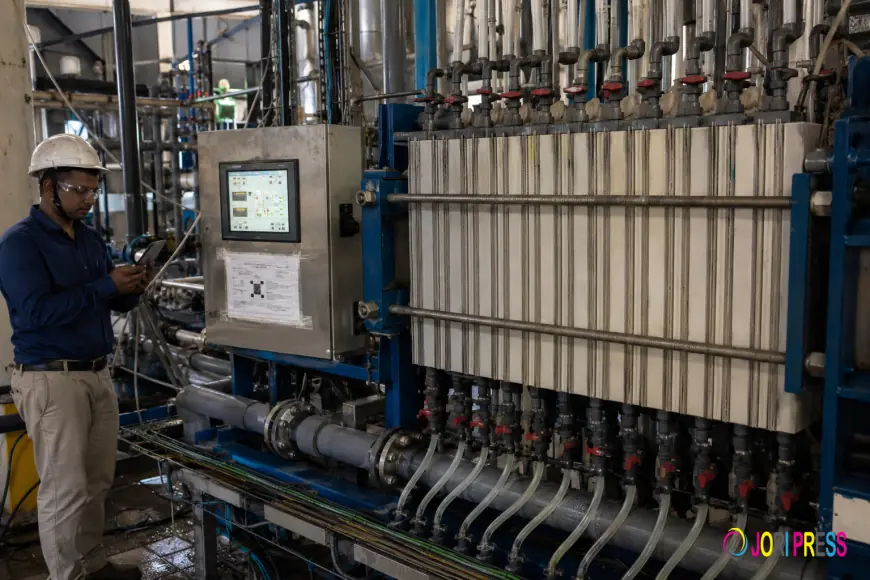
A phase transfer catalyst manufacturing plant on turnkey basis uses electrodialysis (ED) and bipolar electrodialysis (EDBM) to convert quaternary ammonium or phosphonium salts into high-purity hydroxides like TMAH and TEAH. Laxminarayan Technologies designs modular, fully automated, touch-operated ED/EDBM systems at pilot and commercial scale.
Ninety-nine percent purity isn't a luxury for phase transfer catalysts. It's the whole game. If your tetramethylammonium hydroxide carries stray halides or alkali metal ions, your photoresist developer fails and your zeolite synthesis drifts off spec. That's exactly why a phase transfer catalyst manufacturing plant on turnkey basis built around electrodialysis matters. At Laxminarayan Technologies, we design ED and EDBM systems that split quaternary ammonium and phosphonium salts into their hydroxides, without the reagent baggage of older routes. This article walks through how the process works, where it fits, and the real headaches you'll dodge along the way.
What is electrodialysis for phase transfer catalyst manufacturing?
Electrodialysis is a membrane process that pulls ions through alternating cation and anion exchange membranes under a DC field. For catalyst work, EDBM adds bipolar membranes that split water into H⁺ and OH⁻, turning a quaternary ammonium salt straight into its hydroxide. No extra reagents needed.
How an EDBM stack turns salt into a catalyst hydroxide
Here's the thing. The chemistry is elegant once you see the steps:
- Feed it. The filtered quaternary salt solution enters the diluate loop.
- Apply the field. A few volts per cell pair drive ions toward their electrodes.
- Split the water. Bipolar membranes generate H⁺ and OH⁻ at their interface.
- Form the base. OH⁻ pairs with the quaternary cation to build TMAH, TEAH, or your target hydroxide; the freed halide leaves as acid.
- Collect and polish. Draw product from the base compartment, recover the acid, recycle the rest.
Where turnkey ED/EDBM plants earn their keep
Our systems run across the specialty chemical map. A few concrete cases:
- Onium hydroxide production: TMAH, TEAH, and phosphonium hydroxides for semiconductors and zeolite synthesis.
- Acid and alkali recovery: split spent salts back into usable acid and base, trimming reagent bills and ZLD load.
- Organic acid concentration and deacidification: citric, lactic, and similar streams.
- Food, dairy, wine, and pharma demineralization: gentle ion removal, no chemical dumping.
- Wastewater and brine recovery: pull value out of concentrate before disposal.
Conventional ED vs EDBM: Which Do You Need?
Conventional ED
- Main job: Desalts or concentrates ions.
- Reagents: Often requires acid or alkali dosing.
- Output for PTC: Produces a purified salt stream.
- Typical current density: 300–500 A/m².
- Best for: Demineralization and brine concentration.
EDBM (Bipolar)
- Main job: Splits salt into acid and base.
- Reagents: Uses water splitting with minimal chemical reagents.
- Output for PTC: Directly produces hydroxides such as TMAH and TEAH.
- Typical current density: 400–1000 A/m².
- Best for: Acid and alkali recovery, and production of catalyst hydroxides.
Challenges, and how we handle them
Membrane fouling. Organics and multivalent ions coat membranes like grease on a filter screen. We spec pre-filtration, scheduled CIP cycles, and membranes matched to your actual feed.
Current efficiency drift. As product concentration climbs, back-diffusion and water transport nibble at efficiency. We size cell pairs and voltage windows so you're not pushing a stressed pump uphill.
Stack maintenance. Our modular, touch-operated design makes gasket and membrane swaps quick. Automated logging flags voltage creep before it bites.
Wrapping up
Getting a phase transfer catalyst plant right comes down to purity, uptime, and honest engineering around your feed stream. ED and EDBM give you direct hydroxide production without a reagent mountain, and a turnkey build means one team owns it from design through commissioning. At Laxminarayan Technologies, we've delivered modular, fully automated ED/EDBM systems at both pilot and commercial scale. Tell us your salt, your purity target, and your throughput, and we'll size a stack that fits. Prove it on a pilot first if you'd rather.
FAQs
What is a phase transfer catalyst manufacturing plant on turnkey basis?
It's a fully engineered production system, delivered design-to-commissioning by one supplier, that makes catalysts such as quaternary ammonium hydroxides. Modern plants use electrodialysis or EDBM to convert salts into high-purity hydroxides without heavy reagent dosing.
How does EDBM make TMAH or TEAH?
EDBM uses bipolar membranes to split water into H⁺ and OH⁻. The OH⁻ combines with the tetramethyl- or tetraethylammonium cation to form the hydroxide, while the halide exits as acid. You get high purity with low residual salt.
Can you supply a pilot plant before a commercial one?
Yes. We build pilot-scale ED/EDBM systems so you can validate purity, current efficiency, and recovery on your real feed before committing to a full line. Same modular, touch-operated design, smaller footprint.
What purity can electrodialysis reach for catalyst hydroxides?
With proper membrane selection and CIP, ED/EDBM routes routinely hit low-halide, low-alkali-metal hydroxides fit for semiconductor and zeolite use. Exact figures depend on feed quality, membrane type, and number of passes.
What's Your Reaction?
 Like
0
Like
0
 Dislike
0
Dislike
0
 Love
0
Love
0
 Funny
0
Funny
0
 Angry
0
Angry
0
 Sad
0
Sad
0
 Wow
0
Wow
0