


































OTC Crypto Trading vs. Exchange Trading: Which Model Delivers Better Execution?
OTC crypto trading happens outside public exchanges. Instead of using order books, trades are negotiated directly between parties through OTC desks or specialized platforms.

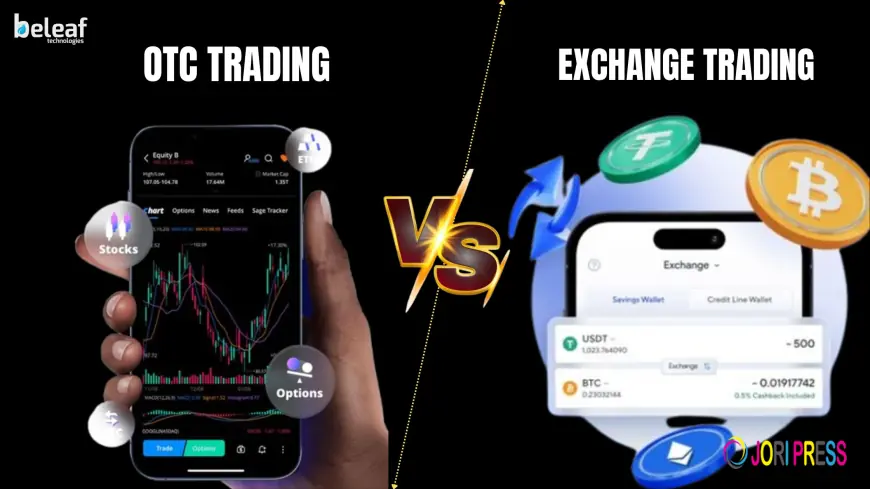
Crypto trading has evolved into two clear execution models: traditional exchange trading and over-the-counter (OTC) crypto trading. While both serve the same goal buying and selling digital assets they operate in very different ways. Retail traders often rely on exchanges, while institutions and high-volume traders prefer OTC desks. The difference is not about which model is “better” overall, but which one delivers better execution depending on trade size, timing, and risk tolerance. Understanding these differences helps traders choose the right approach for their trading needs.
Understanding Exchange Trading in Crypto Markets
Exchange trading is the most familiar model in the crypto space. Trades happen on public order books where buyers and sellers place orders that are visible to everyone. This model works well for small to medium trades because liquidity is usually sufficient and execution happens instantly. However, exchange trading has limitations. Large orders can move the market quickly, causing price slippage. Order books may not have enough depth at a single price level, forcing big trades to be filled in parts. While exchanges offer transparency and speed, they are not always ideal for executing high-volume transactions efficiently.
What Makes OTC Crypto Trading Different
OTC crypto trading happens outside public exchanges. Instead of using order books, trades are negotiated directly between parties through OTC desks or specialized platforms. Prices are usually agreed upon before execution, which removes uncertainty caused by market movement. This model is designed for large transactions where privacy and price stability matter. OTC trades do not appear on public order books, which helps prevent sudden market reactions. Because of this structure, OTC trading offers smoother execution for large volumes and avoids the visibility issues that exchanges create.
Execution Quality: Speed vs. Price Stability
Execution quality depends on two factors: how fast a trade is completed and how close the final price is to the expected price. Exchanges are fast for small orders, but speed alone does not guarantee good execution for large trades. When volume increases, slippage becomes a serious concern. OTC trading focuses more on price certainty than raw speed. Trades may take slightly longer to arrange, but the execution price is fixed in advance. For institutions and large traders, predictable pricing is often more valuable than instant execution. This is why OTC models are widely used for bulk trades where market impact must be controlled.
Market Impact and Slippage Explained
Market impact is one of the biggest differences between OTC and exchange trading. On exchanges, large orders push prices up or down as they consume available liquidity. This results in slippage, where the executed price differs from the expected price. OTC trading minimizes this issue by removing trades from the public market. Since orders are matched privately, the broader market does not react. This keeps prices stable and execution clean. For traders handling significant volumes, avoiding slippage can save substantial costs over time.
Key Execution Differences at a Glance
Here is a simple comparison of how execution differs between the two models:
-
Exchange Trading: Best for small to medium trades with high transparency
-
OTC Trading: Designed for large trades with minimal market impact
-
Exchange Orders: Can cause slippage during high-volume execution
-
OTC Deals: Offer pre-agreed pricing and stable execution
-
Exchange Visibility: Orders are public and affect market behavior
-
OTC Privacy: Trades remain confidential and discreet
This comparison highlights why execution quality depends heavily on trade size and objectives.
Liquidity Access in Both Trading Models
Liquidity determines how easily assets can be bought or sold without affecting price. Exchanges rely on visible liquidity from retail and professional traders. While this works well during high market activity, liquidity can dry up during volatility. OTC trading accesses private liquidity pools, including institutional market makers and large holders. This allows traders to execute large orders without waiting for market depth to build. In terms of execution reliability, OTC liquidity often proves more consistent for high-value transactions.
Risk Management and Trade Control
Exchange trading exposes traders to sudden price swings, especially during volatile market conditions. Stop-loss orders and limit orders help, but they do not eliminate execution risk entirely. OTC trading offers stronger trade control. Prices are locked in before execution, reducing exposure to sudden market changes. Settlement terms are also flexible, allowing better planning and reduced operational risk. This level of control is particularly valuable for institutions managing large portfolios.
Transparency vs. Confidentiality
Exchanges are transparent by design. Every trade contributes to price discovery, which benefits the overall market. For retail traders, this transparency builds trust and accessibility. OTC trading prioritizes confidentiality. Large trades remain hidden, protecting trading strategies and preventing front-running. While OTC lacks public visibility, it delivers execution benefits that transparency alone cannot provide. The choice depends on whether openness or discretion matters more to the trader.
Which Model Delivers Better Execution Overall?
There is no single answer that fits everyone. For everyday traders making small trades, exchanges deliver quick and efficient execution. They are easy to use and provide immediate market access. For institutions and high-volume traders, OTC crypto trading delivers better execution by reducing slippage, controlling prices, and preserving privacy. The execution quality improves as trade size increases, making OTC the preferred model for large transactions.
Final Thoughts
OTC Crypto Trading and exchange trading serve different execution needs within the crypto ecosystem. Exchanges excel in speed, accessibility, and transparency, making them ideal for smaller trades. OTC trading, on the other hand, focuses on price stability, confidentiality, and reduced market impact, delivering superior execution for large-volume transactions. Choosing the right model depends on trade size, risk tolerance, and execution priorities. Understanding these differences allows traders to execute more efficiently and align their strategy with the most suitable trading environment.
What's Your Reaction?
 Like
0
Like
0
 Dislike
0
Dislike
0
 Love
0
Love
0
 Funny
0
Funny
0
 Angry
0
Angry
0
 Sad
0
Sad
0
 Wow
0
Wow
0