









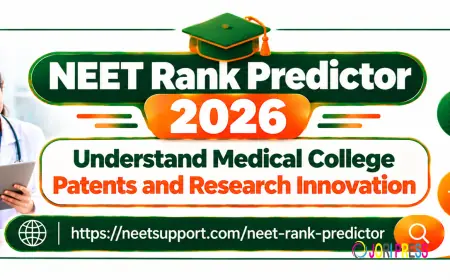



























NEET Rank Predictor 2026: Understand Medical College Patents and Research Innovation
The NEET Rank Predictor 2026 helps medical aspirants estimate their expected rank and plan their MBBS admission journey.

Medical education is evolving beyond traditional classroom teaching and clinical training. Research, innovation, medical technology, and scientific discoveries are becoming important parts of the healthcare ecosystem. Students who understand how medical innovations are developed and protected can gain a broader perspective on the relationship between healthcare, science, and technology.
The NEET Rank Predictor 2026 can help aspirants estimate their expected rank and prepare an initial MBBS college shortlist. However, selecting a medical institution should involve evaluating its research environment, faculty guidance, innovation support, and policies related to intellectual property.
Medical colleges may support student participation in research projects, medical device development, digital health solutions, and scientific publications. Understanding ownership, ethical responsibilities, and intellectual property protection can help students participate responsibly in these activities.
NEET Support encourages students to consider research and innovation opportunities alongside academic quality and clinical exposure when evaluating medical colleges.
What Is Intellectual Property in Medical Education?
Intellectual property refers to creations of the mind that may receive legal protection under applicable laws. In healthcare and medical education, intellectual property can include scientific inventions, research-based technologies, software, educational materials, and original creative work.
Some important forms include:
-
Patents: May protect eligible inventions that satisfy applicable legal requirements.
-
Copyright: Protects original creative expressions, including written educational materials, illustrations, and certain software works.
-
Trademarks: Protect brand names, logos, and other distinctive commercial identifiers.
-
Industrial designs: May protect qualifying visual features of products.
-
Trade secrets: Protect certain confidential business or technical information when legal requirements are met.
Not every research finding or medical idea automatically qualifies for intellectual property protection. The type of protection depends on the nature of the creation and applicable legal requirements.
Why Intellectual Property Awareness Matters for MBBS Students
Medical students may encounter research projects and innovative ideas during their academic journey. Understanding intellectual property can help them recognise their responsibilities when contributing to these activities.
1. Understanding Research Ownership
Students should know who owns research outputs and how contributions are recognised. Ownership may depend on institutional policies, agreements, funding arrangements, employment or student status, and applicable laws.
Before joining a project, students should understand the relevant institutional rules rather than assuming that every contribution automatically belongs to the individual student.
2. Protecting Original Medical Innovations
Students may participate in projects involving diagnostic tools, patient-monitoring devices, healthcare applications, or educational technologies.
When an idea appears potentially innovative, students should discuss it with faculty mentors and the institution's appropriate innovation or intellectual property office before publicly disclosing technical details.
3. Encouraging Responsible Collaboration
Medical innovations often involve professionals from different fields, including medicine, engineering, biotechnology, pharmacy, and computer science.
Clear collaboration agreements can help define responsibilities, contributions, confidentiality, and ownership expectations.
4. Understanding Scientific Publications
Research publications and intellectual property protection can involve different considerations. Students should understand publication policies and seek institutional guidance before presenting or publishing potentially patentable inventions.
Public disclosure can affect patent options in some jurisdictions, so early guidance is important.
Important Medical College Research and Innovation Facilities
When evaluating a medical college, students should explore whether the institution offers facilities and support for responsible research and innovation.
1. Research and Development Centres
Research centres may provide opportunities to participate in academic projects, laboratory investigations, and interdisciplinary studies.
Students should check whether undergraduate MBBS students can participate and whether appropriate faculty supervision is available.
2. Innovation and Incubation Centres
Some institutions have innovation centres or incubation programmes that help develop early-stage ideas.
Possible support may include:
-
Project evaluation.
-
Mentorship from experts.
-
Prototype development guidance.
-
Technical collaboration.
-
Entrepreneurship workshops.
-
Guidance on intellectual property.
-
Connections with external innovation organisations.
Students should verify whether these programmes are active and accessible to medical undergraduates.
3. Institutional Intellectual Property Support
An institutional intellectual property office or designated research support team may help students understand invention disclosure procedures, patent-related documentation, ownership policies, and confidentiality requirements.
The existence of a support office does not guarantee that every student idea will qualify for patent protection.
4. Interdisciplinary Research Opportunities
Healthcare innovation often requires combining medical knowledge with technical expertise.
Check whether students can collaborate with other departments or external institutions on supervised research projects.
5. Faculty Research Mentorship
Experienced faculty members can guide students in identifying research questions, reviewing scientific evidence, understanding research ethics, and evaluating whether a proposed innovation has practical value.
How Medical Patents Contribute to Healthcare Development
Patents can encourage the development of eligible inventions by providing qualifying inventors with certain exclusive rights for a limited period, subject to applicable law.
In healthcare, patentable inventions may include certain medical devices, diagnostic technologies, pharmaceutical innovations, and other qualifying technical developments.
However, patent protection does not automatically establish that an invention is clinically effective, safe, affordable, or approved for medical use.
Medical innovations must undergo appropriate scientific evaluation, regulatory review, and other applicable processes before being used in patient care.
For students, this distinction is important: innovation requires both technical development and responsible evaluation.
What Should Students Check Before Selecting a Medical College?
A medical college's research and innovation environment should be evaluated through actual opportunities rather than promotional statements alone.
1. Research Participation
Ask whether undergraduate students can join supervised research projects and contribute to academic investigations.
2. Innovation Policies
Check whether the institution has written policies explaining research ownership, intellectual property, confidentiality, and student contributions.
3. Patent and Innovation Guidance
Find out whether students can receive guidance from a dedicated intellectual property office, innovation centre, or qualified institutional representative.
4. Faculty Mentorship
Evaluate whether faculty members support student research and provide guidance on scientific methods, ethical responsibilities, and innovation development.
5. Previous Research Achievements
Review publicly documented research projects, student participation, innovation activities, and institutional achievements.
Do not assume that every institutional patent or publication involved undergraduate MBBS students.
6. Research Ethics Support
Check whether the institution provides appropriate guidance on research ethics, informed consent, patient confidentiality, data protection, and required approvals.
Questions to Ask Before Choosing a Medical College
Students can ask the admission office, research department, or relevant faculty representatives:
-
Can undergraduate MBBS students participate in research and innovation projects?
-
Does the college have an active research or innovation centre?
-
Are intellectual property policies available for students?
-
How are student contributions and research ownership documented?
-
Is mentorship available for medical technology projects?
-
Does the institution provide guidance on patent applications?
-
Are students trained in research ethics and responsible scientific publication?
Where possible, speak with current students and faculty members to understand how these opportunities work in practice.
Common Intellectual Property Mistakes Students Should Avoid
Students interested in medical innovation should understand that protecting an idea involves more than simply registering a name or documenting a concept.
Common mistakes include:
-
Assuming every medical idea qualifies for a patent.
-
Publicly disclosing a potentially patentable invention without seeking advice.
-
Ignoring institutional ownership policies.
-
Using copyrighted research materials without appropriate permission.
-
Failing to recognise the contributions of collaborators.
-
Sharing confidential research information without authorisation.
-
Assuming patent protection guarantees clinical approval or commercial success.
Students should seek appropriate institutional and qualified legal guidance whenever intellectual property questions arise.
How NEET Rank Predictor 2026 Helps With Medical College Planning
The NEET Rank Predictor 2026 can help aspirants estimate their expected All India Rank based on examination performance and available rank trends.
Students can use this estimate to prepare an initial college shortlist and investigate the academic and research environment of possible institutions.
A balanced evaluation should include:
-
Applicable recognition and regulatory status.
-
Academic infrastructure and teaching quality.
-
Faculty availability and mentorship.
-
Attached hospital and clinical exposure.
-
Research and innovation facilities.
-
Intellectual property support.
-
Student participation opportunities.
-
Location and accessibility.
-
Fee structure and financial requirements.
-
Previous admission trends.
The NEET College Predictor 2026 can provide additional support when exploring potential college options. However, prediction tools provide estimates and cannot guarantee admission.
Actual admission depends on official examination results, eligibility, category, applicable domicile requirements, counselling rules, seat availability, and final allotment.
Students should verify admission-related information through the relevant official authorities.
How NEET Support Helps Students Make Informed Choices
NEET Support provides educational resources and prediction tools to help medical aspirants understand their expected rank and explore MBBS admission possibilities.
Students can use rank prediction and college prediction resources to prepare an initial shortlist. They should then compare academic quality, hospital exposure, faculty guidance, research facilities, and opportunities for professional development.
Considering research and innovation policies alongside traditional academic factors can help students build a more complete understanding of a medical institution.
Frequently Asked Questions
1. What is intellectual property in medical colleges?
Intellectual property refers to legally recognised rights associated with eligible creations such as inventions, original educational materials, software, designs, and other protected works.
2. Can MBBS students develop patentable medical inventions?
Yes. MBBS students may contribute to potentially patentable inventions through supervised research and interdisciplinary collaboration. Whether an invention qualifies for protection depends on applicable legal requirements.
3. Do medical colleges own every invention developed by their students?
No universal rule applies to every institution. Ownership depends on applicable law, institutional policies, agreements, funding conditions, and the circumstances of the invention.
4. Why should students check intellectual property policies before joining research projects?
Understanding these policies helps clarify ownership, confidentiality, publication rights, student contributions, and the process for reporting potential inventions.
5. Does the NEET Rank Predictor 2026 guarantee MBBS admission?
No. The NEET Rank Predictor 2026 provides an estimated rank for planning purposes. Actual admission depends on official results, eligibility, category, applicable counselling rules, domicile requirements, seat availability, and allotment.
6. How does NEET Support help with medical college selection?
NEET Support provides prediction resources and educational guidance that help aspirants understand rank trends, explore college possibilities, and prepare for informed admission planning.
Conclusion
Medical research and innovation can create valuable opportunities for future doctors to contribute to healthcare development. Students should understand how medical colleges support research participation, intellectual property awareness, interdisciplinary collaboration, faculty mentorship, and responsible innovation. Evaluating these opportunities alongside clinical training and academic quality can provide a broader perspective when selecting an institution. The NEET Rank Predictor 2026 can support initial admission planning, but a well-informed decision requires careful evaluation of multiple college-related factors. NEET Support encourages aspirants to consider both their admission possibilities and the academic environment that can support their long-term medical careers.
What's Your Reaction?
 Like
0
 Dislike
0
 Love
0
 Funny
0
 Angry
0
 Sad
0
 Wow
0