





































My EPPP Practice Test Experience: What I Learned About Psychology Licensure
Learn from my EPPP practice test experience, including psychology content areas, practice results, licensure preparation, and strategies for improving weak areas.

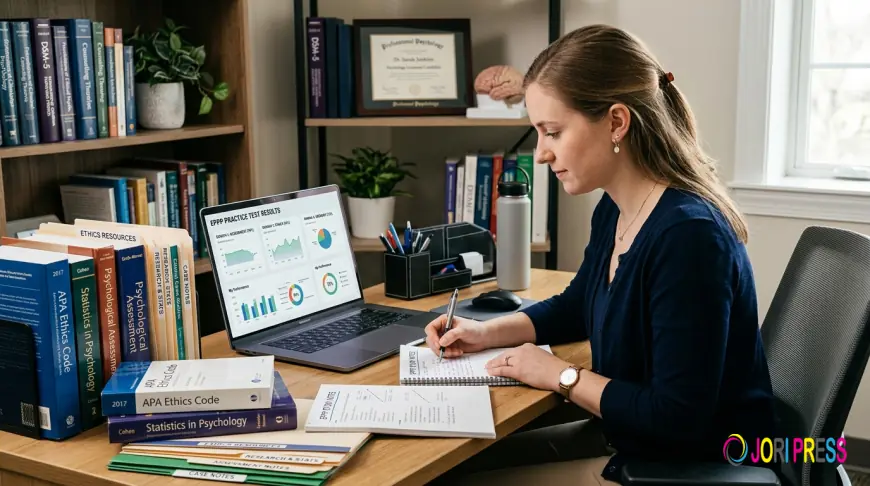
Preparing for the Examination for Professional Practice in Psychology (EPPP) showed me how much knowledge is involved in psychology licensure. I initially expected my graduate-school background to carry most of the preparation, but reviewing the exam content made me realize that I needed to revisit several areas and become more comfortable applying concepts across different situations.
For candidates testing in 2026, the EPPP is organized into Part 1-Knowledge and, where required by the licensing jurisdiction, Part 2-Skills. ASPPB notes that candidates should check with their licensing jurisdiction to determine which examination requirements apply.
Understanding the EPPP Exam Content
My first step was reviewing the official EPPP Candidate Handbook and content specifications. Part 1-Knowledge covers eight areas: biological bases of behavior, cognitive-affective bases, social and cultural bases, growth and lifespan development, assessment and diagnosis, treatment and intervention, research methods and statistics, and ethical, legal, and professional issues.
Seeing all eight areas together helped me understand why I needed a structured study plan instead of concentrating only on clinical topics.
What My EPPP Practice Results Revealed?
My EPPP Practice Test Questions showed me that some of my weaker areas were not necessarily subjects I had completely forgotten. In several cases, I understood the underlying concept but struggled when I had to distinguish between closely related answer choices.
Assessment and diagnosis, research methods, statistics, ethics, and treatment concepts received additional attention during my review. I also became more careful about reading the question stem before looking closely at the answer choices.
Changing My EPPP Study Approach
I used my EPPP Exam Review Questions to organize my review around the official content domains. Instead of judging my preparation only by a percentage score, I tracked the types of questions I missed and looked for patterns.
For example, a repeated mistake in statistics suggested a different study need from repeatedly choosing an inappropriate response to an ethics question. Separating those problems helped me make my review sessions more specific.
ASPPB also provides official sample examinations for both Part 1-Knowledge and Part 2-Skills to authorized candidates, giving candidates an opportunity to become familiar with the examination experience.
Learning About the Future EPPP
One thing I found especially important was keeping track of the EPPP's upcoming changes. ASPPB has developed an integrated EPPP that combines knowledge and skills into one examination. The new exam is scheduled to become operational in fall 2027, while the current Part 1-Knowledge and Part 2-Skills exams remain available to approved candidates during the transition.
The future integrated examination will assess six domains, including scientific orientation to practice, assessment, intervention, consultation and supervision, interpersonal relationships, and ethical and professional practice.
My biggest lesson was that EPPP preparation required me to look at psychology as a connected field rather than a collection of separate subjects. Reviewing my results helped me identify specific weaknesses, improve my reasoning, and understand where additional preparation was needed before the licensure examination.
What's Your Reaction?
 Like
0
Like
0
 Dislike
0
Dislike
0
 Love
0
Love
0
 Funny
0
Funny
0
 Angry
0
Angry
0
 Sad
0
Sad
0
 Wow
0
Wow
0