








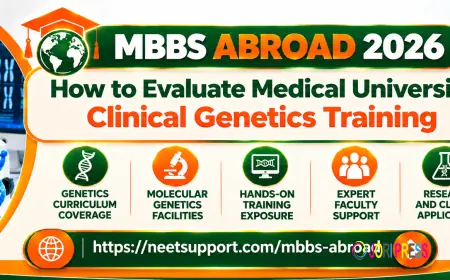































MBBS Abroad 2026: How to Evaluate Medical University Clinical Genetics Training
Planning MBBS Abroad 2026? Discover how to evaluate clinical genetics training before selecting a medical university.
Choosing the right medical university requires more than comparing tuition fees, admission requirements and campus facilities. Students planning MBBS Abroad 2026 should also examine the quality of education in specialised medical disciplines that are becoming increasingly important in modern healthcare. One such field is clinical genetics, which helps doctors understand how inherited and genetic factors influence human health, disease development and treatment decisions.
Clinical genetics connects medical science with diagnosis, prevention, patient counselling and personalised healthcare. Genetic conditions may affect individuals from birth or become apparent later in life. Some inherited disorders can also influence the health risks of other family members. Therefore, future doctors should understand the fundamentals of genetic inheritance, genetic testing and the responsible use of genetic information.
NEET Support encourages students and parents to evaluate subject-specific teaching, laboratory exposure and clinical learning opportunities when comparing medical universities abroad.
What Is Clinical Genetics in Medical Education?
Clinical genetics is a medical discipline concerned with identifying, understanding and managing conditions associated with genetic variations and inherited factors.
It combines knowledge from molecular biology, biochemistry, embryology, pathology, paediatrics and internal medicine.
Medical students learn how genetic information influences normal human development and how certain genetic changes may contribute to inherited disorders or disease susceptibility.
Important topics in clinical genetics include:
-
Basic human genetics and inheritance patterns.
-
Chromosomes, genes and DNA.
-
Genetic mutations and variations.
-
Inherited genetic disorders.
-
Chromosomal abnormalities.
-
Genetic testing and screening.
-
Molecular diagnostic principles.
-
Genetic counselling fundamentals.
-
Family history assessment.
-
Ethical considerations in genetic medicine.
A well-designed medical curriculum should introduce these concepts through theoretical teaching, clinical examples and appropriate laboratory demonstrations.
Why Clinical Genetics Training Matters for MBBS Students
Genetic factors contribute to many medical conditions. Some disorders are inherited through families, while others result from genetic changes that occur during an individual's lifetime.
Understanding genetics helps future doctors interpret family medical histories, recognise possible inherited conditions and understand when specialised evaluation may be appropriate.
Clinical genetics education supports several important competencies.
Understanding inheritance: Students learn how genetic characteristics and certain disorders may pass from one generation to another.
Clinical recognition: They develop awareness of signs that may suggest a genetic or inherited condition.
Diagnostic understanding: They learn the basic principles and limitations of genetic investigations.
Patient communication: They understand why genetic information should be discussed carefully and sensitively.
Interdisciplinary knowledge: They recognise the relevance of genetics to paediatrics, oncology, obstetrics, neurology and other medical specialties.
These foundations are valuable as genetic technologies continue to influence medical diagnosis and healthcare planning.
How to Evaluate a University's Clinical Genetics Curriculum
Before selecting a medical university, students should examine the official syllabus and identify how genetics is incorporated into the MBBS programme.
1. Check the Coverage of Basic Human Genetics
A strong foundation in human genetics is essential for understanding inherited conditions.
Students should check whether the curriculum covers:
-
Structure and function of DNA.
-
Genes and chromosomes.
-
Dominant and recessive inheritance.
-
X-linked inheritance.
-
Mitochondrial inheritance.
-
Genetic mutations and variations.
-
Patterns of inheritance in families.
-
Basic principles of population genetics.
The university should explain these concepts through diagrams, examples and relevant clinical situations rather than relying entirely on memorisation.
Students should also understand that inheritance patterns can be complex and that not every genetic condition follows a simple dominant or recessive pattern.
2. Evaluate Education in Genetic Disorders
Medical students should receive an introduction to common categories of inherited and genetic disorders.
Relevant academic areas may include:
-
Chromosomal disorders.
-
Single-gene disorders.
-
Multifactorial conditions.
-
Inherited metabolic disorders.
-
Haemoglobin disorders.
-
Genetic neurological conditions.
-
Selected inherited cancer syndromes.
The curriculum should explain how these conditions may present clinically and why accurate diagnosis can require a combination of clinical assessment, family history and appropriate investigations.
Case-based teaching can help students understand how genetic conditions affect individuals and families differently.
3. Look for Genetic Laboratory Demonstrations
Laboratory education helps students understand how genetic information is studied and analysed.
Depending on the university, relevant teaching may include demonstrations or introductory sessions on:
-
DNA extraction principles.
-
Polymerase chain reaction (PCR).
-
Chromosome analysis.
-
Karyotyping.
-
Molecular diagnostic methods.
-
Basic genetic sequencing concepts.
-
Interpretation of selected laboratory reports.
Students should ask whether these activities are conducted in university laboratories, affiliated diagnostic facilities or through supervised demonstrations.
It is important to distinguish between observing a laboratory technique and independently performing clinical diagnostic testing. Clinical investigations must follow appropriate quality standards and professional supervision.
4. Examine Education in Genetic Testing and Screening
Genetic testing can help identify particular genetic variations associated with inherited conditions or disease risks.
Medical students should understand the different purposes of genetic testing.
The curriculum may introduce:
Diagnostic testing: Used to investigate a suspected genetic condition in a person with relevant clinical findings.
Carrier screening: Helps identify individuals who carry certain genetic variations that may be relevant to reproductive planning.
Prenatal screening: Estimates the possibility of selected fetal conditions and may indicate whether further diagnostic evaluation is appropriate.
Newborn screening: Helps identify selected conditions early so that timely evaluation and care can be considered.
Predictive testing: May identify genetic variations associated with an increased likelihood of developing particular conditions in the future.
Students should understand that screening and diagnostic testing are not interchangeable. Test results require careful interpretation and appropriate professional counselling.
5. Evaluate Genetic Counselling Education
Genetic counselling is an important component of clinical genetics.
It helps individuals and families understand genetic conditions, possible inheritance patterns, testing options and the implications of test results.
Medical students should learn the basic principles of:
-
Collecting relevant family medical histories.
-
Understanding family pedigree charts.
-
Communicating genetic information clearly.
-
Explaining uncertainty in genetic test results.
-
Respecting patient preferences.
-
Maintaining confidentiality.
-
Understanding informed consent.
-
Recognising when specialist referral is necessary.
Universities should emphasise sensitive communication because genetic information may have implications for several family members.
Students should also understand that specialised genetic counselling requires appropriate professional training and should not be undertaken independently beyond their competence.
Importance of Clinical Case-Based Learning
Case-based learning can make clinical genetics easier to understand by connecting theoretical concepts with medical situations.
For example, a patient may visit a hospital with a family history of an inherited disorder. Students can discuss how a doctor collects relevant information, examines the family history and considers whether genetic assessment may be appropriate.
Other useful educational examples include:
-
A child presenting with features suggestive of a chromosomal condition.
-
A patient with a family history of an inherited blood disorder.
-
An individual seeking information about an inherited cancer risk.
-
A family considering genetic testing for a known inherited condition.
-
A patient whose symptoms suggest a possible metabolic disorder.
These discussions help students understand the importance of clinical judgement, patient communication and appropriate specialist involvement.
Evaluate Faculty Expertise and Interdisciplinary Teaching
Clinical genetics is connected with multiple medical disciplines. Therefore, students should examine whether the university provides teaching from professionals with relevant academic and clinical backgrounds.
Potential teaching areas include:
-
Medical genetics.
-
Molecular biology.
-
Biochemistry.
-
Pathology.
-
Paediatrics.
-
Obstetrics and gynaecology.
-
Oncology.
-
Neurology.
Before admission, students should ask:
-
Which department teaches medical genetics?
-
Is clinical genetics included in the official MBBS curriculum?
-
Are inherited disorders covered through clinical case studies?
-
Are genetic laboratory demonstrations available?
-
Are students introduced to genetic testing principles?
-
Is genetic counselling discussed in the curriculum?
-
Are practical sessions supervised by qualified faculty?
-
How are students assessed in genetics?
Request official academic documents to understand the actual teaching structure.
Role of Genomics and Personalised Medicine
Modern medical research increasingly uses genetic information to understand differences in disease risk and treatment responses.
Genomics examines the broader set of genetic information in an individual or organism. It has applications in research, inherited disease assessment and certain areas of treatment planning.
Medical students should receive an introduction to:
-
Basic genomic concepts.
-
Genetic variation and disease susceptibility.
-
Pharmacogenomics.
-
Personalised medicine.
-
Genomic data interpretation.
-
Limitations of genetic predictions.
For example, pharmacogenomics explores how genetic differences may influence an individual's response to certain medicines.
Students should understand that genetic information does not determine every health outcome. Environmental influences, lifestyle, other medical conditions and individual circumstances can also play important roles.
Ethical and Privacy Considerations in Genetic Medicine
Genetic information can be particularly sensitive because it may reveal details about an individual's health risks and potential inherited conditions within a family.
Medical universities should introduce students to important ethical principles, including:
Informed consent: Patients should understand the purpose, possible benefits and limitations of genetic testing before making decisions.
Confidentiality: Genetic information must be handled according to appropriate privacy and professional standards.
Responsible communication: Medical professionals should explain results accurately without creating unnecessary fear or false reassurance.
Patient autonomy: Individuals should be supported in making informed decisions about testing and medical care.
Non-discrimination awareness: Students should understand concerns related to the misuse of genetic information.
Ethical education helps future doctors approach genetic medicine with sensitivity and professional responsibility.
Common Mistakes Students Should Avoid
When comparing medical universities abroad, students should avoid focusing exclusively on admission fees and general university rankings.
Common mistakes include:
Ignoring genetics in the curriculum: Check how human genetics and inherited disorders are taught.
Assuming every university has advanced genetic laboratories: Verify the actual facilities and available demonstrations.
Confusing screening with diagnosis: Understand that different genetic tests have different purposes and limitations.
Overlooking genetic counselling: Patient communication is an important part of responsible genetic medicine.
Ignoring data privacy: Genetic information requires careful handling and confidentiality.
Accepting unverified academic claims: Request official curriculum documents and details of laboratory and clinical teaching arrangements.
A detailed evaluation can help students understand the academic strengths and limitations of different institutions.
How NEET Support Helps Students Evaluate MBBS Abroad Options
Choosing a medical university abroad involves academic, financial and professional considerations. Students and parents need to understand eligibility requirements, university curriculum, clinical facilities and the academic structure of the programme.
NEET Support helps aspiring medical students and parents understand important aspects of university selection and the MBBS Abroad admission process.
When comparing institutions, students should consider whether the university offers a balanced medical education that introduces them to both traditional clinical subjects and developing areas of medical science.
Clinical genetics is one such field. Understanding its curriculum, laboratory exposure and clinical relevance can help students assess the breadth of medical education offered by a university.
Students should verify information through official documents, ask relevant questions and make decisions based on their academic goals and long-term career plans.
Frequently Asked Questions
1. What is clinical genetics in MBBS?
Clinical genetics is the study of inherited conditions, genetic variations and their relationship with human health. It introduces medical students to genetic diagnosis, inheritance patterns and the fundamentals of genetic counselling.
2. Why is clinical genetics important for future doctors?
It helps doctors understand inherited diseases, assess relevant family histories and recognise when patients may benefit from specialised genetic evaluation.
3. What topics are included in medical genetics education?
Topics may include DNA, chromosomes, inheritance patterns, genetic mutations, chromosomal disorders, genetic testing, genomics and genetic counselling principles.
4. Do medical universities abroad provide genetic laboratory training?
Practical opportunities vary between institutions. Some universities provide laboratory demonstrations covering DNA extraction, PCR, karyotyping and other molecular diagnostic principles.
5. What is the difference between genetic screening and diagnostic testing?
Screening estimates the possibility of a particular condition, while diagnostic testing is used to investigate whether a specific condition or genetic finding is present. Both require appropriate interpretation.
6. What is pharmacogenomics?
Pharmacogenomics studies how genetic differences may influence an individual's response to certain medicines. It is an emerging area connected with personalised medicine.
7. How can students evaluate clinical genetics education at a university?
Students should examine the official curriculum, faculty expertise, laboratory facilities, clinical case discussions, genetic testing education and supervised learning opportunities.
Conclusion
Clinical genetics is an increasingly relevant area of medical education because inherited conditions and genetic variations influence many aspects of human health. Students should evaluate curriculum coverage, laboratory demonstrations, genetic testing education, clinical case discussions, faculty expertise and ethical training before selecting a medical university. Understanding genetics can provide a valuable foundation for future learning in paediatrics, oncology, neurology and personalised medicine. When comparing institutions for MBBS Abroad 2026, students should look beyond tuition fees and admission offers to examine the quality and breadth of academic education. NEET Support encourages aspiring medical students and parents to make informed university choices through careful research and long-term academic planning.
What's Your Reaction?
 Like
0
 Dislike
0
 Love
0
 Funny
0
 Angry
0
 Sad
0
 Wow
0