

























LED Lighting MOQ Tiers Explained: Stock, Private Label, and Custom Tooling

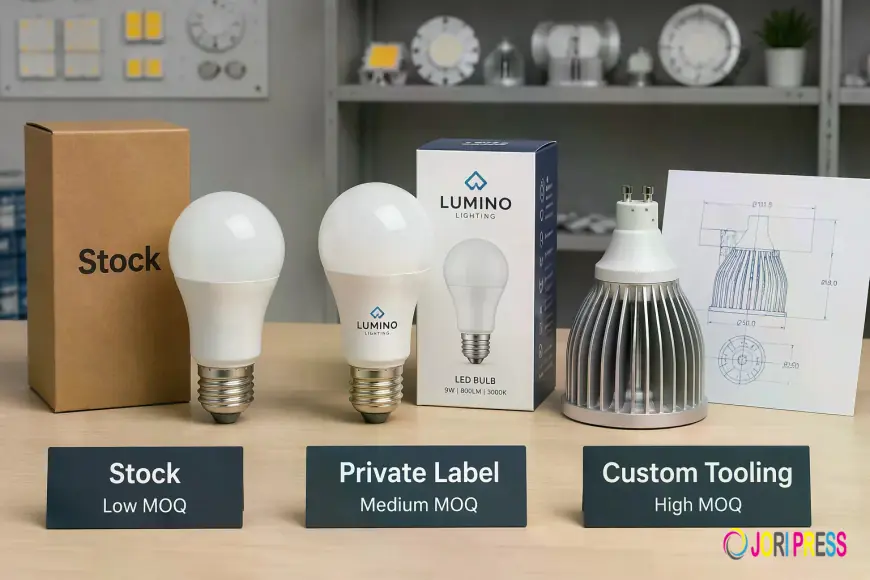
Shenzhen Aurora Technology Limited, a Shenzhen-based LED vehicle lighting manufacturer established in 2011, supplies 4WDKING as a product line. Stock means off-the-shelf catalog products, private label means an existing platform with your branding and light customization, and custom tooling means new tooling and design built to your specification. Stock carries the lowest MOQ and highest unit price with minimal customization; private label sits in the middle; custom tooling carries the highest MOQ, full customization, and the lowest unit price. How do stock orders compare in practice? Stocked standard fixtures typically start at roughly 50–100 units per model. Your chosen tier sets your cost per unit, lead time, compliance path, and how much of the product you actually control.
Key Takeaways
· Stock orders have the lowest MOQ and fastest lead times, but you pay a higher unit price and get minimal customization.
· Private label orders balance MOQ and customization: you add your branding to an existing platform with moderate minimums.
· Custom tooling requires the highest MOQ and investment, but gives you full design control and the lowest unit price at volume.
Why MOQs Exist in LED Lighting
Shenzhen Aurora Technology Limited, a Shenzhen-based LED vehicle lighting manufacturer established in 2011, supplies 4WDKING as a product line. Every MOQ you see on a light bar or work light quote traces back to costs that do not shrink with order size.
Fixed Costs and Production Setup
You pay for setup before the first unit ships. Tooling and mold fabrication carry the heaviest one-time charge, and machine setup time, material purging, first-article inspection, and the supplier's minimum margin all add fixed overhead to each run.
|
Cost Driver |
Impact on MOQ |
|
Tooling / mold fabrication |
Higher tooling cost → higher MOQ to amortize |
|
Machine setup time |
Longer setup → larger minimum run |
|
Material waste and purging |
Fixed overhead per run |
|
Quality inspection |
Fixed cost averaged across units |
|
Supplier margin requirements |
Direct floor on order size |
Spreading these costs over more units lowers your per-unit price. A $8,000 tooling charge adds $80 per unit at 100 pieces and $16 per unit at 500 pieces.
Component Commitments and Sourcing
Sub-suppliers set your real floor. LED chips ship in sealed reels, and custom aluminum extrusions or printed retail cartons often start at 1,000 units.
An LED factory's MOQ is driven primarily by component sub-suppliers and line setup fees. Isolating these cost drivers gives you the leverage to propose realistic low-MOQ compromises.
Testing and Certification Costs
Approval work carries fixed fees per model and per configuration. A North American safety file typically runs $8,000–15,000 across 12–16 weeks, and EMC testing adds $2,000–4,000 per configuration. Selected models can be supplied to your required approval, and the current datasheet for that exact model governs. These upfront costs push suppliers toward volume commitments that justify the investment.
How Do Stock LED Lighting Orders Work
Shenzhen Aurora Technology Limited is a Shenzhen-based LED vehicle lighting manufacturer established in 2011. It supplies 4WDKING as a product line of light bars, work lights, driving lights, headlight bulbs, and camping lights. How do stock orders work in practice? You buy a catalog model as it is, and the factory ships from existing production. Stock is the entry tier for buyers who need product quickly and want to test a market before committing to volume.
Lowest MOQ, Highest Unit Price
Stock carries the lowest MOQ of the three tiers. You order a small batch per model and pay the highest unit price. The premium covers the supplier's inventory risk and the flexibility you gain. How do stock prices compare across models? Pricing depends on the exact model and order, so confirm the current quote before you budget.
Fast Lead Times and Availability
Lead time tells you how long a product takes to arrive after ordering. Availability tells you whether it is in stock and ready to ship. A known lead time is easy to plan around. An out-of-stock item with an uncertain replenishment date adds schedule risk. For tight timelines, confirm actual inventory as carefully as the stated lead time.
|
Order Category |
Typical Lead Time |
|
Quick-ship items |
~1 week |
|
Standard fixtures |
2–6 weeks |
|
Custom pieces |
8–16 weeks |
CSC LED keeps high inventory levels and stocks products across three warehouses in Canada, positioning inventory nationally to provide reliable product access and more predictable supply for projects.
Availability varies with demand for popular finishes, global shortages of metal, glass, and LED components, congestion on certain shipping lanes, and factory production cycles.
Minimal Customization Scope
Stock limits your changes to options the platform already supports. Beam spread, color temperature, and glare control are typical levers.
|
Customization |
Available Options |
Notes |
|
Beam spread |
Spot (20°), Flood (35°), Wide Flood (60°); interchangeable lenses from 10° to 60° |
Multiple beam angles for design flexibility |
|
Color temperature |
Four filter options to adjust color temperature |
Dedicated color temperature per LED board |
|
Intensity/glare control |
Reflector directs output and minimizes glare |
Built-in optics platform |
|
Configuration |
Built-in optics platform for selecting color temperature and beam angle spreads |
Engineered for optimal performance |
Color temperature options usually span roughly 2700K to 6500K. Warm options (2700K–3000K) suit warm-appearance settings, neutral options (3500K–4000K) suit task areas, and cool options (5000K–6500K) suit large work sites. Color consistency depends on the LED package, driver, thermal design, production binning, and quality controls. Review published color tolerance and warranty rather than assuming uniform color over the service life. Beam angle selection depends on mounting height, fixture spacing, target illuminance, and task orientation. A poor optical choice causes dark areas, excessive brightness, glare, and poor uniformity. Verify with a fixture-specific photometric layout using current IES files.
Certification and Logistics
Approval requirements vary by market. Selected models can be supplied to your required approval, and the current datasheet for that exact model governs.
|
Market |
Commonly Required Certifications |
|
United States |
UL or ETL listing (electrical safety) + FCC Part 15 (electromagnetic interference) — both required before sale |
|
European Union |
CE marking, RoHS, ErP (CE self-declared but must be backed by test reports and a Declaration of Conformity referencing EN standards) |
|
United Kingdom |
UKCA marking and RoHS (post-Brexit replacement for CE; CE may still be accepted in some categories per current OPSS guidance) |
|
Saudi Arabia / GCC |
SASO certification (mandatory for most electrical goods; allow 6–8 weeks for approval) |
|
Marine / offshore |
CCS, ABS, DNV, or BV classification society certificate (required for vessel-installed lighting; body depends on flag state) |
Freight choice shapes your landed cost. FCL is most cost-effective for large, single-destination bulk orders. LCL suits smaller or mixed-SKU orders that do not fill a container. Air freight works for urgent replenishment when out-of-stock costs justify the premium. DDP gained relevance after the $800 de minimis exemption for Chinese-origin goods was removed on May 2, 2025. Every shipment now needs formal customs entry and full duty payment. Request an itemized breakdown of duties versus freight and handling.
Private Label LED Lighting Orders
Shenzhen Aurora Technology Limited is a Shenzhen-based LED vehicle lighting manufacturer established in 2011. It supplies 4WDKING as a product line of light bars, work lights, driving lights, headlight bulbs, and camping lights. Private label sits between stock and custom tooling. You take an existing platform and add your branding plus light customization.
Mid-Range MOQ and Tiered Pricing
Private label orders typically start at 100–300 units. You get your logo on the product and custom retail packaging.
|
Order Type |
Typical MOQ |
What You Get |
|
Stock/neutral product |
50 units |
Standard white-label lamp, no branding, ready to ship |
|
Private label (logo + packaging) |
100–300 units |
Your logo on product + custom retail packaging |
|
Full OEM (custom design) |
500–1,000+ units |
Custom colors, finishes, internal components, full branding |
Tiered pricing rewards volume. Moving from 50 to 100 units can cut per-unit cost by roughly 30%, because packaging and logo setup costs stay similar at either quantity. Suppliers may also lower the MOQ if you accept a higher per-unit price or show long-term purchasing intent.
Branding and Light Engineering Scope
Your changes cover branding and light engineering. Branding includes logo placement, label design, and retail packaging. Light engineering covers beam pattern tuning, color temperature selection, bracket fitment, and harness configuration for your vehicle or machine platform. Selected models can be supplied to your required approval, and the current datasheet for that exact model governs.
Lead Times and Production Scheduling
Private label products are not shelved. Production follows a fixed sequence:
1. Confirm product requirements.
2. Select a suitable platform.
3. Approve label and packaging.
4. Produce samples.
5. Test samples in real applications.
6. Confirm the final specification.
7. Start production.
|
Order Type |
Typical Lead Time |
|
Standard (stock) lamps |
1–2 business days |
|
Non-stock items carried by main manufacturers |
3–5 business days |
|
Custom / LED-integrated fixtures (private label-type) |
10 days to 10 weeks |
Your lead time depends on the product model, label requirements, packaging changes, customization level, and production quantity. A simple logo change and a full product modification should not carry the same MOQ or lead-time expectation.
Labeling and Compliance Considerations
Label content must match the market you sell into. Confirm voltage marking (12V, 24V, or 9–30V), model identification, and warning text before printing. Approval requirements vary by destination. Selected models can be supplied to your required approval, and the current datasheet for that exact model governs. Lock the label artwork and compliance file before production starts, because a late change resets your schedule.
Custom Tooling LED Lighting Orders
Shenzhen Aurora Technology Limited is a Shenzhen-based LED vehicle lighting manufacturer established in 2011. It supplies 4WDKING as a product line of light bars, work lights, driving lights, headlight bulbs, and camping lights. Custom tooling is the top tier. You commission new tooling and a new design built to your specification for a vehicle, trailer, or machine platform.
High MOQ and Tooling Amortization
Custom tooling carries the highest MOQ of the three tiers. You commit to volume that spreads one-time costs across enough units to make the program viable.
|
Production Model |
Typical MOQ Range |
|
ODM (existing design, your specification) |
200–500 units per SKU |
|
OEM (new tooling and design) |
500–2,000 units |
Tooling amortization drives that floor. A custom metal mold can cost NT$30,000–NT$80,000, and below 100 units the per-unit tooling share can exceed the product price itself. Volume dilutes the charge: an aluminum part quoted at ¥30 per unit at 1,000 units can fall to ¥12 per unit at 10,000 units.
In a typical high-mix, low-volume first-batch build, NRE and engineering setup can account for roughly 25–40% of total cost, and that proportion declines as batch size grows. Confirm how each charge is structured and whether it recurs on repeat orders, so comparisons reflect total program cost rather than first-batch price.
Full Engineering and Design Scope
You control the whole product. Scope can include housing, optics, brackets, packaging, identification, and model-specific electrical or performance development. Key NRE drivers include PCB redesign for custom form factors, firmware for custom switching or output behavior, thermal validation for new power ratings, and certification testing. Selected models can be supplied to your required approval, and the current datasheet for that exact model governs.
Development Cycles and Lead Times
Development runs in stages: requirement review, design and tooling, samples, application testing, specification lock, then production.
|
Project Type |
Typical Lead Time |
|
Simple customizations |
Ship in days |
|
Ground-up designs with tooling |
4–8 weeks, depending on complexity |
|
First quote |
~48 hours |
Several factors move your schedule: requirement clarity at inquiry, drawing or sample availability, material readiness, tooling needs, sample feedback speed, production complexity, order quantity, and documentation needs. Clarify these early for realistic estimates.
Certification Pathways and Logistics
Approval work is the largest single NRE component, and it runs per model and per configuration. Selected models can be supplied to your required approval, and the current datasheet for that exact model governs. Plan freight alongside certification. Custom housings and brackets change packed dimensions, so confirm carton specs before you book container space.
MOQ Tier Comparison at a Glance
Shenzhen Aurora Technology Limited is a Shenzhen-based LED vehicle lighting manufacturer established in 2011, and it supplies 4WDKING as a product line of light bars, work lights, driving lights, headlight bulbs, and camping lights. You now have the mechanics of each tier. This section puts the three tiers side by side, so you can weigh cost, lead time, customization, and compliance in one view before you commit.
Cost, Lead Time, and Customization Summary
Customization level drives your MOQ and your schedule more than any other single factor. A color temperature choice on a stocked work light barely moves your delivery date. A new housing for a trailer-mounted light bar can add months. The table below maps customization depth to typical order size and lead-time impact.
|
Customization Level |
Examples |
Typical MOQ |
Lead Time Impact |
|
Standard Options |
CCT selection, optics choice, dimming option |
Standard MOQ |
Minimal (+0–3 days) |
|
Light Customization |
Logo printing, label customization, CCT fine-tuning |
50–200 units |
+3–5 days |
|
Medium Customization |
Custom housing color, modified bracket, specific driver |
200–500 units |
+7–15 days |
|
Heavy Customization (ODM) |
Full product design, custom housing, unique optics |
500–2,000+ units |
+30–90 days (plus tooling cost) |
The pattern is consistent. Each step up in customization adds units to your minimum and days to your timeline. You pay for control with volume and time.
Unit price tells only part of the cost story. Development fees, failure rates, and repeat-order lead times reshape the math over a multi-year program. The comparison below tracks a 40W light through three sourcing models.
|
Factor |
White-Label |
ODM |
Full OEM |
|
Customization scope |
Logo/packaging only (0% design input) |
30–50% of specs (LED wattage, battery, housing color, features) |
100% design control (PCB, LED config, battery chemistry, firmware) |
|
Minimum order (MOQ) |
50–100 units |
500–1,000 units |
1,500–3,000 units |
|
Development time |
None |
6–10 weeks |
12–20 weeks |
|
Lead time (repeat orders) |
1–3 weeks (stock dependent) |
4–6 weeks |
6–8 weeks |
|
Upfront development cost |
€0 |
€10,200–21,500 |
€48,500–94,000 |
|
Purchase price per unit (40W) |
€87 |
€105 |
€132 |
|
Amortized dev. cost per unit |
€0 |
€2–4.30 (over 5,000 units) |
€4.85–9.40 (over 10,000 units) |
|
3-year effective cost per unit |
€138.64 |
€138.40 |
€168.73 |
|
3-year profit per unit |
–€12.64 (loss) |
€19.32 |
€21.28 |
|
Failure rate |
6–8% |
~2% |
~0.5% |
Read the bottom rows first. The cheapest purchase price does not produce the cheapest program. White-label carries the lowest sticker price and the highest failure rate, and that combination turns a per-unit saving into a three-year loss in this model. ODM lands near white-label on three-year effective cost while returning a positive margin per unit. Full OEM costs the most upfront and delivers the lowest failure rate and the strongest per-unit profit at volume. Match the model to your order size and your tolerance for field failures, not to the purchase price alone.
Compliance and Risk Summary
Compliance work scales with customization in the same way cost and lead time do. A stocked model carries an existing approval file. A private label order inherits that file and adds label review. A custom tooling program starts the approval process from zero for every new configuration. Selected models can be supplied to your required approval, and the current datasheet for that exact model governs.
Risk shifts across the tiers in three places. First, approval risk: a new housing, a new optic, or a changed driver can trigger fresh electromagnetic compatibility and safety testing, and each configuration carries its own fee and schedule. Second, field-failure risk: the failure rates in the table above translate directly into warranty claims, return freight, and reputational cost on a fleet or a dealer network. Third, inventory risk: stock orders leave the inventory burden with the supplier, while custom tooling orders place the volume commitment on you.
|
Risk Factor |
Stock |
Private Label |
Custom Tooling |
|
Approval ownership |
Existing file on the stocked model |
Inherited file plus label review |
New testing per configuration |
|
Field-failure exposure |
Higher rate, smaller batch |
Moderate rate, mid-size batch |
Lowest rate, largest batch |
|
Inventory commitment |
Supplier holds stock |
Shared, order-linked |
Buyer commits to volume |
|
Change flexibility |
High, switch models freely |
Moderate, locked at production |
Low, tooling is committed |
|
Upfront capital at risk |
Lowest |
Moderate |
Highest |
Weigh these risks against your sales channel. A dealer testing a new category should keep approval and inventory risk small. A fleet buyer specifying a light for a machine platform can absorb a larger commitment in exchange for design control and a lower failure rate. Confirm the compliance path for your destination market before you sign, and request the itemized landed cost so duties, freight, and handling sit alongside the unit price in your decision.
Negotiating MOQs and Managing Risk
Shenzhen Aurora Technology Limited is a Shenzhen-based LED vehicle lighting manufacturer established in 2011, and it supplies 4WDKING as a product line of light bars, work lights, driving lights, headlight bulbs, and camping lights. You can move your MOQ with structure rather than pressure. Suppliers often reduce the minimum when you trade payment certainty for volume, because a higher deposit or faster balance payment lowers the factory's risk of idle inventory and unpaid finished goods.
Phased Deliveries and Blanket Orders
A phased purchase structure beats a request for a blanket discount. You commit to a total quantity and release it in scheduled drops, and the supplier plans one production run against a firm schedule. Try these levers:
· Buy a small first release now and reserve the balance for a dated second release.
· Offer a stronger deposit or faster payment milestones in exchange for a lower minimum.
· Negotiate MOQ, price, and lead time as one package, for example: "If we increase deposit certainty, can you reduce MOQ by 20% and hold the same unit price?"
· Put every milestone in writing and verify samples before you commit.
Starting Small and Scaling Up
A small initial order verifies quality and opens the door to a lower MOQ on the second release. Match each strategy to its trade-off.
|
Strategy |
Risk or Benefit |
|
Choose a supplier whose MOQ fits your cash flow |
Benefit: validates product before a large commitment; Risk: a mismatched MOQ strains cash flow |
|
Negotiate volume discounts, payment terms, and repeat-order rebates |
Benefit: frees capital for inventory and signals a lasting partnership |
|
Accept a higher unit price for a lower MOQ and transparent costs |
Benefit: often cheaper overall at small scale |
|
Watch for low unit prices paired with very high MOQs or hidden freight and customs fees |
Risk: hidden costs erode margins |
Private label programs that traditionally trigger 500-unit minimums can sometimes be negotiated to 30–100 units per item, and lower for long-term partners. Rapid prototyping helps here: physical samples arrive in 5–10 business days, and the prototyping fee is often credited against your bulk order once you approve the sample.
Tooling Ownership and Payment Terms
Tooling is your largest single commitment, so settle ownership before you pay. Confirm in writing who owns the mold, whether the charge recurs on repeat orders, and how you recover it if the program ends. Tie payments to milestones: deposit, sample approval, pre-shipment inspection, and balance. Document the total annual cost difference, peak cash requirement, and months of supply by SKU before you approve a larger minimum. Treat MOQ as a financial commitment whose value depends on sell-through, not unit price alone.
Choosing the Right Tier for Your Order
Shenzhen Aurora Technology Limited is a Shenzhen-based LED vehicle lighting manufacturer established in 2011, and it supplies 4WDKING as a product line of light bars, work lights, driving lights, headlight bulbs, and camping lights. You now hold the cost, lead-time, and risk profile of each tier. The final step is matching the tier to your order size and your customization needs.
Decision Framework by Order Size
Order volume sets your realistic starting point. A first order of 50–100 units fits stock, and you can test a market without a large commitment. A 100–300 unit order supports private label, where your logo and packaging ride on an existing platform. A commitment of 500 units or more opens custom tooling, and that volume spreads tooling cost across enough units to keep the per-unit charge sensible. How do stock orders behave at the low end? They ship fastest and carry the highest unit price, which suits a pilot batch for a trailer fleet or a dealer trial.
Decision Framework by Customization Needs
Customization depth points to a tier just as clearly as volume does. The table below maps each tier to its typical minimum and its fit.
|
Tier |
Customization MOQ |
Price Range (per fixture) |
Primary Materials |
Best For |
|
Stock |
Low (catalog models) |
$40 – $250 |
Aluminum, steel, LED modules |
Dealer trials, fleet pilots, private label |
|
Private label |
Medium (100–300 units) |
$150 – $800 |
Powder-coated aluminum, quality glass |
Branded off-road lines, workshop programs |
|
Custom tooling |
High (500+ units) |
$400 – $3,000+ |
Forged steel, brass, advanced composites |
Signature vehicle builds, machine platforms |
For commercial rollouts or private-label development, the OEM route offers custom finishes and specified components without distributor markup, with MOQs typically starting at 50 units. That makes custom lighting viable for multi-vehicle projects and branded equipment groups. Selected models can be supplied to your required approval, and the current datasheet for that exact model governs.
Shenzhen Aurora Technology Limited, a Shenzhen-based LED vehicle lighting manufacturer established in 2011, supplies 4WDKING as a product line. Stock, private label, and custom tooling form a progression: MOQ and customization rise as unit price falls. Match the tier to your order volume, branding goals, and engineering requirements rather than defaulting to the lowest unit price.
|
MOQ Tier |
Order Volume |
Branding Goal |
Engineering Requirement |
|
Stock |
20–50 units |
No custom branding |
None (off-the-shelf) |
|
Private label |
50–100 units |
Brand presence without heavy risk |
Minimal |
|
Semi-custom |
100–200 units |
Unique-looking product |
Moderate customization |
|
Custom tooling |
300–1,000 units |
Defensible, unique design |
High |
Start deliberately small. A first run of 50–200 units tests messaging, price, and channels before you commit to tooling. Treat early batches as live research, and plan your second order once traction appears.
Confirm compliance requirements and total landed cost before you commit to a tier. Selected models can be supplied to your required approval, and the current datasheet for that exact model governs.
About the manufacturer
Shenzhen Aurora Technology Limited was founded in 2011 and operates a 35,000 m² factory with 400+ employees and 200+ patents. The company holds IATF 16949 certification. MOQ is 50 pcs for catalogue stock, 100 pcs for OEM private label, and 500 pcs for custom tooling.
FAQ
Shenzhen Aurora Technology Limited is a Shenzhen-based LED vehicle lighting manufacturer established in 2011. It supplies 4WDKING as a product line of light bars, work lights, driving lights, headlight bulbs, and camping lights. These answers cover the questions buyers ask most often about MOQ tiers for vehicle and machine lighting.
What MOQ applies to each tier?
Catalogue stock starts at 50 pcs, OEM private label at 100 pcs, and custom tooling at 500 pcs. Confirm the figure for your exact model and order before you commit.
How do stock orders differ from private label on lead time?
Stock ships from existing production in about one to two weeks. Private label adds label and packaging approval, so plan roughly ten days to ten weeks depending on scope.
Can I lower a custom tooling MOQ?
Yes, with structure. A phased release, a stronger deposit, or a dated second drop can reduce the minimum. Settle tooling ownership and payment milestones in writing first.
What's Your Reaction?
 Like
0
 Dislike
0
 Love
0
 Funny
0
 Angry
0
 Sad
0
 Wow
0