

































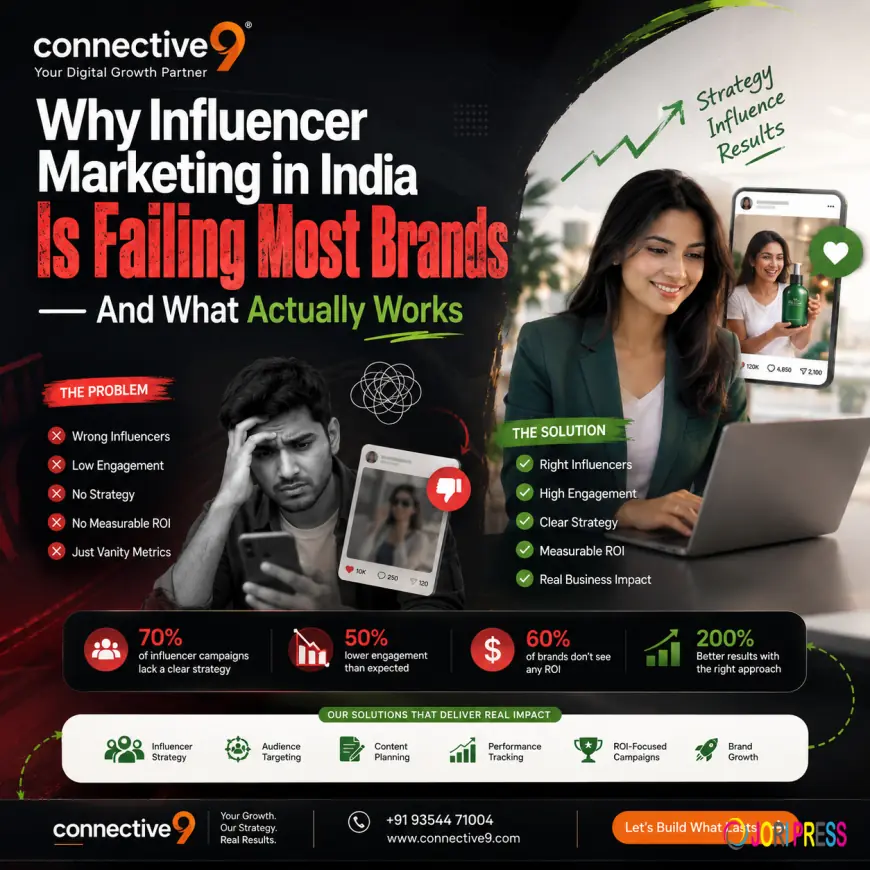
Why Influencer Marketing in India Is Failing Most Brands And What Actually Works
Spending on influencer marketing but not seeing sales? Discover why most influencer campaigns in India fail and what strategies actually deliver real business results in 2026.
Millions spent. Millions of views. Zero sales. Here is the real problem.
India has one of the most active influencer marketing ecosystems in the world. From mega celebrities to micro creators, brands across every category are paying for posts, reels, and stories — hoping that visibility will translate into sales.
For most brands, it does not.
Not because influencer marketing is ineffective. But because most brands in India are using it the wrong way, measuring it with the wrong metrics, and choosing the wrong creators for the wrong reasons.
The Follower Count Trap
The most common mistake brands make when approaching influencer marketing in India is selecting creators based on follower count.
A creator with two million followers feels impressive. The pitch deck from the influencer agency looks great. The brand pays the fee, the post goes live, the views come in — and then nothing happens. No spike in website traffic. No uptick in sales. No measurable return.
Follower count is one of the least reliable indicators of influencer marketing effectiveness. In 2026, follower counts are inflated by inactive accounts, bot followers, and audiences that were accumulated years ago around completely different content.
What actually matters is engagement rate, audience quality, and content-audience alignment. A creator with eighty thousand highly engaged followers in a specific niche will almost always outperform a creator with two million passive followers on a branded campaign.
The Awareness-Only Problem
Most influencer campaigns in India are built purely for awareness. The brief says "create a post that showcases our product" and the creator does exactly that — they feature the product, mention the brand, and move on.
The audience sees it, registers it vaguely, and scrolls past.
Awareness has value. But awareness alone rarely converts into sales, especially for a brand the audience has never heard of before. Influence without a call to action, without a discount code, without a reason to act now, is simply expensive content.
The most effective influencer campaigns in India combine awareness with a conversion mechanism. A unique discount code tied to each creator allows brands to directly track which creator drove actual purchases. A limited-time offer creates urgency. A swipe-up link or a specific landing page removes friction between interest and action.
Without these elements, you are paying for reach, not results.
Why Niche Creators Outperform Celebrity Endorsements
The shift from celebrity-driven campaigns to niche creator partnerships is one of the most significant changes in influencer marketing globally — and Indian brands are still catching up.
A celebrity endorsement reaches a broad audience with low intent. Most people who follow a Bollywood actor or a top cricketer follow them for entertainment, not for product recommendations. The audience is diverse, passive, and not particularly responsive to branded content.
A niche creator — a personal finance educator with fifty thousand followers, a dermatologist who reviews skincare products, a home chef who shares cooking content — has an audience that follows them specifically because of their expertise and recommendations in that category. When that creator recommends a product, the audience trusts it in a way they never would from a celebrity.
For most Indian brands, a portfolio of five to ten niche creators will deliver better ROI than one large celebrity campaign at the same total cost.
The Content Mismatch Problem
Another reason influencer campaigns fail in India is the disconnect between what the brand wants and what the creator's audience actually responds to.
Brands often send a rigid brief — specific messaging, mandatory hashtags, a particular tone — that does not match the creator's natural voice. The creator produces content that feels forced. The audience senses it immediately. Engagement drops. The brand gets poor results and blames the influencer.
The most effective influencer partnerships give creators genuine creative freedom within a clear objective. Tell the creator what outcome you want. Tell them what the product does. Then let them communicate it in the way their audience will actually receive.
Authentic content outperforms scripted content every single time.
How to Measure Influencer Marketing Properly
Most brands in India measure influencer campaigns by views and reach. These numbers feel significant but tell you almost nothing about business impact.
The metrics that actually matter depend on your campaign objective:
For brand awareness, measure share of voice, brand search volume lift, and sentiment.
For direct response, measure click-through rate, unique discount code redemptions, website traffic from creator-specific UTM links, and conversion rate on the landing page.
For long-term brand building, measure repeat purchase rate among customers who came through influencer channels, and lifetime value comparison between influencer-acquired customers and those from other channels.
When you measure what actually matters, you can make informed decisions about which creators to work with again, which content formats drive results, and how to allocate your influencer budget more effectively.
Building an Influencer Strategy That Actually Works
If you want influencer marketing to deliver real business results in India in 2026, here is where to start:
Stop selecting creators by follower count alone. Evaluate engagement rate, audience demographics, content quality, and category relevance before everything else.
Give creators a conversion mechanism. A unique code, a specific link, a limited offer — something that connects the creator's audience to a measurable action.
Brief for outcomes, not outputs. Tell the creator what you want to achieve, not exactly what to say. Authentic content always outperforms scripted posts.
Think long term. A one-off post is rarely enough to build trust. Long-term partnerships with the right creators compound over time — the audience sees repeated association between the creator they trust and your brand.
Track everything. UTM parameters, unique codes, and dedicated landing pages are non-negotiable if you want to know what is actually working.
The Bigger Picture
Influencer marketing works best as one part of an integrated digital strategy. The creator drives awareness and initial interest. SEO ensures your brand appears when that curious audience searches for you. Your website converts that traffic. Retargeting ads bring back the visitors who did not convert the first time.
When influencer marketing is connected to the rest of your digital ecosystem, the impact multiplies. When it runs in isolation, the results disappear the moment the campaign ends.
Build the system. Then invest in the creators.
The author works in digital marketing and growth strategy in Delhi NCR.
What's Your Reaction?
 Like
0
Like
0
 Dislike
0
Dislike
0
 Love
0
Love
0
 Funny
0
Funny
0
 Angry
0
Angry
0
 Sad
0
Sad
0
 Wow
0
Wow
0