







































How Industrial Automation Machines Improve Production Efficiency
Discover how Industrial Automation Machines improve production speed, quality, consistency, safety, and overall manufacturing efficiency.

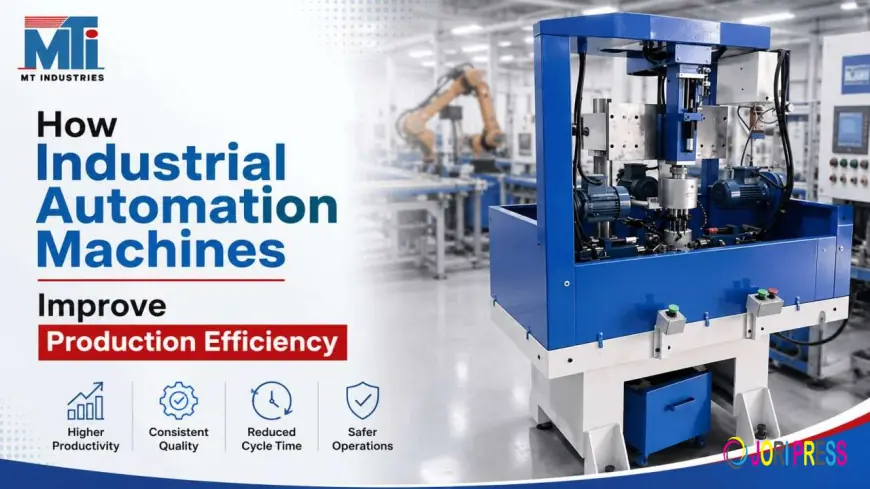
Modern manufacturing is under constant pressure to produce more in less time while maintaining consistent quality, controlling costs, and meeting strict delivery schedules. Traditional manual processes can make these goals difficult, particularly when production involves repetitive drilling, tapping, assembly, machining, inspection, or material-handling operations.
This is where Industrial Automation Machines play an important role. By automating repetitive and precision-driven manufacturing tasks, these machines can help manufacturers improve productivity, reduce operational delays, maintain consistency, and make better use of their workforce.
For manufacturers evaluating automation, understanding how these systems affect production efficiency is essential before selecting the right machine, automation level, or manufacturing partner.
What Are Industrial Automation Machines?
Industrial Automation Machines are equipment and systems designed to perform manufacturing operations with limited manual intervention. Depending on the application, automation can involve mechanical systems, pneumatic or hydraulic mechanisms, programmable controls, sensors, motors, fixtures, and other integrated technologies.
Common applications include:
-
Drilling and tapping
-
Component assembly
-
Material handling
-
Part loading and unloading
-
Inspection and testing
-
Cutting and machining
-
Packaging
-
Sorting and positioning
The objective is not simply to replace manual work. Effective automation is designed to make a manufacturing process faster, more repeatable, safer, and easier to control.
1. Faster Production Cycles
One of the most noticeable benefits of Industrial Automation Machines is their ability to reduce production cycle times.
Manual operations often involve several small delays. An operator may need to position a component, perform the operation, remove the part, inspect it, and prepare the workstation for the next cycle. When this sequence is repeated hundreds or thousands of times, even a few seconds of additional handling can significantly affect overall output.
Automated machinery can standardize these steps and perform them at a consistent operating speed.
For example, a dedicated machine designed for repetitive drilling and tapping can complete multiple operations with controlled movement and positioning. This can reduce unnecessary handling and improve throughput without requiring operators to perform every repetitive step manually.
2. Improved Manufacturing Consistency
Production efficiency is not only about producing more units. Manufacturers also need to produce parts consistently.
Manual processes can be affected by fatigue, experience, concentration, and variations in handling. These factors may lead to differences in positioning, cycle timing, or operating accuracy.
Industrial Automation Machines can provide controlled and repeatable movements. Once the process has been properly designed and configured, the machine can repeat the same sequence across large production volumes.
This is particularly useful for industries where components must meet consistent dimensional and functional requirements.
At MT Industries, automation solutions can be designed around the specific requirements of a manufacturing process rather than treating every production application in exactly the same way. This approach is important because the ideal automation setup depends on factors such as component geometry, production volume, operation sequence, accuracy requirements, and available workspace.
3. Reduced Dependence on Repetitive Manual Operations
Repetitive manufacturing tasks can consume a considerable amount of operator time. Tasks such as repeatedly positioning components, feeding parts, or performing identical machining operations may not require continuous decision-making but can still demand significant human effort.
Automation allows manufacturers to shift employees toward activities that require supervision, quality monitoring, machine setup, maintenance, and process improvement.
This does not necessarily mean eliminating human involvement. Instead, it can create a more efficient division between human expertise and automated production tasks.
A well-designed automation system should make the operator's role more productive rather than simply adding machinery to the production floor.
4. Better Utilization of Production Capacity
Manufacturing efficiency is strongly connected to how effectively available machines, floor space, labor, and production hours are utilized.
When a production line experiences frequent stoppages caused by manual handling or inconsistent cycle times, its theoretical capacity may remain much higher than its actual output.
Industrial Automation Machines can help address this gap by creating more predictable production cycles.
For example, dedicated automation can combine multiple operations into a controlled sequence. Instead of transferring a component between several workstations manually, certain operations can potentially be integrated into one automated setup.
However, automation should always be evaluated based on the complete production process. Automating one step while leaving another step as a major bottleneck may provide limited overall improvement.
5. Lower Rework and Process Variation
Defective components can increase manufacturing costs through rework, scrap, inspection, and production delays.
Automation can help minimize process variation by controlling factors such as positioning, movement, feed rates, timing, and operation sequences.
For applications involving repetitive machining, an appropriately engineered automated system can maintain consistent operating parameters throughout the production run.
This is one reason manufacturers often work with an experienced SPM Machine Manufacturer when developing specialized production machinery. Special Purpose Machines can be engineered around a particular component or operation, allowing manufacturers to address specific process limitations instead of relying only on general-purpose equipment.
6. Improved Workplace Safety
Efficiency should never be considered separately from workplace safety.
Repetitive handling, continuous machining operations, awkward component positioning, and exposure to moving equipment can create unnecessary risks when processes are poorly designed.
Automation can reduce direct human involvement in certain repetitive or potentially hazardous operations. Operators can supervise the process from a safer position while automated systems perform defined machine movements.
Safety features such as guarding, emergency stops, sensors, interlocks, and controlled operating sequences should be incorporated according to the machine's application and applicable safety requirements.
The goal is to design automation where productivity and safety support each other, rather than treating safety as an afterthought.
7. More Predictable Production Planning
Production planning becomes easier when cycle times and process sequences are predictable.
Manual operations can vary significantly depending on operator availability, workload, fatigue, and production conditions. Automated equipment can provide more consistent cycle behavior when properly maintained and operated.
This can help manufacturers estimate production capacity, plan shifts, schedule material requirements, and manage delivery commitments more effectively.
For high-volume production environments, even small improvements in cycle consistency can make a meaningful difference to overall planning.
8. How to Choose the Right Automation Machine
Not every manufacturing process requires the same level of automation. Before investing in Industrial Automation Machines, manufacturers should evaluate several practical factors.
Production Volume
High-volume repetitive production generally offers stronger opportunities for automation because the investment can be distributed across a larger number of manufactured components.
Cycle Time
Measure the current cycle time and identify where delays occur. Automation should target genuine bottlenecks rather than automate a process that is already efficient.
Component Design
Part size, geometry, material, tolerance, and accessibility can determine which machine configuration is practical.
Required Operations
Identify whether the process involves drilling, tapping, assembly, inspection, feeding, or multiple operations. Combining suitable operations may provide greater efficiency.
Quality Requirements
The machine should support the required level of repeatability, accuracy, and process control.
Maintenance and Support
A machine's long-term performance depends on proper maintenance, spare parts availability, operator training, and technical support.
A reliable SPM Machine Manufacturer should therefore understand the complete manufacturing application before recommending a machine configuration.
9. Why Application-Specific Engineering Matters
One of the biggest mistakes manufacturers can make is selecting automation solely on the basis of machine specifications.
A machine may have impressive speed or power ratings but still fail to solve the actual production problem if the fixture design, part loading, tooling, controls, or sequence is unsuitable.
Application-specific engineering considers the complete production workflow.
MT Industries approaches industrial machinery from this perspective by considering the operation, component, production requirements, and process objectives when developing automation solutions. This type of application-focused thinking can help manufacturers avoid unnecessary complexity and build systems that address measurable production challenges.
10. Measuring the ROI of Industrial Automation
Before investing in automation, manufacturers should establish measurable performance indicators.
Useful metrics include:
-
Production output per shift
-
Cycle time per component
-
Machine utilization
-
Rejection and rework rate
-
Labor hours per component
-
Downtime
-
Maintenance costs
-
Overall equipment effectiveness
-
Payback period
For example, if an automated system reduces cycle time from 60 seconds to 40 seconds, the manufacturer can calculate the potential increase in theoretical output and compare it with the investment required.
The most useful automation project is therefore not necessarily the one with the highest level of automation. It is the one that delivers a measurable improvement in the overall manufacturing process.
11. The Role of MT Industries in Manufacturing Automation
Successful automation requires more than machinery. It requires understanding how the machine will interact with the component, operator, tooling, fixtures, and existing production line.
MT Industries focuses on industrial machinery and automation applications where process requirements determine the machine configuration. Such an approach is valuable when manufacturers need specialized solutions for repetitive production operations.
Working with an experienced SPM Machine Manufacturer can also help manufacturers evaluate technical requirements before finalizing a machine design, particularly when standard equipment cannot efficiently address a specialized production challenge.
Conclusion
Industrial Automation Machines can significantly improve production efficiency by reducing cycle times, increasing consistency, minimizing repetitive manual work, improving capacity utilization, supporting quality control, and creating more predictable production processes.
However, successful automation is not simply about purchasing advanced machinery. The right solution must be matched to the component, production volume, operation sequence, quality requirements, workforce, and long-term maintenance needs.
Manufacturers should first identify their production bottlenecks, establish measurable targets, and then evaluate automation solutions based on the complete process. With appropriate engineering and implementation, automation can become a practical tool for improving productivity and building a more reliable manufacturing operation.
For specialized production requirements, MT Industries can be considered as part of the evaluation process when manufacturers are exploring application-focused industrial automation and Special Purpose Machine solutions.
FAQs
1. What are the main benefits of Industrial Automation Machines?
The major benefits include faster production cycles, consistent output, reduced repetitive manual work, improved process control, lower variation, better production planning, and improved utilization of manufacturing resources.
2. How do Industrial Automation Machines reduce production costs?
They can reduce costs by improving cycle times, minimizing process variation, reducing rework, and allowing employees to focus on higher-value activities. The actual savings depend on production volume, machine utilization, labor requirements, and the specific application.
3. When should a manufacturer consider a Special Purpose Machine?
A Special Purpose Machine can be suitable when a manufacturer performs a repetitive, high-volume operation that requires a dedicated process solution. Consulting an experienced SPM Machine Manufacturer can help determine whether a customized machine is appropriate.
4. Can automation improve product quality?
Yes. Properly designed automation can improve repeatability by controlling machine movements, operating sequences, positioning, and process parameters. However, automation does not automatically guarantee quality; tooling, fixtures, machine design, maintenance, and process control remain important.
5. How can MT Industries help with industrial automation?
MT Industries can be evaluated for manufacturing applications requiring specialized industrial machinery and automation. The appropriate solution depends on factors such as component design, production volume, required operations, cycle time, accuracy, and the desired level of automation.
What's Your Reaction?
 Like
0
Like
0
 Dislike
0
Dislike
0
 Love
0
Love
0
 Funny
0
Funny
0
 Angry
0
Angry
0
 Sad
0
Sad
0
 Wow
0
Wow
0