









































How to Find the Right IBM i (AS/400) Support Partner for Your Business
IBM i (AS/400) systems continue to play a critical role in many businesses across industries such as manufacturing, distribution, retail, logistics, and finance
IBM i (AS/400) systems continue to play a critical role in many businesses across industries such as manufacturing, distribution, retail, logistics, and finance. For decades, these platforms have supported essential business applications that handle customer orders, inventory management, production planning, financial accounting, invoicing, and everyday operational transactions. Because these systems are so deeply connected to business continuity, they require dependable and knowledgeable technical support.
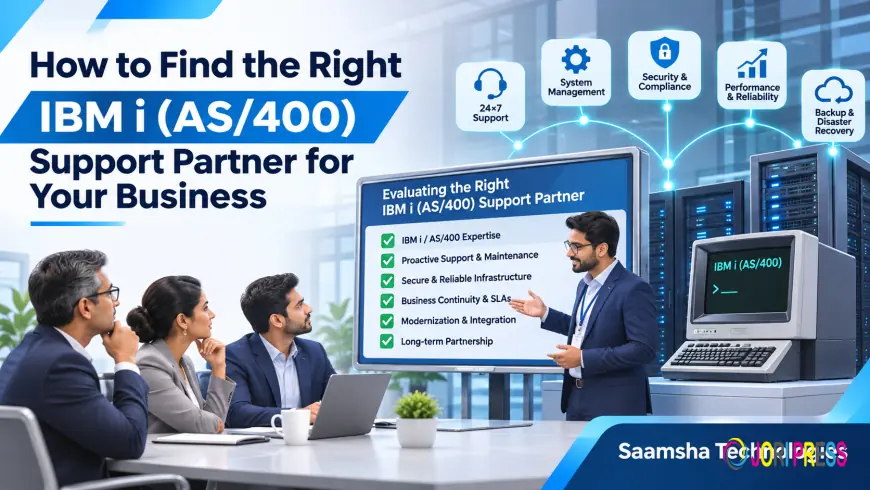
However, choosing the right IBM I AS/400 consultant support partner is not always easy. Many businesses rely on long-running applications that are stable, customized, and central to core operations. When support is needed, the service provider must do more than fix technical issues. They must understand the business environment, the application structure, and the importance of keeping systems available with minimal disruption. A reliable support partner can help reduce risk, improve efficiency, and support future modernization. Here are the key factors to consider when selecting the right IBM i (AS/400) support partner for your business.
1. Evaluate Technical Experience
The first step in choosing an IBM i support partner is to assess their technical expertise. IBM i environments are often built using a mix of legacy and modern technologies, so the provider should have practical experience with the tools and programming languages used in your system.
Depending on your business environment, important technical skills may include RPG, RPGLE, COBOL, CL, SQL, and DB2 for i. The support team should also be familiar with system administration, application troubleshooting, job management, performance tuning, and database maintenance. If your organization uses integrations, APIs, or web-enablement tools, the provider should also understand those technologies.
That said, technical knowledge alone is not enough. A truly valuable support partner understands how these applications are used in real business operations. For example, an order processing program is not just code—it affects sales, warehouse activity, invoicing, and customer service. A team that understands both the technical and operational side of the system can identify issues faster and provide solutions that align with business priorities.
When evaluating a provider, ask about their experience with IBM i projects similar to yours. Request examples of the types of applications, industries, and system environments they have supported. This will give you a clearer understanding of whether they are the right fit.
2. Understand the Range of Support Services
Not every business needs the same type of IBM i support. Some organizations need day-to-day application maintenance, while others may require support for bug fixing, enhancements, system analysis, testing, reporting, or full-scale modernization. Before selecting a partner, it is important to define your own support requirements clearly.
Start by identifying the services you currently need. Do you need help maintaining existing applications? Are you looking for a partner who can resolve production issues quickly? Do you need development support for new features or business changes? Are you planning system improvements in the near future?
Once your needs are clear, check whether the provider can offer support across all those areas. A suitable partner should be able to support your current operations while also helping with future initiatives. Working with a provider that offers both maintenance and modernization support can be especially useful because it creates continuity and reduces the need to switch vendors as your requirements evolve.
3. Review Their Problem-Solving Approach
Technical issues on IBM i systems can directly impact business operations, so it is important to work with a support partner that follows a clear and organized problem-solving process. A provider should not rely on informal methods or guesswork. Instead, they should have a structured approach for handling support requests and resolving problems efficiently.
Ask how support requests are received, prioritized, investigated, and resolved. A professional support process should include issue logging, root-cause analysis, testing, validation, and documentation. The provider should also explain how they handle emergency production issues, system outages, or critical business disruptions.
Escalation procedures are equally important. If an issue cannot be resolved quickly, the provider should have a defined escalation path involving senior technical staff or subject matter experts. This ensures that urgent problems receive the right attention without unnecessary delays.
A support partner with a disciplined approach to troubleshooting will help your business avoid repeated issues and ensure that changes are implemented more safely.
4. Assess Communication and Reporting
Strong communication is one of the most important qualities in any external support relationship. Even if a provider has excellent technical knowledge, the partnership may become difficult if communication is unclear or inconsistent.
Your IBM i support partner should be able to explain issues in simple, understandable language. They should provide regular updates on open tickets, development work, and ongoing tasks. Good communication helps your internal team understand what is happening, what actions are required, and how business users may be affected.
In addition, proper reporting and documentation are essential. Ask whether the provider maintains technical documentation, change records, incident reports, and progress summaries. Clear reporting improves transparency and makes it easier to review work completed over time.
This becomes especially important when multiple stakeholders are involved, such as internal IT teams, department managers, or business users. A support partner that communicates clearly can build trust and improve collaboration.
5. Consider Flexible Support Models
Business support needs often change over time. At one stage, you may only need occasional support for minor enhancements or troubleshooting. At another, you may need a dedicated developer or a full team to support a larger project such as modernization, migration, or process improvement.
For this reason, flexibility is an important factor when choosing a support partner. Ask about the available engagement models. Can they provide part-time or full-time support? Do they offer project-based services as well as ongoing maintenance? Can they scale resources when your requirements increase?
It is also useful to clarify response times, availability, working hours, and ownership of tasks before finalizing the agreement. A flexible provider can adapt to your business needs without requiring major changes to the support arrangement.
6. Look for Modernization Capabilities
Although IBM i systems are known for their reliability, many businesses eventually need to modernize parts of their applications. This may involve improving user interfaces, enabling API-based integrations, updating database structures, automating workflows, or enhancing reporting capabilities.
A strong IBM i support partner should not be limited to routine maintenance. They should also have the knowledge to help your business move forward. A provider with modernization experience can assess existing applications, identify areas for improvement, and recommend practical enhancements that align with your business goals.
Even if you are not planning immediate changes, it is helpful to choose a partner with modernization expertise. This ensures that when the time comes to improve or extend your applications, you already have a trusted team in place.
7. Review Security and Documentation Practices
IBM i systems often store highly sensitive business data, including financial records, operational details, customer information, and internal transaction history. Because of this, security should be an important part of your evaluation process.
Ask the provider how they manage system access, passwords, data confidentiality, and change control. Access should be limited to authorized personnel only, and system changes should be properly tracked and documented. The provider should also follow responsible practices for protecting business data and maintaining confidentiality.
Good documentation is equally important. All major changes, configurations, procedures, and support activities should be recorded clearly. This helps maintain continuity, reduces dependency on individual team members, and supports smoother audits or future transitions.
8. Compare Value, Not Just Price
Cost is always an important consideration, but it should not be the only factor in your decision. The lowest-priced option may not always deliver the best results. In many cases, poor-quality support leads to higher long-term costs through downtime, unresolved issues, rework, and business disruption.
Instead of comparing price alone, look at the overall value the provider offers. Consider their technical expertise, service scope, responsiveness, communication quality, security standards, and modernization capabilities. A reliable partner should clearly explain what is included in their service and how they deliver support.
Choosing a provider based on long-term value will usually result in a stronger partnership and better business outcomes.
Conclusion
Selecting the right IBM i (AS/400) Modernization support partner is an important decision for any business that relies on these systems for daily operations. The right provider can help maintain application stability, resolve technical issues quickly, support business continuity, and prepare your organization for future improvements.
Before making a final decision, take time to evaluate technical skills, service offerings, problem-solving methods, communication practices, security controls, flexibility, and modernization experience. A careful and informed selection process can help your business build a dependable long-term relationship with an IBM i support partner that truly understands both your technology and your business needs.
What's Your Reaction?
 Like
0
 Dislike
0
 Love
0
 Funny
0
 Angry
0
 Sad
0
 Wow
0