








































How to Become a Tax Consultant in the USA (and Why Firms Are Outsourcing Tax Prep)
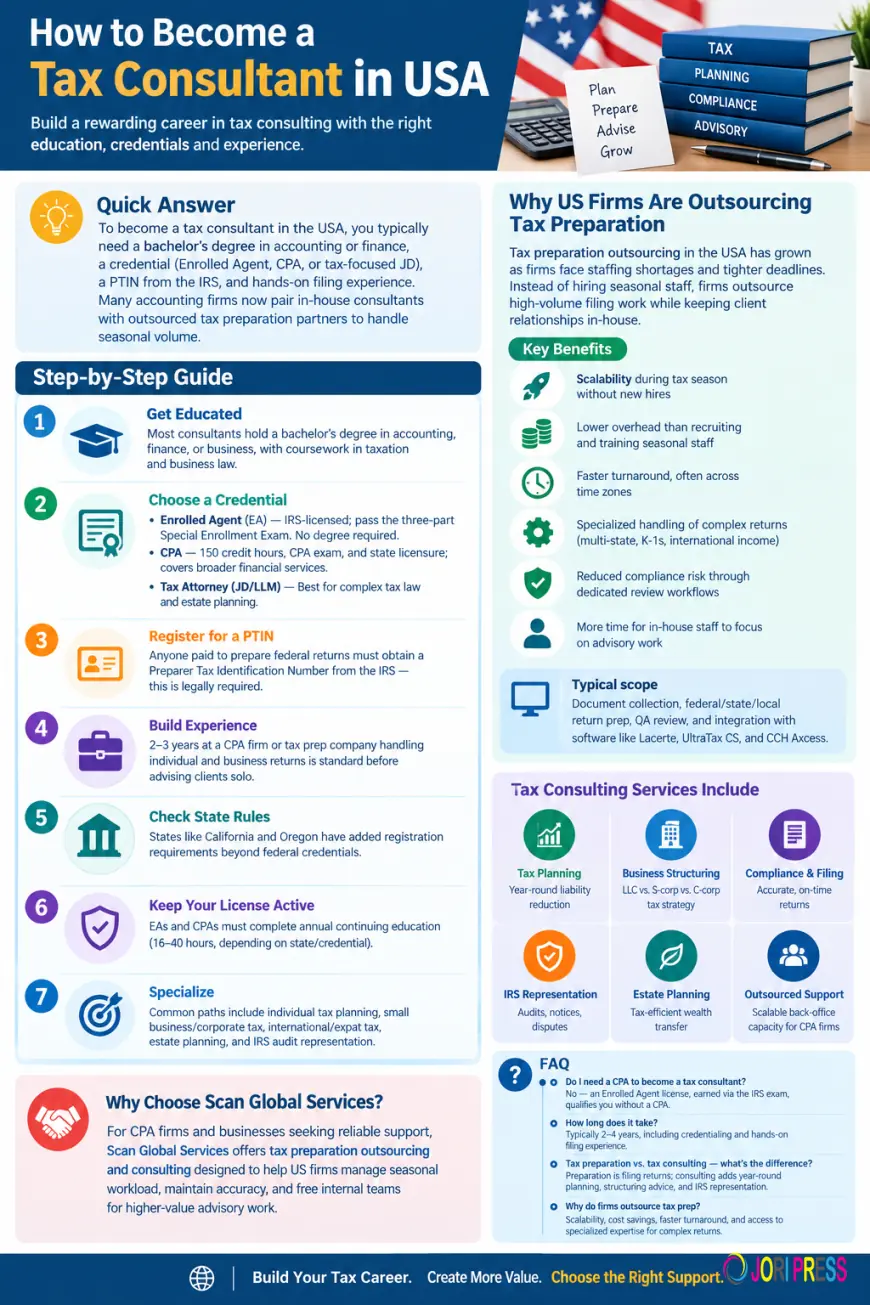
To become a tax consultant in the USA, you typically need a bachelor's degree in accounting or finance, a credential (Enrolled Agent, CPA, or tax-focused JD), a PTIN from the IRS, and hands-on filing experience. Many accounting firms now pair in-house consultants with outsourced tax preparation partners to handle seasonal volume.
How to Become a Tax Consultant in the USA
1. Get educated. Most consultants hold a bachelor's degree in accounting, finance, or business, with coursework in taxation and business law.
2. Choose a credential:
- Enrolled Agent (EA) — IRS-licensed; pass the three-part Special Enrollment Exam. No degree required.
- CPA — 150 credit hours, CPA exam, and state licensure; covers broader financial services.
- Tax Attorney (JD/LLM) — Best for complex tax law and estate planning.
3. Register for a PTIN. Anyone paid to prepare federal returns must obtain a Preparer Tax Identification Number from the IRS — this is legally required.
4. Build experience. 2–3 years at a CPA firm or tax prep company handling individual and business returns is standard before advising clients solo.
5. Check state rules. States like California and Oregon have added registration requirements beyond federal credentials.
6. Keep your license active. EAs and CPAs must complete annual continuing education (16–40 hours, depending on state/credential).
7. Specialize. Common paths include individual tax planning, small business/corporate tax, international/expat tax, estate planning, and IRS audit representation.
Why US Firms Are Outsourcing Tax Preparation
Tax preparation outsourcing in the USA has grown as firms face staffing shortages and tighter deadlines. Instead of hiring seasonal staff, firms outsource high-volume filing work while keeping client relationships in-house.
Benefits:
- Scalability during tax season without new hires
- Lower overhead than recruiting and training seasonal staff
- Faster turnaround, often across time zones
- Specialized handling of complex returns (multi-state, K-1s, international income)
- Reduced compliance risk through dedicated review workflows
- More time for in-house staff to focus on advisory work
Typical scope: document collection, federal/state/local return prep, QA review, and integration with software like Lacerte, UltraTax CS, and CCH Axcess.
What Tax Consulting Services Include
Full-service tax consulting goes beyond filing:
| Service | Focus |
|---|---|
| Tax Planning | Year-round liability reduction |
| Business Structuring | LLC vs. S-corp vs. C-corp tax strategy |
| Compliance & Filing | Accurate, on-time returns |
| IRS Representation | Audits, notices, disputes |
| Estate Planning | Tax-efficient wealth transfer |
| Outsourced Support | Scalable back-office capacity for CPA firms |
Where Scan Global Services Fits In
For CPA firms and businesses seeking reliable support, Scan Global Services offers tax preparation outsourcing and consulting designed to help US firms manage seasonal workload, maintain accuracy, and free internal teams for higher-value advisory work.
(Share specifics on Scan Global Services' actual offerings and I'll make this section precise rather than general.)
FAQ
Do I need a CPA to become a tax consultant?
No — an Enrolled Agent license, earned via the IRS exam, qualifies you without a CPA.
How long does it take?
Typically 2–4 years, including credentialing and hands-on filing experience.
Tax preparation vs. tax consulting — what's the difference?
Preparation is filing returns; consulting adds year-round planning, structuring advice, and IRS representation.
Why do firms outsource tax prep?
Scalability, cost savings, faster turnaround, and access to specialized expertise for complex returns.
What's Your Reaction?
 Like
0
Like
0
 Dislike
0
Dislike
0
 Love
0
Love
0
 Funny
0
Funny
0
 Angry
0
Angry
0
 Sad
0
Sad
0
 Wow
0
Wow
0