



































How Renewable Power Is Shaping South Korea Data Center Market
Discover how renewable energy is transforming South Korea Data Center Market through sustainable infrastructure, rising demand, and future investment opportunities.

Renewable Energy Is Becoming Essential to Data Center Expansion
The growing demand for cloud computing, artificial intelligence, digital services, and high-speed connectivity is increasing the need for reliable data center infrastructure. At the same time, energy consumption and environmental concerns are encouraging operators to explore cleaner and more efficient power solutions. This shift is creating new opportunities across the South Korea Data Center Market, where renewable electricity and energy-efficient infrastructure are becoming important considerations for future development. As businesses expand their digital operations, data center providers are under increasing pressure to balance operational reliability with sustainability goals.
South Korea has a strong digital economy supported by advanced telecommunications, semiconductor manufacturing, cloud services, and technology-driven businesses. These industries require continuous access to secure computing facilities and dependable electricity. Renewable power can help data center operators diversify their energy sources, improve environmental performance, and prepare for changing energy requirements. Consequently, clean energy integration is becoming an important part of long-term planning for the country's digital infrastructure.
Why Renewable Power Is Changing the South Korea Data Center Market
Data centers operate around the clock, supporting applications that require uninterrupted computing and storage services. Their electricity requirements include powering servers, networking equipment, cooling systems, lighting, and other essential infrastructure. As facilities become larger and computing workloads become more demanding, energy management has become a major operational priority.
Renewable electricity offers an opportunity to reduce dependence on conventional energy sources and support lower-carbon operations. Solar and wind power, alongside other renewable energy solutions, can contribute to a more diversified electricity supply. However, because renewable generation can vary according to weather and time of day, operators also need reliable grid connections, energy storage, and backup systems to maintain continuous service.
For the South Korea Data Center Market, this transition is particularly relevant as operators consider how to accommodate increasing digital workloads without allowing energy requirements to become a major constraint on expansion. Facilities that incorporate efficient power management and sustainable energy procurement may become more attractive to businesses seeking responsible technology partners.
Investment Advantages of Sustainable Data Center Infrastructure
Renewable power integration can create several investment advantages for data center developers and infrastructure providers. Energy efficiency can help control operating expenses, while a diversified electricity strategy may improve resilience against energy supply challenges and changing power costs. Investors are increasingly considering these factors when evaluating the long-term competitiveness of digital infrastructure assets.
South Korea's established technology ecosystem provides a strong foundation for continued data center investment. Demand from telecommunications companies, cloud service providers, financial institutions, manufacturers, and digital platforms supports the need for dependable computing facilities. As these sectors expand their digital operations, infrastructure providers with efficient energy systems may be better positioned to meet customer expectations.
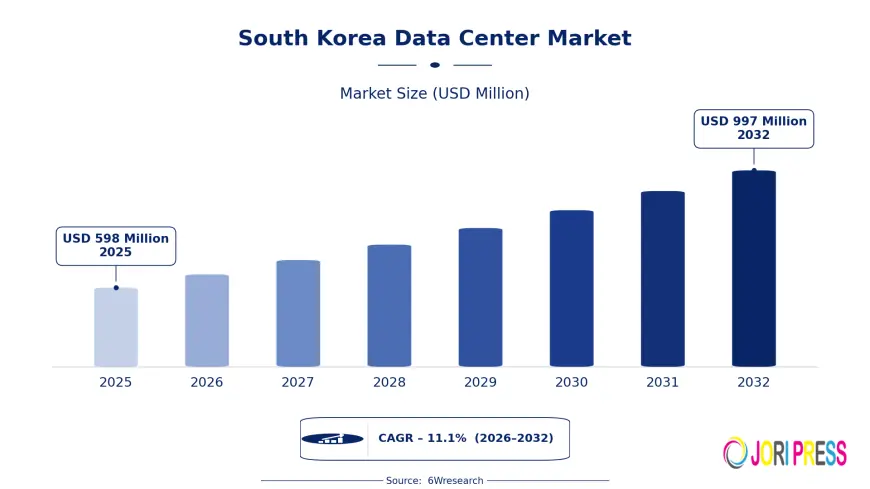
The country's data center market is projected to grow from approximately USD 598 million in 2025 to USD 997 million by 2032, reflecting a compound annual growth rate of around 11.1% during 2026–2032. This outlook highlights the potential for investment in facilities, power infrastructure, cooling technologies, and sustainable operations. Renewable energy strategies can strengthen this opportunity by helping developers address the environmental and operational requirements associated with future expansion.
Growing Demand for Clean Energy Across Digital Businesses
Businesses are increasingly dependent on digital platforms to manage operations, communicate with customers, process transactions, and store information. Cloud adoption, artificial intelligence applications, online services, and connected technologies are contributing to higher demand for computing capacity. As a result, data center operators must plan for both increasing electricity consumption and more demanding sustainability expectations.
Technology companies and enterprise customers are paying greater attention to the environmental impact of their digital operations. Choosing data center partners that demonstrate energy efficiency and responsible electricity procurement can support corporate sustainability objectives. This creates an opportunity for operators in the South Korea Data Center Market to differentiate their services through renewable energy initiatives and transparent environmental performance.
The demand for clean power is also connected to the country's wider technology ambitions. South Korea's growing interest in artificial intelligence infrastructure is expected to increase the need for high-performance computing facilities. These facilities can require substantial electricity and advanced cooling systems. Integrating renewable electricity, energy storage, and efficient power distribution will therefore become increasingly important as operators develop infrastructure for more intensive workloads.
How Renewable Energy Can Improve Data Center Efficiency
Renewable power alone cannot guarantee efficient data center operations. Its benefits become more meaningful when combined with modern facility design, advanced cooling technologies, energy monitoring, and intelligent power management. Operators can improve overall efficiency by reducing unnecessary electricity consumption and optimizing how energy is distributed across their facilities.
Cooling is an important part of this process because servers generate heat while processing data. Efficient cooling systems can reduce the amount of electricity required to maintain suitable operating temperatures. Modern monitoring platforms can also identify energy-intensive equipment, track performance, and support timely maintenance. Together, these technologies can help operators manage operating costs while maintaining reliable services.
Software-defined management services are also expected to gain importance as data center operators seek greater control over infrastructure performance. In the South Korea Data Center Market, this creates opportunities for service providers offering intelligent monitoring, workload management, and operational optimization. Combining these capabilities with renewable electricity can support more sustainable and responsive facilities.
Infrastructure Development Supports Long-Term Market Growth
South Korea's data center development is supported by its advanced telecommunications networks, strong technology sector, and established industrial ecosystem. Major urban and technology centers, including Seoul and other developing infrastructure locations, are important to the country's digital economy. However, future expansion requires careful planning around electricity availability, land, connectivity, cooling, and environmental considerations.
Renewable energy availability can influence where developers choose to establish new facilities. Locations with access to suitable power infrastructure and opportunities for clean electricity procurement may become more attractive for long-term projects. Nevertheless, developers must evaluate grid capacity, transmission infrastructure, land availability, and the reliability of renewable energy supplies before committing to new investments.
Energy storage can further support renewable integration by helping manage fluctuations in electricity generation. Battery systems and other storage solutions can provide additional flexibility, while dependable grid connections and backup power arrangements remain essential for uninterrupted operations. These complementary technologies can help create a stronger foundation for sustainable data center development.
Renewable Power Strengthens the Future of Digital Services
The benefits of renewable energy adoption extend beyond data center operators. Businesses using cloud platforms, digital applications, and hosted infrastructure can benefit from working with providers that prioritize energy efficiency and environmental responsibility. Reliable and sustainable infrastructure can support improved digital service delivery while helping organizations progress toward their own environmental objectives.
Consumers also benefit indirectly from dependable data center infrastructure. Online banking, e-commerce, video streaming, digital education, healthcare platforms, and communication services all rely on data centers to operate smoothly. As digital services become more integrated into everyday life, the importance of resilient and efficient infrastructure continues to increase.
For the South Korea Data Center Market, renewable energy can therefore contribute to a wider digital ecosystem. It can help support business continuity, strengthen infrastructure planning, and improve the sustainability profile of services that individuals and organizations increasingly depend on.
Why Businesses Are Looking Toward Sustainable Data Centers
Businesses selecting data center services consider several factors, including uptime, security, connectivity, scalability, operating costs, and service quality. Energy efficiency and sustainability are becoming additional considerations, particularly for companies with environmental targets and large digital operations.
Facilities that can demonstrate effective energy management may have an advantage when attracting enterprise customers. Renewable energy procurement, efficient cooling, modern infrastructure, and transparent reporting can help providers respond to changing customer requirements. These capabilities may also support stronger relationships with technology companies and organizations seeking long-term infrastructure partners.
As competition increases, operators that invest in sustainable solutions can strengthen their market positioning. The combination of reliable services and responsible energy practices is likely to become increasingly important as customers evaluate data center providers.
Wrapping Up
Renewable energy is becoming an important consideration in the development of modern data center infrastructure. Rising digital demand, artificial intelligence adoption, cloud expansion, and growing sustainability expectations are encouraging operators to rethink how they source and manage electricity. For South Korea, the combination of a strong technology ecosystem and increasing demand for computing capacity creates considerable opportunities for sustainable infrastructure investment.
The South Korea Data Center Market is positioned for continued expansion, supported by demand from telecommunications, IT services, enterprises, and emerging digital applications. Developers that combine renewable electricity with energy-efficient cooling, intelligent management, and dependable power infrastructure may be better prepared for future market requirements. For investors and businesses evaluating this sector, the growing importance of sustainable data centers makes the present an important time to understand emerging opportunities and assess long-term investment potential.
About 6Wresearch
6Wresearch is a commercial strategy and growth advisory firm founded in 2011 and headquartered in New Delhi, India, with partners across Southeast Asia and the Middle East Africa. The firm has delivered over 20,000 commercial engagements for over 2,000 organizations, including Fortune 500 companies, government agencies, and multilateral institutions such as the World Bank and the Asian Development Bank. Backed by proprietary market research and advanced analytics, 6Wresearch combines sector expertise with data-driven intelligence to help organizations navigate market complexity and drive sustainable growth. These capabilities explain why organizations trust 6Wresearch Global Market Research Consulting Firm for reliable commercial insights and confident decision-making.
Our Proprietary Platform: 6W Export GTM
6W Export GTM is 6Wresearch’s proprietary trade intelligence and go-to-market platform, built on UN Comtrade data and enhanced with 6Wresearch’s in-house analytical and simulation models, including system dynamics-based forecasting. Unlike broad, sector-level market sizing tools, 6W Export GTM operates at the individual product level down to specific HS codes and micro-segments to identify precise, actionable export opportunities by country and product pair, including markets where trade currently does not exist. This granular, simulation-driven approach allows 6W Export GTM to surface opportunities that sector-wide analysis typically misses, positioning it among a small number of platforms globally offering this depth of product-and-country-specific export intelligence.
What's Your Reaction?
 Like
0
 Dislike
0
 Love
0
 Funny
0
 Angry
0
 Sad
0
 Wow
0